Monday, November 22, 2010

Evening Meal at Explorer's Bar


Cheese Bread, Bread and Butter.


Bruschetta di Misto.


Fettuccine Bolognese

Understanding "3.5"


The Uganda Coffee Development Authority Worldwide Headquarters.

It's Day One of barista training in preparation for the 4th Annual Ugandan Barista Championship. Twenty-two baristas have advanced from the early elimination rounds to go to championships this weekend. The task for the next two days is to spend a little time with the baristas and answer any question they may have regarding competition. Some have competed before but many are making their first foray into the competition.

As a competitor, one of the hardest aspects of competition was understanding what constituted a "3" or a "5" or any of the scores. I mean, what exactly is a "5" espresso? I don't know. I don't know if anyone really knows. In four years of judging national barista championships, I've never even seen a "5" espresso.


Ugandan coffee trees. Almost harvest.

Which is why I don't understand why the World Barista Championship is reluctant to release that nice espresso cappuccino visual guide to the general public. Let it out, I say. Let it out so that people/competitors/judges worldwide can have a common understood language, because your "3.5" may very well be that persons "2.5" and without common reference, it becomes very difficult to make sure everyone is on the same page.

The morning started with an open discussion about the scoresheets, its parameters and their meanings. Break it down, strategize and really figure out whether or not those two points for Immediate Insert and Brew are worth sacrificing for something else. We focused on time strategies and when to just throw it all in and stop. We discussed ideal ways to maximize those 0-6 point sections and which sections used the x4 factor.

I even let it out of the bag that even the World Champions themselves don't get all perfect scores. That it is possible to make it into the finals after going overtime, or that you can win the World Barista Championship with Espresso Scores of 3.5. Then we drilled on identifying and scoring visual aspects of espressos and cappuccinos.


Baristas listening intently to my Science.

After lunch, we watched videos from the 2007 World Barista Championship and discussed the differences in the rules between then and now. From the relaxed and confident presentation of James Hoffman, to the experimental sig drink of Carl Sara, to the sharp and ruthless execution of Heather Perry. Like her or not, the best lessons to learn from watching Heather Perry is her ruthless drive to extract as many points out of the scoresheets as possible. Everything is presented just enough to hit those point factors.

From there we moved on to practical work. The baristas went to work on the SAB Espresso Machines and we spent the rest of the afternoon tasting, scoring and judging the drinks.

All in all, a good day of working with the baristas. The training workshop continues tomorrow at 9:30am.


Watching Hoffman make his 2007 moves.


Hands on practicals.

Ugandan Lunch


It's lunchtime in Kamapala and what better way to spend it than eating traditional foods? Ugandans are big on starch, big on Indian style foods and big on large portions. Yesterday, Louis commented that Ugandans like their plates big and piled high. I was amazed at the piles I saw at lunch today. How ironic that the biggest guy at lunch had the smallest plate!

I haven't quite learned about everything I ate today, but it's a beginning!

Are You Having Your Breakfast Today?


Could this be the best hotel coffee ever???

It's morning at the Kampala Serena Hotel and I'm sleeping in late again. The eight hour time difference between Uganda and Baltimore is really getting to me. Last night, I was up until nearly 4am lying in bed, trying to sleep. It's hard to sleep at what is essentially 8pm. I'm not a kid anymore!

At 9am, I hear the phone ring. Once. What time is it? Crap. Again. Rush, rush, rush to get dressed and then another phone call a few minutes later. This time it's from the barista downstairs inquiring if I will be eating breakfast this morning. The entire coffee staff at the hotel has been anticipating my arrival and while I was thinking it was too late for breakfast, I make a point of it to dine.


Steamed banana, Lyon potatoes, beef sausage, Paneer something, fried tilapia, beef and Eggs Benedict.

Hotel coffee is usually of reluctant quality. Some of the worst coffee we've ever had was at a hotel somewhere. When they ask, I feel obliged to order coffee. It comes in a ceramic pot and looks sharp. The flavor is surprisingly pleasant. Tasty even. It's good stuff. I would drink it at home. A little sugar and cream to start my day and it's quite nice.

The food is good but feels a bit heavy. Tomorrow it's back to something simple: mueslix, yogurt and a little fruit.

Sunday, November 21, 2010

Live Free, Die Hard


Cigar Heaven. In Kampala.

The great irony of modern day America is that Americans (like myself) seem to only experience "freedom" when outside of America.

Today's America is a sissified nation where the government tells you how to live and that you should be grateful for it. Within the country, the USAPATRIOT Act lives on invading your privacy, the TSA wants to grope your balls, they tell you which oil to use, you can't smoke indoors, you can die at 18 but can't drink 'till 21 (though vehicular manslaughter is mandated at 15), some states prohibit sex until 18 and when you return to your home country you're put in the line for "random screening not related to race."

Yes, in other countries you find guards walking around with AK-47s and bandits lurking in the dark alleyways of the slums. True, the roads may be in disrepair and the implementation of stop signs and lane lines seems utterly useless. No doubt that's the smell of pollution and something burning in the air. But these seem to be the hallmarks of Freedom in these modern times. Ironic.


Indian matches - these suckers really light!

Indoor smoking, so vehemently reviled in the United States is shockingly unusual when you leave the country. What are these people doing??? Don't they know that's AGAINST THE LAW? Evidently, not in these parts. People here smoke and do so without fear of reprisal, sniveling yuppie democrats or fear of government fines or arrest by some bureau called The Department of Fatherland, err, Homeland "Security."

The United States Government: Protecting its Citizens FROM their freedoms...


The Arsenal: Montecristo #2 Habana and Diet Coke (with ice).

Which makes this Cuban cigar, illegal in the United States under the Trading With The Enemy Act, all the more appealing. I can relax and enjoy my cigar without fear of reprisal. With a Diet Coke. In a nation whose 22 year civil war ended about a year ago. I guess in other nations there's a bit more to concern oneself with than smoking in public.

Maybe I should head to the market tomorrow and pick myself up an AK-47, just because...


The View.


The Bill.

Koffee Kampala


Welcome to Cafe Pap.

At 11:30am this morning, Claire called to check up on me. I was still sleeping. Holy crap, it's eleven thirty! I tell her I'll call her in about an hour.

One of the "problems" with staying at the Kampala Serena Hotel is the very comfy king-sized bed and the excellent heavy curtains. I'm essentially cocooned in darkness and have no idea what time it is. Normally, I never sleep this late. Even when tired, I rely on the sun to roust me from slumber. Good thing today is a non-scheduled day!

By the time I really wake up, get ready, call Claire and she comes to meet me, it's easily 2pm and the day is lazily passing away. She's here to brief me on the week's schedule and we negotiate some of the days, trading setup time for training time and strategize on just what we're going to do this week.


Cafe Pap Espresso.

Right now, it's two days of barista training and a half day of setup and half day training judges. Initially, I think there's too much time for barista training and not enough time for judges training. But it's all good and we work things out amicably.

Barista training immediately before a competition. On one hand, it sounds like a great idea. On the other, it's fraught with peril since I'm going to presume these baristas have been training for months and these sessions might cause them to change what they're comfortable doing to the point where it throws off their game and they don't present themselves in the best possible light.

But the opportunity here is great. Unlike other trainers who work exclusively with one barista, therefore, giving an advantage to only one person, I get to work with a field of baristas and share with them thoughts and strategies to improve their scores.


Cafe Pap Macchiato.

There's probably some out there who will disagree with my assessment on improving their scores, but this is a competition whose winner is decided on who gets the most points - and well, why not help them maximize their point potential? The by-product of this is that they improve their skills, make better drinks and, hopefully, make themselves more valuable to their employers (or other employers) which may command better compensation.

On the competition side, it hopefully results in better competitors which raises the bar of the WBC style competitions. To my mind, this is a win-win-win situation.

One of the things the International Judges remarked upon while training judges in Bogota last month was the diversity in tastes amongst the local judges. What we, as International Judges, deemed excellent was different than the local judges. One thing we acknowledged was that we were unable to take the time to explore the local cafe scene to see just what kinds of coffees the local judges were used to drinking.

With that in mind, I asked Claire to take me on a tour of Kampala's finer coffee shops.


How much the average Ugandan barista makes a month.

So, we toured Kampala's coffee shops and luckily, three of the four of them were in the same shopping center. And the fourth was in the shopping center next door. This made for simple touring where we could spend time sitting, drinking and chatting with the baristas and coffee people about their coffees and their lives.

In the process, we ended up having brunch with Louis at Boda Boda, named after Kampala's famous motorcycle transportation services whose fearless drivers transport up to two passengers on a hair-raising ride through the city's notorious traffic. Louis is a Kenyan transplant with great personality and will be the emcee for the barista competition. Can't wait to see him in action.

We also took some time to do one of my favorite travel things: visit a local grocery store. There are always lots of fascinating things to discover about a place in their supermarkets. Their choices in food, fruit, drinks, snacks and foods are always interesting and I didn't come away disappointed. I also came away with some foodstuffs to ease my paying burden at the hotel.


Cafe Pap Cappuccino. Thanks Anthony!

I won't go much into the coffees we drank because I don't want it to seem like I'm influenced by my tasting experiences here. Today wasn't about judging coffees. It was about exploring the local coffee culture and seeing just what that culture is like.

Like anywhere else, I'm concerned about the baristas and their future. What is the average wage for baristas in Uganda? Can they make a living on that wage? More importantly, can they have a future as a barista? Meaning, is their wage appropriate for buying a place to live, getting married and having children? Basically, the same issues I deal with as the owner of Spro.

Without a doubt, the wages earned by Ugandan baristas seems un-Godly low and the wages of American baristas seem incredibly high. But put into context and they're still in essentially the same boat. They need higher wages to make it work.


Cafe Pap Almond Croissant. Different.

The coffee scene is relatively young in this country. True specialty coffee didn't really emerge until about 2008 and in discussing the future with Steven Banya, the owner of Bancafe Coffee, there's still much work to go. A coffee scene must learn to walk before it can run.

Luckily, the coffee scene here isn't unfamiliar with terms like "macchiato" meaning a three ounce beverage of espresso and steamed milk. There's none of that 16z "macchiato" nonsense going on here, but the large lattes and frappuccinos of the American coffee scene are also a staple here.

Another aspect of the coffee shop scene is the need for food. A food menu in Uganda goes hand-in-hand with the coffee menu. Think you're a coffee purist who only wants to serve a coffee menu of espresso in six different variations? Then either remain content with very low sales figures (at least you can rent a livable house here for US$100/month) or add food and make millions a day (in Ugandan Shillings). The choice is up to you.


Going to Boda Boda for Sunday Brunch.

And if you come to Kampala in search of that fabled V60 brew bar that's all the rage in the United States, you're not going to find that here - hey, remember their coffee scene is only a couple years old and they're already ahead of the curve with their macchiatos.

Not to mention that Uganda is not a coffee drinking nation. True, they grow coffee and some of it is truly wonderful, but their main drink here is tea - a remnant of their days under British subjugation, but at least they're not holding on to that. One thing of note is that while Uganda's main coffee crop is the robusta, their exports of arabica coffee has declined over the past year due to greater internal consumption. Evidently, Uganda is one exporting nation that does not export all of its' best coffees.

I'll follow up more as the week progresses.


Fried eggs, rice, green beans, carrots, bacon, chips, tomatoes, red onions, fried tilapia, beef and a croissant.


Louis and Claire discuss the finer points of Life in Kampala.


Star Coffee - Uganda's most famous coffee.


Safari Tea - Uganda's most famous tea. Mix equal amounts water, milk, a spoon of tea and boil.


Bell Lager - Sander's and Shaner's favorite.
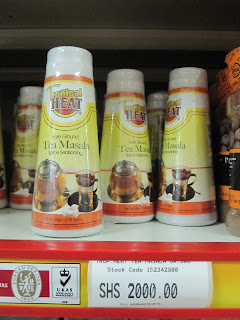


Tea Masala - add to your favorite black tea and you have chai!


Glucose on the grocer's shelves. Surprising.


Cafe Java's - probably the busiest cafe in Uganda. Estimated daily revenue: approx. USh 6,000,000.


Cafe Java's macchiato.


The Bar at Cafe Java's.


The Bar at Mokka Terrace.


Talking coffee at Mokka Terrace.


Serving our macchiatos.


Mokka Terrace - Macchiato.


Brenda and her barista at Bancafe


Bancafe Coffee - Macchiato.


Steer's - a local fast food joint.


Two piece fried chicken, fries and salad with russian dressing.

Saturday, November 20, 2010

Kampala Serena


Welcome to the Kampala Serena Hotel.

One of my favorite hotels in the world is the Halekulani in Honolulu. It's a member of The Leading Hotels of the World, which is a designation of some of the finest hotels on the planet and usually an indicator of a hotel which I cannot afford. My hosts here in Uganda have been gracious enough to house me at the Kampala Serena Hotel and it's quite nice.

It's nearly midnight when I arrive after a very long trip so the mind is groggy, but the grounds are reserved and understated. It's luxurious but not in the opulence of say, the Sheraton Addis Ababa. Reserved and unassuming, it's how I prefer my luxury.

Everything is thought out and executed, from the leather-wrapped brass bedside clock to the inlaid woodwork in the furniture. Lovely. And their collection of ethnographic art just lines the walls throughout the hotel. Lovely. I bet they even allow cigar smoking in the lounge.


Fresh sandals and a bottle of water await my arrival.

But it's been a long trip here and there's some work I need to catch up on, not to mention that I'm starving for something hot and proper. A quick call to room service nets me a club sandwich that's pretty tasty with fries, hot sauce and a Diet Coke.

I finish my work around 2am and hit the bed for a little slumber.


Ethnographic Art in the room.


A midnight snack.


The Serena Triple Decker - chicken, bacon, lettuce, fried egg and tomato.


Looks like a hometown girl has already been here.

Over Africa


Croissants and a hard boiled egg at Brussels Airport.

Looking at the flight schedule and calculating the itinerary, I came up with a number:

Ten hours.

Dix heures.

Diez horas.

Ten hours.

That's a long time to travel. Ten hours. I had forgotten just how far Africa is from my home.


First stop: Kigali, Rwanda 6367 km.

After half a million miles (seat time) of travel, I think I still enjoy it. Well, not really. Now that United (and most airlines) have gotten so cheap with everything, what was once an experience is now just painful. Ten hours. Not fun.

As I was checking in for the flight in Brussels, behind a group of French who had their luggage piled high that I couldn't tell if they were just tourists, going on safari or missionaries, I asked the agent just how "heavy" the flight would be today. She said it's about 49% full - gotta love these Europeans and their efficiencies. Back in the United States, the agent would have said something like "pretty full" or "about half". Here, in Europe, they've got it down to the exact percentage.

I figured I could hijack some seats.


Our A330 cabin.

When a flight is flying "light" you have the opportunity to jump your assigned seat and grab an open one. As long as you're not jumping up a class, they usually leave you alone. They do tell you to take your seat and then once airborne, you can change.

Since economy has so many people, it's unlikely that a flight crew will take the time to check if you're actually assigned that seat. First and business? Oh, they'll know if you're an interloper, but economy? They really don't care.

Instead of waiting until we're airborne, or at least the doors have been closed, I opt for a different strategy. I've got a single carry-on that's relatively small, so I try to be one of the last people to board the aircraft. If I'm the last person and they close the door behind me as I board, all the better. It now means that I have my pick of the seats!


Lunch - that I divided over the duration of our flight.

As I walk down the aisle to my assigned seat: 39H, an aisle seat on the right side of the aircraft with an adjoining window seat, I know that it's full and that I need to jump my seat. I scan the selection of seats and find a completely center open row of four seats: 27D-G and hop in. Serendipitously, it happens to be next to the cute Spanish girl I saw in line at border control.

Now, this is where it gets tricky. How do you hold four seats and discourage someone from sitting in 27D when you're in 27G? Slide over to 27F and place your jacket and carryon in 27E. In a plane with so many open options, you make 27D just a little more unattractive. Happily, it worked.


First Course: Lemon Chicken with potatoes and lentils.

The first hop on our flight was to Kigali - roughly eight hours away. It's God-awful and had I been forced to fly the entire way upright in a cramped seat it would have been absolutely brutal. But with four open seats, I could try to lie down and sleep.

I stretched out across the seats and donned my earbuds (for silence) and blindfold almost immediately after takeoff. I wanted to claim my seats, make no mistake about it. The goal was to sleep (or try to sleep) for two hours. After changing positions four times and not sure if I actually slept, I checked the time. Two hours had passed. Thank you, Baby Jesus.

Another round of trying to sleep ended up killing two more hours for a total of four. That's half the flight gone and I'm not going crazy. Yet.


Second Course: Chicken Pasta Salad...

Toss in a couple of meals, the ending of Despicable Me and the entirety of Marmaduke and we're nearly six hours through the flight. Pop open the laptop to watch this weeks episodes of Community and The Big Bang Theory and another 44 minutes has gone by. Fire up the movie Skyline and I'm only 3/4 though when we start our descent into Kigali.

Roughly an hour on the ground in Kigali to clean up the plane and take on a boatload of passengers, so much so that I'm forced back to my assigned seat, and we're off again.

From Kigali, Entebbe is only a 40 minute flight over Lake Victoria. The flight is quick and easy - and I don't have enough time to finish the last six minutes of Skyline before we're landing, going through customs and taking the one hour ride to Kampala.

And Skyline? It's pretty dumb.


and Chocolate Ice Cream!


Sunset over the Sahara.


Course Three: Corned Beef Salad with bread.


Kigali means only another 338km to go!


I'm back to my assigned seat: 39H.


Somewhere cruising over Lake Victoria.


Arrival: Entebbe International Airport.