Showing posts with label barista. Show all posts
Showing posts with label barista. Show all posts
Tuesday, August 20, 2013
The HTF Conundrum
This post probably will not come off well-constructed nor will it have any conclusions - mainly because it's something that I'm still thinking about and trying to figure out myself, but it's been on my mind for the past few years.
In the coffee business, we give a lot of lip service about how we do "direct trade" or want to do "direct trade" or how we are "helping the farmer" and all sorts of "Do Good, Feel Good" kinds of things. We boast about how we are paying "higher prices" for our coffee and how that's "making a difference" in the lives of the poor, lowly campesino toiling on the soil and under the sun to produce our award-winning coffee that retails for sixteen bucks (and up) per pound.
Throughout our business (and especially in our niche of "high end" specialty) we can peruse all sorts of media - brochures, product sheets, websites, blogs, facebook pages) of us mugging and posing at the farm, with the farmer, holding the beans and pretending to do any and all of the coffee processing - from picking the cherries, lugging the bags, raking the parchment - and of course, there's the de rigueur shot of someone from the company pondering carefully and intently about the beans he/she is holding.
We know that our efforts have not gone unnoticed because we're now seeing "the big guys" starting to do the same - and it's not just those old school darlings, Fair Trade or Rainforest Alliance. Recently, an executive of worldwide coffee operations for a very large hospitality organization told me that they too were looking for that "compelling story" - because that's what their guests are looking for - especially with the recent trend of everything "Farm To Table". "Seasonal Direct Trade Farm To Cup" - it's what's chic in the today's world.
To be honest, I'm probably as guilty as everyone else. I've been to origin. I've been photographed while posing with that basket pretending to collect beans off the tree. Truth be told, I wouldn't last an hour picking coffee cherries. That's hard work. And when I'm in Nicaragua, I'd much rather be drinking Flor de Caña and eating paella at Taska Kiko in Managua than toiling under the sun in Nueva Segovia (though I have been facebooked doing both).
Third Wave Types love to pay what seems like a lot of money for their coffee. We brandy about our green prices like a badge of honor - as though we should be lauded because we pay so much for this and you only pay that little for your coffee. Each of us is looking for the hot new coffee that's going to set the industry on fire, intent on being the first person to bring the new Esmeralda to market. To this effort, we flit and flirt around from year to year buying a little of this and a little of that. "Only the best of your crop, please." The rest is rubbish that isn't fit for my ancestor's slaves.
And next year, when that same farmer toils under adverse weather conditions or roya? Adios, burro. You don't have that purple jade green beauty we're looking for. I mean, afterall, your coffee is only scoring an 82 and I'm a 90 plus kind of roaster. Especially because I'm good-looking, wear ironic eyeglasses and don a retro-rockabilly look. My loyalists would be aghast for me to deliver a coffee so, common...
Through all this I've constantly been wondering: To what end? To what end are we doing all of this? We talk about "helping the farmer" but what does this mean really?
I'm from America. Born and raised. The American Way. To my mind, when we talk about "helping" someone, I presume we're talking about The American Dream: to lift oneself from their current position. To help ensure that our children will have a better life and a better future - one different and better than our current station. This is what I presume when people say we're "helping the farmer" and this is what I think most people presume too.
But is this the reality?
If the average Central American coffee farmer (that small plot holder we're thinking about) makes only about US$2,500 per year (which is far lower than the lowest paid barista in America), is that enough? Is that enough for this couple, with maybe three children, to pull themselves out of poverty and move their children up the Food Chain? Or are they destined to remain at their station - in the lower classes of their societies?
Deliver us great quality and we'll pay more, you say? How? If we presume that the average coffee farmer is operating at a subsistence level, then how can they afford to do any of this? How can they learn new techniques? Go to a class? Can they afford that class? Can they afford that raised bed dryer? Can they afford to do anything but just barely grow their coffee and send it to the beneficio (processing mill)?
Conversely, there's the producer Rock Stars. You know their names. They're the ones you see touring America (and other first world nations). They're US or European educated, smart dressing and part of their nations' elite. Their coffee is typically the most lauded in the world and they've got the savvy, the education, resources, connections and money to make that happen (and command the greatest prices) year after year. We all know them. They're my friends too. And we all want to pose for pictures with them - to show our public just how "real" we are about coffee. When your family already owns hundreds of hectares of land and you're invited regularly for events at the presidential palace, are you the kind of coffee farmer that really needs "help"?
What about events like the Cup of Excellence, you say? They demonstrate the best coffees of any country for that year and those coffees command tremendous prices. Certainly that's gotta be good for the campesino! Agreed. The CoE is a great event, has done good works and delivers great coffees. That 2011 CoE Lot 19 Nyakizu Rwanda I bought is fantastic, but is it repeatable? Jon Lewis will probably correct my data but a trusted friend related to me last weekend that no farmer has won the CoE Peru more than once, asking the question: if these winners actually have the knowledge and formula to sustainably produce great coffees year after year (and raise their revenue and lifestyle), or are these one-off, one-hit wonder flukes?
I know I've hit on a number of different topics here and I'm offering no answers, definitions or solutions. I don't know what or if there is a "solution". Maybe it just is what it is. But I do think that this is part of a discussion we should be having in our industry - questioning our motives and our goals when we say we're "helping the farmer".
The comments section is open for discussion.


Thursday, August 02, 2012
Beating Homogeneity Out Of Iced Coffee

Just yesterday I was mentioned in a blog post about Iced Coffee and Cold Brews. For those of you not following the coffee biz it's been a heated topic for the past few months with various people arguing about which iced coffee brew method is "best" - as though there has to be one magical brew formula that bests all others.
Quite frankly, I just think it's a load of hogwash.
All across 3WCoffee people with the intention of proving that they're "right" because they've used some sort of psuedo-scientific method or newfangled electronic device that tells you that their technical numbers are "right" and that number means that your drink is "awesome." And they haven't even tasted it yet.
It's as though there's some sort of campaign to get everyone to brew the same way.
Which leads to the question: do I think that the methods we use at Spro are superior to the others? The answer is: of course! Otherwise, we wouldn't be serving coffee in that manner.
Do I then want everyone else to brew and present coffee the same way we do? Absolutely not - that's just ridiculous.
What I want to see when visiting coffee places is vision and interpretation. Sure Mad Cap and Spro can buy the Ardi green coffee from the same person and have the same coffee from the same lot, but do I want the two coffees to taste exactly the same? Gosh, what fun would that be? That's about as exciting as a tour of DC coffeehouses where the coffee is the same everywhere.
I want to experience the interpretation and the nuance as offered by that barista or that shop. Give me something different, interesting and exciting. And for God's sake, taste the coffee instead of running it through some machine!
Is that to say that we expect our way of brewing to be the do-all, end-all for all people? Well, that would be nice. But I accepted many years ago that what we do will not be the right fit for all people. We're making coffee to our vision and to our tastes. We want people to experience our interpretation of coffee - hopefully, they find it as interesting and exciting as we do, but sometimes they do not.
Some people dislike the way we brew iced coffee and that's okay. There are plenty of places brewing coffee in a different manner that they might find more appealing. But all of this argument, discussion and banner waving about whose method is "best"? That's just malarkey. Taste is what determines what is "best" and we let taste be our guide, and I hope you do too.
Because my guests don't come into Spro bearing measuring devices looking for some magic number, they actually drink the coffee.
Friday, January 20, 2012
Bona Vita Electric Kettle

Starting off with cold water.
During last year's coffee industry trade show, I ran across a small booth with one guy. He was hawking a new drip coffee brewer that was supposed to deliver water at 200F - the ideal temperature for coffee brewing. We talked and I was very interested in bringing these brewers to our customers but they wouldn't be ready for a few months due to UL listing, importation and whatever ills plagues the import manufacturer.
Fast-foward to a couple of weeks ago and Todd finally made it out to see us with some gifts in tow: the aforementioned coffee brewer, along with their new electric water kettle. In case you haven't been following, hand pour water kettles have been all the rage in the barista ranks for the last few years. And while there are a few nice ones on the market, they're usually pretty pricey and are subject to thermal loss during use. HarioUSA has been threatening for a couple of years to import their electic Buono kettle but they've been lazy to do so, and it's such a pain in the butt to do business with Hario distributors that it's easier to just abandon their line altogether - especially when there are easier options available.
The Bona Vita Electric Kettle is one such option.
Manufactured in China, the BVEK features stainless steel construction, a nice tapered pouring nozzle, simple electronics and ease of use. The lid fits securely to the top and features pressure relief holes that can double as an orifice for your temperature probe.
The bottom of the kettle and the base are made from high-impact plastics and feature a switch, located beneath the handle, and a red indicator light to let you know when the thing is "on". Overall, construction is nice and it feels good, though the finger relief on the handle for ergonomics isn't as comfortable as you'd prefer.

Brewing a pour over with the Bona Vita.
Originally I thought I would conduct these tests in the real world of Spro, but it can be so darn busy in there that it's easier for me to take the unit elsewhere where I have the time and space to concentrate and give it a try.
The unit itself is compact and smart-looking. The design has just the right blend of stainless and black plastic, making it pleasing in the workspace. For the home user, it's absolutely brilliant. For the professional barista considering its deployment in a shop environment, there are a few things to consider.
First off, it's reasonably well-built and I do expect it to take a bit of a beating, and if you can avoid dropping the kettle, it should last quite some time. My concern lies with the number of cycles the unit is designed to take. If you're serving 100 cups per day and heating each batch of water to order (or reheating), you could be talking 75,000 cycles per year. It might take the home user a lifetime to reach that many cycles.
But that's not to discredit the Little Kettle That Can. In the few days that I've been playing with it, and the week prior being mauled by the Spro baristas, the BVEK seems like a winner. The construction is good, the design is pleasant and the price point blows even the regular Hario non-electric Buono Kettle away.
For the purposes of this test, I used the BVEK to heat 32 ounces of water from 60.7F to boiling point (212F) and the auto shut off of the unit. With an ambient temperature of 68F, the kettle started steaming (145F) around three minutes and reached 212F at 6 minutes 2 seconds. Not bad performance for a little 120volt kettle. Though, if you were using this in a professional environment, six minutes is quite a long stretch that could be mitigated by running multiple kettles constantly heating.
At Spro, we only serve 12 ounce brewed coffees. For these kinds of situations, how does the kettle perform with lower volumes of water? Typically, a 12 ounce coffee absorbs two ounces of water in the brew cycle. The next test involved heating 14 ounces of water (65.4F) to boiling, resulting in a time of two minutes and fifty-three seconds. Definitely this heating time is well within striking range of any brew cycle, roughly halving the 32 ounce time.
However, heating 14 ounces of water does not allow for cup preheating or hot rinsing of the paper filter. A twenty ounce sample of water (65.1F) took just under four minutes (3:57) to reach the boiling point.

The overall look of the handsome Bona Vita Kettle.
From an operational standpoint, there are a few more things to consider. If you're pulling your water from a hot water tank and using the kettle to stabilize temperature, then you'll experience much quicker heat times. Also, the test times here are run to the boiling point when the kettle's auto-shutoff feature kicks in. With a thermometer in hand, and the 200F goal, you should be able to shave off up to 30 seconds (or more) from the heat times.
While not as finely tapered as the Hario Buono kettle, the Bona Vita's taper provides for smooth pouring action, as well as fine stream control. Those of you used to the Buono will find the transition quite easy.
One concern that I do have with the Bona Vita is the bottom of the kettle and it's electrical contacts. Even though they are recessed and probably designed as best as possible to reduce shock, my concern is for use in wet and messy environments - especially those run by messy, disorganized baristas. Stray grounds may get into the contacts and muck things up, which is more reason for every barista to run a clean station.
Another potential problem, though a minor one, is the length of the electric cord. At 29 inches, it's plenty long for use on a kitchen counter or backbar, but if your electrical requirements require a bit of a run underneath the counter (as it is at Spro), you will need an extension cord.
In summary, the Bona Vita Electric Kettle is a winner. Either for the home user (excellent) or the professional coffee shop (very good). We will be stocking them at Spro and while they are simple on/off kettles, the next generation Todd promises me will have programmable temperature controls so that you can offer a variety of water temperatures for coffee or tea.
Tuesday, November 29, 2011
5th Uganda Barista Championship

Barista Jonathan Ddumba presents to Head Judge Clare and sensory judges Miriam, Richard, Evelyn and Emma.
A few weeks ago, I received a call from David Roche of the Coffee Quality Institute. He was calling to ask me if I would be willing to go to Kampala again to be the head judge and trainer for their barista championship. He said they had been asking for me personally. An honor.
Not too long later, I found myself boarding yet another trans-Atlantic and trans-African flight to Uganda where we would be holding two days of barista workshops, one day of judges training and then three days of competition.

Surrounded by competitors for a "photo op."
Last year, I thought it was a bit odd to have a barista training literally hours before the competition. I mean, how much could the competitors digest, make changes and (perhaps) improve right before the championship. But I was tasked to do a job and I did what I could and shared as much information as possible on how to compete, methods of flow and even ways to improve your scores.
While I was at first a bit skeptical, I'm now a fan of. One of the greatest problems in barista competitions is the disconnect between competitor and judge. One person within the USBC once remarked that the WBC Rules and Regulations are the only training manual you would need, but the interpretation of those rules can vary wildly from judge to judge and competition to competition. Add to that the WBC's reluctance, or outright refusal, to provide materials and information to illuminate these areas and you've got a situation where only a small percentage of competitors have the ability to truly be competitive.

Joseph Kyeyune rocks it to the Finals.
Of course, the pundits will argue that it's a "level" playing field and that one doesn't need to have money to win. These are also the same people who never comment that those who win have also spent time training with the likes of World Barista Champion Fritz Storm - whose rates are in the thousands. So much for the average competitor...
Which is what the majority of the competing world is comprised of: average competitors trying to learn finer points of our craft and doing a better job in the world. Everyone wants to do well and win a trip to Vienna, but not everyone has the resources available to them. And that's what the barista workshops are designed to do: bring the information to the competitors before the competition when they will have some time to perhaps make changes and incorporate them into their performances.

Daphne awaiting lunch.
And that's what I see here in Kampala. Lots of passion. Lots of interest and the desire to do well and improve. So, after two days of instruction, we're off to the races.
The competition itself went very smoothly. With a resident WBC Certified Judge, the duties of Head Judge were split between myself and Clare - relieving me of the intensity that comes from Head Judging 26 competitors non-stop.
As with any competition, we want to judge the competitors on the same level at the rest of the world. Meaning that a score of "5" is equivalent to a "5" elsewhere in the world. What we don't want is a "5" in Uganda to mean a "3" at the World Championship. We want a realistic evaluation according to world standards, which is a difficult proposition when you're trying to wrangle local judges who've never seen competition before (or maybe never outside of their country).
In my world, there's a bit of pushing, prodding and even outright challenge to judges' evaluations. Scores go up, scores go down, but always with lots of information, discussion and detail as to why. The hardest part is getting the judges to write enough information on their sheets to be helpful to the competitor later.

Finalists Emma Katongole, defending champion Mark Okuta, two-time champion Roberts Mbabzi and Joseph Kyeyune.
As the competition winded down and the finalists announced, I looked over the scores compared to last years competition and was pleasantly surprised. The average scores had improved considerably. Only one disqualification this year compared to four in 2010. And the finalists all performed very strongly - one could easily see the improvements from the previous year.
When the Finals got rolling on the last day, the excitement was palpable. The Defending Champion Mark Okuta versus the former two-time champion and a slate of some very tough competitors. Quickly, four of the finalists pulled away from the field. Nearly 100 points would separate the fourth and fifth positions. While Simon's cultural smoked milk electrified the audience, Mark's tour of the coffee bean was fascinating and Salim's dazzling performance rocked, it was the former two-time champion, Roberts Mbabzi who came a calling to reclaim his title as Barista Champion of Uganda.

They said I was looking "smart" at the barista awards party.
Many hours later, after the partying was over, some of the competitors came to me to ask how they had done. What they really wanted to know is: how could they have lost? And: how did Roberts win again? I understood their question because it's common amongst those who don't take the title. There's always the wondering if the competition isn't somehow, fixed. Especially for someone who always seems to win.
I sat down with them and pulled up the electronic scoresheets that I keep on file as the Certifying Judge for a national championship. And I compared their scores. Even without the actual notes of the scoresheets, the scores tell a lot. The top four were very close. Each of them within striking range of the Champion spot. An improvement in this set of espressos, or an improvement in your professionalism, plus a slight mistake on the part of the Champion could easily have switched positions. Even hitting an even 4.5 on cappuccinos taste balance could have scored you the title.
In the end, I discussed it with them to show that there's nothing rigged about the competition. The scores reflect the performance. Maybe that one puck was off and you served it because it would burn time to redo the shot. That shot got you 1.5 in scores. Maybe it would be worth it to burn the additional 30 seconds to grab a 3.5 in scores? All things that have to be considered by the competitive barista.
I think they all left understanding the process a little bit better. Perhaps still not happy that they "lost" but at least with a better understanding.
And if I can leave a place with a better understanding of our craft, then it's been a worthwhile trip.
Tuesday, November 22, 2011
Robusta, Naturally!

Welcome to Great Lakes Coffee - the honorary Consulate of Greece.
After eating a bit too much barbecue and partying together in Houston this past April, Andy invited me to visit his coffee factory the next time I was in Kampala (you know, because I always just happen to swing out to Africa).
And since I was in Kampala, I gave him a ring and off we were running in a Euro-spec Nissan Patrol careening through the streets of Kampala off to some far-flung place on the eastern side of the city, past rutted roads, mud huts and sinfully gorgeous gated mansions to this industrial section where I wondered how anyone navigated the "road" without a four wheel drive truck or SUV.

Where the women hand sort for defects.
Drive up and you face a gated wall that's simply ominous and forbidding. Until the armed guard with the Ak-47 swings the gate open with a friendly "You're very most welcome!"
Africa: Situation Normal.
Once inside the high, concrete walls, I'm reminded of my cousins rice mill in the Philippines. Large, flatbed trucks wait to haul away container loads of coffee and some kind of mill towers above all else.

A mosque for the Muslim workers.
Our tour begins with the sorting room. Here dozens of women sit on the floor, spread out with a bag of green coffee in front of them. Each of the women sit there sorting the coffee and picking out the bad beans. Those go into a hopper where they'll evidently be sold to Lavazza or Illy or Folger's, or any of the dozens of coffee companies looking for coffee of any quality - so long as it's priced below the C-Market.
For the women, it's a great way to make money and socialize. They sit in the large room, openly discussing the days gossip. Who's doing what to whom, and so on. Showing me a wooden desk that looks like an oversized cigar rolling table, Andy tells me that he once tried to create these work stations where the women would sit and sort. It would be more comfortable and more efficient, allowing these women (who are paid by the bag) to work faster and earn more.
Problem is that these workstations ended up being five feet high and when seated, the bin would obscure the women's view from each other, thus ending the social interaction that they enjoy more than cranking out another bag a day. The one model stands lonely in the space, a monument reminding the women that this is about sorting quality coffee AND discussing what that crazy muzungu lady must have been thinking wearing that outfit to church.

Laser sorting green coffee.
From there it's past the Mosque built specifically so that Muslim workers would have a place to worship and into the processing room where thousands of pounds an hour can be mechanically dried, hulled, sorted and bagged. It's a large and impressive operation with laser sorters that divide the beans at incredible speed.
Next to the processing area is the arrival storage area where the room is nearly packed to the ceiling with green coffees fresh from the fields. The harvest is starting to peak here in Uganda and we're seeing the greatest volume right about now.

Reaching the peak of harvest.
After a tour of the offices to meet the company principals (Dad, uncle, brother and Kat), I'm whisked into the lab where the fun really will begin. Andy, Corey and Emma have set up an 11 sample cupping for me to taste the latest crop arrivals along with some interesting specimens from the DRC (Democratic Republic of the Congo) and a freakingly interesting natural processed robusta.
Awareness of Ugandan coffees is very low, with most people only knowing or hearing about Ugandan Bugisu. According to Andy, coffees from this Bugisu region can be very good - especially the select stuff from Mount Elgon. The problem with Bugisu is similar to that of Kona in Hawaii. Coffees from other parts of Uganda, which may be interesting on their own, are trucked across the country to be blended with coffees from the Bugisu region to become Uganda's "Bugisu" coffee.

Cupping New Crop arrivals.
Happily, Andy and company are forging ways to preserve the unique characters of the growing regions and develop a specialty market for these coffees. I'm interested in tasting these coffees and bringing them back to the United States.
Despite (or maybe because of) the fact that we buy and sell some of the best coffees available on the market at Spro, my personal exposure to the many cupping defects out there really is quite limited. By the time we receive our green or roasted coffees, they've already gone through a multi-stage process of cupping and vetting. Here, we're tasting the stuff as it's coming from the field and anything goes.

Screening 320 bags (container load) with my face.
One cupping sample (out of the five) immediately smelled of boiled peanuts when dry and wet potatoes when wet. There's that potato fungus right there. Sadly, while it was interesting to actually cup a coffee from the DRC, the coffee itself wasn't quite what we were looking for.
There were, however, several samples that I found really intriguing and I'm planning on following these coffees through the harvest to see exactly how they're going to shape up in the coming weeks.
UBC Barista Training - Day Two

Evaluating a cappuccino.
Day Two of barista training for the Uganda Barista Championship consists of mock trials. Originally, I had planned to show videos of World Barista Champion Alejandro Mendez but the dual punch combination of the incessantly excessive and irritating "sports commentary" while reviewing the footage in my hotel room the night before and the poor 3G reception in wireless Kampala, along with the stupidly difficult to load Livestream feed, meant that we were going to abandon watching "official" footage and instead focus on live interaction.
Which I think turned out much better than watching some streaming video of average quality over the Internet.
By placing the baristas in the role of judges, I think gave them a greater appreciation for what pressures the judges face and how difficult it really is to score accurately, consistently and impartially.

Can you give this a visual score upside down? Evidently, one barista judge did not think it was possible.
For this exercise, we would eliminate the signature drink because it's much more interpretive than the rest. Just espresso and cappuccino rounds with the baristas taking turns presenting and judging.

You might give it a "3".

Drawing their presentation order for The Big Day.
Monday, November 21, 2011
UBC Training - Day One

The prize of Eastern Africa.
With 20+C weather outside, Kampala is a lovely place filled with a cacophony of sounds, briliant sights and quite a bit of traffic. Making our way along the crowded streets is a demonstration of the mass humanity filling Africa's cities. Vehicles of all sizes, pedestrians and even the women balancing just about anything and everything on their heads.
Today is the first day of three days worth of training. Two for barista competitors and one for championship judges. I always find these trainings to be quite a challenge because you never know what you're in for. Everyone has been through basic training and passed a preliminary qualifying round, but even in this group of 21 baristas, the experience ranges from independent competitors learning competition coffee for just a few months to seasoned cafe and competition baristas with five years in the field.
In the end though, it all goes back to basics: the scoresheets and rules. Most of Day One was spent going over the scoresheets and making sure that they understand the scoring, how the categories are scored and a little bit on how to exploit the scoresheets to their advantage.

Pouring it out.
In the afternoon, we review visual identification techniques for cappuccino and espresso, giving the baristas the chance to judge scores on multiple examples of both, familiarizing themselves with just how the judges will be reviewing their drinks. Later, it's open stations for the baristas to make drinks and then we sit down and evaluate the drinks together - giving them the chance to visually score and taste their own drinks for deeper understanding.
Afterwards, the interested baristas hang out roasting coffee, talk about blending and work on more advanced techniques. It's interesting to see who stays behind until the bitter end - it may be an indication of the standings to come.

Uganda's 2010 Barista Champion: Mark Okuta.
Sunday, November 20, 2011
Serena-ty Uganda

Poolside at the Kampala Serena Hotel in Uganda.
After leaving my house at noon on Thursday, I finally arrived at my room in Kampala, Uganda at 3am on Sunday morning: a total travel time of 55 hours (including a stopover in Frankfurt, Germany). Finally got into bed around 5am and slept until 1:15pm to find myself in what is easily the highlight of my entire years worth of travels.
My hosts here in Kampala are gracious and generous enough to put me up at the gorgeous Kampala Serena Hotel where luxury and comfortable living is the norm and I highly recommend anyone staying here. The staff is wonderful and the attention just right. Not too overbearing but right there when you need it.
The only downside at the Serena is the crazy sporadic Internet connection. Maybe that spot you're sitting doesn't have great reception, but move five feet to the right and a step back and the kilobytes start flying. But no matter, if the problem is really serious, one of their service techs will be here right away to help you with the matter and find the optimum location for your laptop. They'll even move your beverages and umbrella to accommodate you.
For a few moments, I thought about calling some friends and heading out into the Big City, but how often in my life do I find myself with a day to luxuriate and do nothing in particular except enjoy just being alive? That week between Christmas and New Year's in Honolulu at The Porn King's bungalow overlooking Honolulu back in 2004 comes to mind.

Danke schoen Alemania for the Montecristos.
So what better way to spend the day than in t-shirt, board shorts, slippers and lounging poolside with a pack of Montecristo Minis, some cold beverages and the occasional swim in the pool? I should note that I did bring my Foodservice Management and Controls textbook with me as part of my continuing studies retinue (which I didn't crack open once this afternoon).
After laying down some bronzing foundation on my rapidly whitening winter skin, I decided to retire from the pool to the outside lobby bar to rest and recover from the constant movement trying to avoid the shadows cast poolside from the waning sun (it's difficult work!)
I also met a woman (with her visiting son) who has been living here for four years. I asked her how she liked Uganda and she clarified that she has been living here, in the hotel, for the past four years.
At the lobby bar, I've settled myself with a pot of African tea - an interesting and slightly odd blend of tea with ginger to give it a zing, already steeped with milk and served with sugars and some cookies. Somewhere from the pool area wafts strong traditional African music. It's alluring and wonderful, and I want to wander over there and watch the musicians but I'm too relaxed to do anything that strenuous.

Working at The Mist bar.
My mind wanders back to that woman and her son. Four years. I've always secretly envied those people who have found a way to live in the best hotels of the world. How does one even arrange that kind of arrangement? I can only imagine what the rate is here for my stay. Multiply that by a month then by years???
But what a fantasy. You're daily live tended to by the best hotel people in the world. Meals prepared in the nations best kitchens. There's always a pool and a spa, a bar and 24 hour room service to satiate your every desire. The baristas here make killer coffee to the standard which I desire. It would be heavenly - and when your time comes, you can rest assured that your remains will be disposed of with care and your loved one notified with the proper amount of discretion.
If I don't return to America by December 7th, you'll know where to find me...
Sunday, October 09, 2011
Call Of The Siren Song

Grande Mocha Frappuccino.
It's another weekend in Pawtucket, Rhode Island for the annual Mid-Atlantic NorthEast Coffee Conference (aka MANE) where we've talked coffee, discussed coffee, argued about coffee, theorized about coffee and even drank some coffee. So much going on but the essence is that the MANE is simply the best barista coffee event in the United States today.
Where other events are surrounded by the politics and dogma of the coffee industry, MANE is solidly independent and free-thinking. It's a place for open exchange of ideas and the closes thing that the barista craft has to a chefs congress and it's only going to get better in the future.

At some point in time, everyone goes to Starbucks.
But all that's over for this year and after two solid days of non-stop barista craft, we headed out for a Sunday brunch, a walk around Providence and some refreshments at that one coffee place we all know: Starbucks. While everyone enjoyed a tea lemonade drink, I couldn't but help myself to that granddaddy of Starbucks creations: The Mocha Frappuccino.
Nothing like hanging with the world's top barista, machine tech and green importers at the place that started it all.
Wednesday, August 24, 2011
Nice & Shiny

In certain circles, it's impolite to ask one's age.
To my mind, the craft is about attention to detail. It's something I try to instill into each and everyone on our staff. Much of this manifests itself in details that the guest may never see or notice. Take this steaming pitcher, for example. Take a close look and tell me how old you think it is.
It is clean. Polished. Shiny. If one were so inclined, one could use it as a steaming pitcher in a barista competition. It looks nearly as good as one straight out of the box. To note, this isn't a display pitcher or one that we use for dressing. It's the main pitcher that our baristas use day in and day out. Lattes, cappuccinos and chais are steamed in this vessel all the time. It is washed between each use. It is a demonstration as to why I think Spro baristas are some of the greatest working baristas in the industry today.
This pitcher that has worked every day making all sorts of drinks, under constant use by our baristas...
Is now five years old.
Sunday, August 21, 2011
Cold In-Fusion

Adding cold water to the coffee.
I've been thinking about cold infusions lately. Infusions that don't require heat and are not destructive (changing) to the ingredients used. Heat up the ingredients and a change occurs. What ways can we move to infuse liquids while trying to capture the vibrancy of the natural ingredients?
A technique developed by Dave Arnold at the French Culinary Institute described using an iSi Whip Charger to infuse flavors. At its most basic, the iSi is widely used to make whipped cream. Insert cream, add a little sugar, seal and charge with a nitrogen cartridge and you've got ready made whipped cream.

Double-charged and three minutes.
The whipper is a great tool and I've used it before to make foams and played a little with them to inject carbon dioxide into products - "Strawberry Soda", anyone?
All of this started the other night while I was lying in bed thinking about mole - that ubiquitous Mexican dish of spices, chiles, nuts and cocoa. How might we be able to create a drink that represented mole?

Straining the liquid infusion.
Originally, I pondered this similar question four years ago and didn't get very far. The complex and powerful flavors of the mole, not to mention the gritty paste (for a drink) that serves as the base, made it difficult to work with and I soon abandoned that idea for others (the "Breakfast In Bed" concept).
Fast forward four years and I'm back in the same situation, considering the options. This time, the potential lies in being able to take the ingredients and infuse them into a liquid to carry the flavor and combine that with coffee (or espresso). And maybe Dave's idea of cold infusion might work.

Still a bit cloudy.
But without the necessary ingredients at the ready to make a proper mole, I decided to give it a conceptual try using whatever we had on hand - namely coffee. Stumptown's Finca San Vicente coffee from Honduras has been performing brilliantly this week with notes of vanilla, cinnamon, caramel, hops and macadamia nuts and would make for an interesting test subject. What kind of notes and nuances might we be able to extract from the coffee with this method?
As a baseline, we took 24 grams of the San Vicente and ground it coarser than for french press on a Compak R80 grinder (roughly the 90 setting). Placed that in the iSi Whipper along with 14 ounces of cold water. Screw the top on tight and charge with two (2) nitrogen cartridges, making sure to wait a few moments to allow the nitrogen to absorb into the liquid and shake well between charges.

Through a paper filter.
Once charged, we waited about three (3) minutes for the infusion to take place, being sure to note the fact that if we had simply brewed the coffee it would have taken the same amount of time.
Degas the whipper by holding it upright and using a container to catch any liquid that may come through the nozzle. Slowly allow the gas to escape and then unscrew the top. You'll notice that the liquid looks like it's boiling. This is perfectly normal. After straining the liquid, we noticed that there were still quite a bit of particulates in the liquid and then passed it through a paper coffee filter. Note: it will be more efficient to stir the liquid in the whipper and then pour the entire contents through the paper filter instead of using the strainer first. Passing strained coffee liquid through a paper filter always results in too many fines clogging the filter and slowing the process immensely.

Gassed up.
We tasted the liquid and it was light, fruity with a slight tartiness. Jacked it up with a little simple syrup and the liquid became vibrant. What were just a moment ago light and elusive fruit flavors were now dominate notes of tamarind - both sweet and tarty.
But it needed something more to give it a kick. Back into the iSi, we hit it with one charge of carbon dioxide, degassed and then poured it out.
Something to keep in mind about carbonation: you want the liquid to be cold. CO2 does not hold in warm temperatures. It simply gasses out into the environment. Which is why warm Coke goes flat at alarming rates. The colder the better. We added ice cubes to the iSi to chill down the liquid and keep it as cold as possible.

Finished. Sort of.
Degas the whipper in the same manner as before and we found a lovely amber colored liquid with lovely notes of tamarind and that refreshing carbon dioxide kick. It really brought it to life.
Next week: time to give it a try with actual mole ingredients!
Saturday, August 20, 2011
100g of Calibrating Power

One of the coolest things I picked up yesterday at the gem show was a calibration weight. Perfectly tuned to 100 grams, this weight is used to calibrate your scales and make sure they're in sync.
At home and at work, I use gram scales all the time and the gem show is one of the few places where I can go, buy a gram scale and not have funny or "knowing" looks between me and the person selling me the scale. In America, it seems that the only people using gram scales are gem dealers and drug dealers. In a way, they're all scam artists selling highly addictive products.
Come to think of it, baristas, jewelers and drug dealers all seem to have this in common. Go figure.
And, as any dealer (drugs, gems or otherwise) will tell you: we live and die by the scale, so it has to be accurate and on the money. A couple of grams off and you're talking profit or loss. In the millions. So, a calibration weight is a handy tool.
Some of our scales have been in constant use for nearly two years now. They're dropped on the floor, plopped into drawers, tossed around, slammed around, weigh continuously and are subject to a wet environment. I was almost sure that one of them would be off but when I placed the weight on the scales, they all read "100" grams.
Even the new scales I picked up yesterday were on the money - though the one that weighs to the hundreth of a gram measured "100.12" grams. Hmmm, I'm starting to worry about that .12 gram.
I'm now on the lookout for a proper Bentley so I can join the ranks of dealers worldwide.
Wednesday, August 03, 2011
Killing Myself By The Numbers

Losing my mind in a sea of numbers.
Sometime today I started to lose it. Calculating the various details and expenses of each menu item was starting to get to me. All around me a cacophony of activity carried on. Prepping, cooking, washing, cleaning, the clomp clomp clomp of people going up and down the stairs, the acrid aroma of roasting garlic, footsteps above my head signaling the continuous stream of guests coming and going, the high-pitched squeal of the espresso grinders, the dull clunk of portafilters hitting the knockbox and I'm sitting there trying to figure out just how much that teaspoon of piquin pepper adds to the cost of the terrine.
Somewhere out there sits a smug, crisply pressed white jacketed chef with a binder filled with perfectly calculated menu item costs. Each item is perfectly accounted for, by ingredient, to the gram, to arrive at a precise and logical menu price. Someday, I would like to meet this person and slap him with my HAACP binder (presuming that I someday actually finish writing it).
It's been a busy week. Tomorrow, after two years of thinking about it, we're launching a food menu at Spro Hampden. Nothing too fancy or out of control, just some nice and solid items composed of fresh, local and healthy ingredients. Since Cynthia decided to close Soup's On across the street, Lauren has decided to come join us and bring forth our vision of food for the people.
Longtime readers of this blog might be expecting a menu heavily laden with fattening meats and cheeses and gobs of Mexican dishes. This outing is a bit more delicate than that. Light and fresh items that are thoughtfully sourced without being too precious or pretentious.
It's been a hectic day of calculating costs, sampling menu items and rushing to get everything done and prepped before the 7pm menu tasting with the entire Spro Hampden staff. Add a big bottle of Belgian ale, an assortment of chicken salad sandwiches and the entire menu and it makes for a nice evening before tomorrow's storm.
Menu starts tomorrow at 11am.
Friday, July 29, 2011
A 3W Kind Of Opening?

Someday someone will welcome guests to this place.
I've been in the coffee game since the rough dawn of the "third wave" and I've heard all sorts of stories about baristas and their shops pissing off and offending customers of all kinds. However, what I haven't seen before is a shop that pisses off their customers before it opens.
I'm in Charleston, West Virginia this weekend and was fully prepared not to find any sort of serious coffee until I started searching Barista Exchange and found my way to the facebook page of a shop called Moxxee Coffee. With an interesting blue logo that looks to be inspired by Kaldi the dancing goat, the facebook page sports an address and hours of operation but no phone number and a website address that doesn't exist (yet).
The photos on the facebook page show the Moxxee people giving demonstrations, going to SCAA Anaheim and some build out details. All in all, the facebook pages gives the impression of an operational shop that's making 3W style coffee beverages.

Someday people will sit here.
Then you do a google search and you find one Charlestonian who's just fed up and pissed off. He's been following and posting about Moxxee's progress for the past two years and I guess that if I had been eagerly following and waiting for ostensibly good coffee in my town, I'd be pissed too.
The angst of the blogger and the photos on their facebook page (plus the potential for tasty coffee) compelled me to make the drive down to Morris Street to see if Moxxee indeed was closed or open.
Situated on a quiet corner, the reclaimed building has been clad in metal panels and the interior done with mesh seats, contemporary banquette, copper window counters and a really nice-looking steel collage main counter. It's contemporary and high-tech looking.
The bar itself sports a big double Fetco drip coffee brewer, twin Clover brewers, dual Cirqua water systems, two Mazzer Robur-E grinders, a Mazzer Mini grinder (guessing decaf espresso here), and a three-group Synesso Cyncra espresso machine. All-in-all, Moxxee's equipment list reads like the baristas dream list. Of 2009.
Aside from the scattered pieces of technology and a paella pan/cooker combo scattered around the shop, Moxxee Coffee looks like it's ready to go. To my eye, with just a little cleanup, they should be able to add coffee, turn the lights on and rock and roll. Barring unforeseen technical issues or permitting, I can't imagine why they wouldn't be open - especially considering how much they've spent on the build out.
I guess I'm a bit influenced by Charles West's frustration because as I looked over their menu board, I couldn't help but to think that these guys really are stuck in 2009. Individual, brew-to-order coffee for $2.00? Shots of espresso for $1.50? Latte for $2.50? These really are 2009 prices and is a difficult way to make a profitable shop. I'm guessing the owners will revisit their pricing once they actively start purchasing inventory.
Today isn't the day, but ostensibly the day will come when the citizens of Charleston will be able to walk into Moxxee to try their version of 3W coffee.
I just wonder if Charles West will visit.
Wednesday, July 27, 2011
Strada-ling DC

Scott and The Boys latest album cover art.
I'm in DC for the day to hang with friends and take the La Marzocco Strada EP espresso machine technicians course, ostensibly one of the final hurdles before La Marzocco will allow me to have one of the new machines for Spro Hampden.
For as advanced and high-tech as the Strada EP really is, it's actually quite simple, and seemingly easy, to service. Pump rebuilds, firmware updates, potentiometer replacements all seem so much simpler than the Linea or GB5 series of machines. It's also vastly different than its sister MP version, with the MP being closer to a GB5 than the EP.

Inside the Strada EP paddle.
After an afternoon with Chris and the rest of the guys jockeying for a new Strada EP, I headed over with Rashid to check out his place, Filter. I had heard quite a lot about Filter from other baristas and chef Mark Furstenburg. Actually, it was really Mark's recommendation that made Filter the first on my list of coffee shops to visit in Washington DC and it just so happened that Rashid was taking the tech class as well.
Breaking away from the typical coffee supplier of the area, Rashid has decided to go with Annapolis' Pronto Coffee, who just so happens to buy some coffees from the same source I buy coffees - meaning they've got great coffees and I was interested to see their interpretation of the Ardi Ethiopia. Fruity, round and lovely. Paired that with a Hawthorne Bakery blueberry muffin and it was indeed a treat.

A little Ethiopian Ardi at Filter.
Filter itself is a smaller shop with seating for about 13 on the inside and a few more chairs (and lots of stoops) outside. At 4pm on a Wednesday, the place was full and humming along - one of the better reasons to investigate opening a shop in DC. Filled with colors of orange and brown, the space gives off a warm feeling and everyone seemed happily running along drinking coffee, eating pastries and surfing the internet on the free wi-fi.
For drink making, there's a La Marzocco GB5, a row of pourover brewers, a large hot water tower and a bunch of french presses for making coffee during the "busy morning rush".

Frisee Salad and Frites at Bistrot du Coin.
After departing Filter and not having eaten since my breakfast at Chick-Fil-A many hours before, I headed over to Bistrot du Coin for a little mid-afternoon meal. I've been to du Coin before and found it to be decent, in spite of some of my friends constantly raving about it.
I had the frisee salad and a side of frites. The salad was good but was a bit light on the acidity which would have popped it and really make it stand out. The frites were decent enough but slightly limp and didn't have that crisp that I really enjoy in a well-made frite. Numerous menu offerings such as blanquette du veau, curry mussels, steak tartare and the onglet made me wish for a phalanx of friends to order en masse for a sampling, which just means I will have to return at a later date.

It's Julie's last week as a District resident.
From there it was back to the La Marzocco event, this time it was for anyone interested in learning more about the Strada EP. I got to hang a bit with Samuel Demisse and see Julie Housh before she left DC and moves to the West Coast. Otherwise, I only hung out for less than an hour before heading off to dinner.
Monday, July 25, 2011
Making Craft
Several weeks ago, or was it a few months now? Some people had been haranguing me to put up the various certifications and certificates on the wall of Spro to show our guests just how much we've been recognized. Put up the newspaper and magazine articles too, I was told. They'll like it. Give them something to read.
In my mind, all I could really think was: "poppycock."
Don't get me wrong, being noticed by CNN, The Washington Post, La Prensa and the rest is truly an honor. Those Certificates of Appreciation from the various nations thanking us for working with their baristas and judging their competitions is a humbling honor, but do I really feel the burning need to put them up on our wall for the world to see? Not really. In fact, it's slightly embarrassing.
Truth is, I really don't care. Those certifications and articles are recognitions for what we've done in the past. We've already done it and, hopefully, are moving on to the next thing. While I'm very happy that the last review was a good one (or not), I'm concerned and focused on the guest that's coming in today for a visit. What can we do to ensure that today's guest will have an equally wonderful time as the reviewer? Or will that guests drink today be as good as they remember from yesterday (or last week)?
Shuna's recent post says it all: Reliability. Accountability. Cleanliness. Humility. Manners. Efficiency
What we've done in the past is nice, but how much does it really matter? What matters is what we do today and how we approach what we do today. And today I hope were making craft.
Monday, June 27, 2011
Outsourcing Your Core Competencies
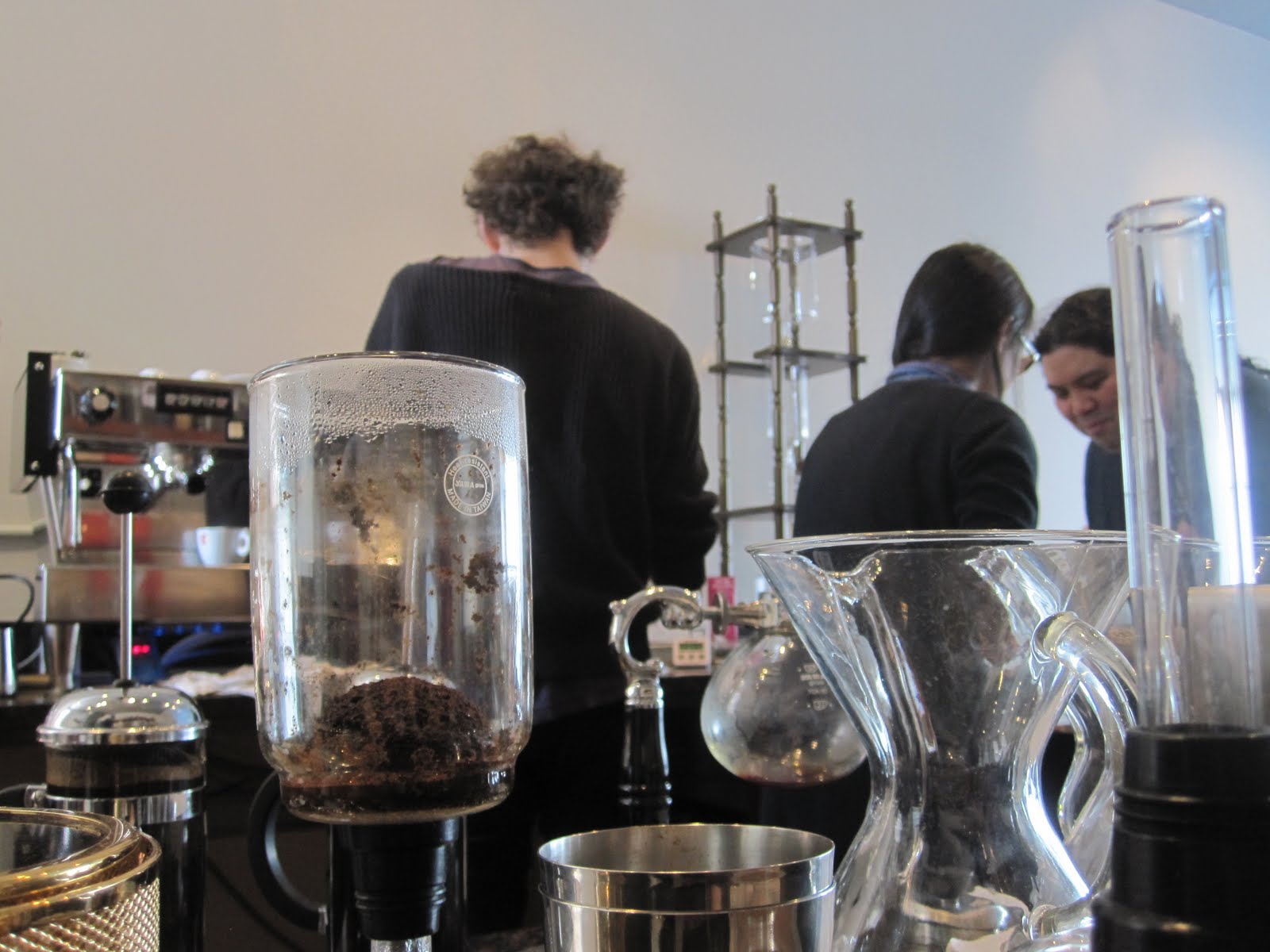
Testing and vetting brew methodologies, January 2010.
Lately, I've been thinking that it's time for me to start up a restaurant. A restaurant that can seat about 30-40 people and turn roughly 200 covers on a busy service. Without a doubt, it should be cutting edge, comfortable, casual but with serious ingredients and a serious approach to quality and service. I want this new restaurant to be the best restaurant in my city.
To achieve this, I'm going to find a local supplier of restaurant equipment and produce and ask for their help. I'm going to buy the best equipment available, like a Jade cooking suite and maybe even some equipment for sous vide and molecular gastronomy.
Problem is: I'm not a "chef." But it's all good because both the guy selling me my Jade suite and the local farmer selling me super quality heirloom tomatoes are going to teach me how to use the suite and cook the food properly. In just a few days time, these people are going to teach me and my employees how to make and run what will easily become the best restaurant in the city serving high-quality food product. It's going to be awesome!
If you're reading this and thinking "this guy must be smoking crack cocaine" then you'd be right. For anyone to invest the kind of money it takes to get a business going and then expect their equipment and produce people to teach them how to cook and run a restaurant is absolutely preposterous and foolhardy.
Yet, day in and day out, people get in the coffee business expecting their coffee roaster to teach them how to become a "barista" and be "the best" and make "quality" drinks.
At Spro, we do coffee. That is our core and our focus. We are Baristas. That is what we do. This is who we are. Why I would ever allow another company and another person from outside the company and our culture to come in and "teach" our team how to do what we do, is as preposterous as me starting a restaurant and asking my Sysco rep to teach me how to be a "chef."
We have a culture. We have an approach. We have a way of doing things that is uniquely different than others. While other baristas rely on their coffee roaster to tell them how to brew coffee, pull shots, make drinks and cup profile, our baristas do it themselves. They cup the coffee samples, they cup the new arrivals, they help create the descriptions and they know their coffees.
We teach our own on how to tamp, pull shots and prepare drinks. We teach our own on our culture and our approach to hospitality and service. Our team tests and vets brew methodology. We develop and train. We learn how to make everything by hand, as a craftsman should.
The road to becoming a Spro Barista is long and difficult. There is a lot to learn - much more than can be taught in a couple of days with some roaster "customer service representative" - who, chances are, either doesn't have real world barista experience or has been away from cafe service for so long that I question their suitability to teach modern coffee production techniques.
Truth be told, I don't encourage so-called "Third Wave" thinking. I don't encourage "rock star" worship I see in many other baristas. I don't even encourage competitions. I should note that I don't discourage those areas either (except the "third wave" thinking part - I truly abhor "third wave"). And while I don't encourage and don't discourage, I would be supportive of any Spro Barista that desired to engage in those areas of the industry.
What I do encourage and support is craftsmanship and hospitality. Our focus is not somewhere out there in the pretense and condescension of "third wave" or in the hype and fallacy of barista competitions, it is here on the home front and making great coffee day in and day out for our guests. We make coffee and provide a warm, nurturing environment - one that must come from within and one that cannot be outsourced to a third-party company.
It's time that those who desire to call themselves "baristas" and "coffee professionals" break away from this fallacy that your coffee roaster can make you and your people "baristas."
Friday, June 24, 2011
Why Didn't I Think Of That!

Cuppers pondering their future.
Regular readers of this blog know that despite the fact that I travel around the world training baristas, judges and judging barista competitions (in addition to having been a competitor myself), I find watching coffee competitions to be insanely droll and boring to watch.
At the SCAA Houston a couple of months ago, the coffee powers that be created a new competition called the Brewer's Cup (or something silly like that). I had the opportunity to watch one competitor (a friend of mine) in the first round and was gobsmacked that someone somewhere had (incredibly) found a way to design a coffee competition more mind numbing than the barista competition. Imagine watching someone brew coffee with all the narration and enthusiasm of grass growing and you've got a baseline idea of the misery purported upon those foolish enough to watch.
Of all the coffee competitions, one of the more interesting (from an audience perspective) is the World Cup Tasting Championship. Essentially, you have three competitors going head-to-head with eight sets of three coffee samples in front of them. The idea is that the competitor is supposed to taste the samples and determine the odd coffee amongst the three in each set. Do this with the most accuracy and quickest time and move on to the next round and perhaps become the champion.
Depending on the coffee and depending on how it's brewed (as well as other factors), different coffees can actually look different. But it's a cupping competition and everyone is focused on tasting the coffees and using their palate to discern the differences.
Somewhere far away from America, the little nation of Greece is in jeopardy of defaulting on its debt and causing the destabilization of the Euro and perhaps the worldwide economy. Maybe it's inspiration by his nation but the Greek competitor in the cupping championship has just destabilized the legitimacy and credibility of the World Cup Tasting Championship.
Instead of actually tasting the coffees, the Greek competitor simply looked at the three samples and quickly discerned the sample that looked different without tasting. Evidently, he identified all of them correctly. He did this in the First Round, which landed him in the Semi-Finals where he did it again which propelled him to the Finals and, finally, as World Champion.
All without ever tasting any of the coffees.
I think that would have been the most entertaining coffee competition ever.
Saturday, June 18, 2011
Handmade Totalmente

Two bottles of Gahara Vanilla Syrup starting their journey.
So far, 2011 has been a busy year. I've been back and forth to Central and South America, as well as southern North America several times. My times at home have been short and it wasn't until last month when I actually had time to slow down and return to my roots, so to speak.
In May, I was home for 22 days. Time to slow down. Time to focus. Time to work. Time to re-connect with my baristas and get back to what we do best. People think I'm lucky because I am given the opportunity to travel. I think I'm lucky because I return to a great team focused on making fantastic products for our guests.
For the past couple of days, after recovering from the haze that was the World Barista Championship in Bogota, Colombia, I've been working in the bowels of Spro working with ingredients, tasting coffees and whipping up new batches of handmade this and that. I've been back on the farmers market circuit seeing what's new and available, and planning new menu items for the heat of summer.
It brings me back to the aspect of barista that I like the most: preparing everything handmade. I'm happy to say that nothing at Spro is commercially processed. We prepare everything in-house or work with purveyors who share our same passion for doing things "the hard way." From making the coffees individually to order to the handmade syrups to the traditionally made agua fresca to the quirky take on classic sorbets whipped up in the PacoJet. Everything is sourced thoughtfully and carefully. Everything is tasted and vetted before we present it to our guests.
I'm fortunate to have the opportunity to travel the world, work with baristas and judge barista competitions. I meet wonderful people and make incredible friends. But at the end of the day, I find myself inspired most by the very people I work day in and day out - the team at Spro.
Thursday, May 19, 2011
And Sometimes I Fail
I'm big on customer service and working to provide the guest with a great experience every time they visit one of our locations.
And sometimes I fail.
Yesterday, I failed in a major - looking like a complete asshole kind of way.
I've been running my own little company for twelve years now and I've made just about every customer service mistake one person could make. I've yelled at customers, argued with customers and kicked customers out - sometimes in a very fiery and spectacular fashion.
Maybe some of those times I was in the "right" on the matter and the customer/guest/visitor transgression was met with a commensurate response that could be completely justified - meaning that I was "right."
However, there has never been an incident where, after cooling down, thinking about it and analyzing the situation, I have ever felt that it truly was the right way to handle the matter and that I couldn't have responded better, and won out with aces.
The situation was this: I'm standing in a walkway chatting with a long-time guest whom I haven't seen in months when an elderly gentleman walks between us (there's about three feet between the guest and I). Instead of the usual convention of saying "excuse me", the elderly man gruffly tells me to get out of the way and makes a disparaging remark on my tummy. At first, I didn't catch his meaning but the snideness of his manner just tweaked me enough to press it a little farther.
Now, it's later in the day (about 4pm) and I had just come to the location to drop off some supplies after spending the morning at the roasteria repairing the roaster and the afternoon in the garden planting tomatoes. So, by this point, I'm looking pretty disheveled: my hair is messy, I'm wearing work boots and probably look slightly grimy from planting the garden. In other words, I look like a laborer.
I press the guy a little on his meaning and he still comes at me with the disparaging remarks. Usually, I don't let these kinds of people bother me but today, I'm in that mix of being tired and dirty from working and slightly irritated about a variety of things, meaning that when this guy comes at me, I lose perspective and become confrontational.
You know, why the guy didn't just do the polite thing and say "excuse me" or "excuse me, but you're in the way", I don't know. Maybe he was having a bad day or maybe he just thought that I was some (to his mind) piece of shit Hispanic laborer that didn't deserve the general respect and courtesy that he would give to other white people (I note this because the guest I had been talking to is white and the guy didn't address him and singled me out).
Whatever the case may be, it started out poorly and went all downhill from there.
Come to think of it, the guest and I were talking about the piss poor ways that the SCAA and WBC treats their volunteers and judges - a subject that always irritates me - and probably was the catalyst (on my end) for the degradation in handling the matter.
I don't remember the specifics but it wasn't pretty. I did not handle myself in the manner that I desired. I was the offended party who thought he deserved justice. Regardless of who was "right", I still ended up looking like an asshole. Not only to the elderly man without manners but, more importantly, to the other guests that were in the house at the time.
I'd like to think that I was justified. That I was "right." I stood up and didn't take prejudiced crap from some jerkoff. But in the end, like every time before, I don't feel that it was the "right" thing to do. I handled it poorly and engaged that elderly man in the manner that he engaged me. I didn't elevate the interaction. I didn't improve upon it. I helped degrade it. And that, to me, is a Failure.
I often talk about hospitality and leadership. That an environment of hospitality and quality can only be maintained if it is strongly demonstrated by the leadership. I'm embarrassed and ashamed that I failed so poorly and brilliantly as a leader during this incident. In front of staff, guests and passers-by. That kind of interaction can only give people a poor impression of who we are and what we are about.
Hospitality is easy when things are running smoothly and everyone is happy. The real test is when you're met with someone as grumpy and rude as that old man. Granted, I wasn't working the bar but anytime that I step into the scene, I should always be "on" and not running in cruise mode. What I should have done was dropped off the delivery and gotten the heck outta there. I had just come from working in the garden so I looked terrible (and probably smelled funky). I wasn't prepared for the "show" that we like to give to our guests.
I just hope that the next time I'm faced with a challenging guest, I'll have more clarity to handle the situation better.
Subscribe to:
Posts (Atom)