Showing posts with label business. Show all posts
Showing posts with label business. Show all posts
Tuesday, August 20, 2013
The HTF Conundrum
This post probably will not come off well-constructed nor will it have any conclusions - mainly because it's something that I'm still thinking about and trying to figure out myself, but it's been on my mind for the past few years.
In the coffee business, we give a lot of lip service about how we do "direct trade" or want to do "direct trade" or how we are "helping the farmer" and all sorts of "Do Good, Feel Good" kinds of things. We boast about how we are paying "higher prices" for our coffee and how that's "making a difference" in the lives of the poor, lowly campesino toiling on the soil and under the sun to produce our award-winning coffee that retails for sixteen bucks (and up) per pound.
Throughout our business (and especially in our niche of "high end" specialty) we can peruse all sorts of media - brochures, product sheets, websites, blogs, facebook pages) of us mugging and posing at the farm, with the farmer, holding the beans and pretending to do any and all of the coffee processing - from picking the cherries, lugging the bags, raking the parchment - and of course, there's the de rigueur shot of someone from the company pondering carefully and intently about the beans he/she is holding.
We know that our efforts have not gone unnoticed because we're now seeing "the big guys" starting to do the same - and it's not just those old school darlings, Fair Trade or Rainforest Alliance. Recently, an executive of worldwide coffee operations for a very large hospitality organization told me that they too were looking for that "compelling story" - because that's what their guests are looking for - especially with the recent trend of everything "Farm To Table". "Seasonal Direct Trade Farm To Cup" - it's what's chic in the today's world.
To be honest, I'm probably as guilty as everyone else. I've been to origin. I've been photographed while posing with that basket pretending to collect beans off the tree. Truth be told, I wouldn't last an hour picking coffee cherries. That's hard work. And when I'm in Nicaragua, I'd much rather be drinking Flor de Caña and eating paella at Taska Kiko in Managua than toiling under the sun in Nueva Segovia (though I have been facebooked doing both).
Third Wave Types love to pay what seems like a lot of money for their coffee. We brandy about our green prices like a badge of honor - as though we should be lauded because we pay so much for this and you only pay that little for your coffee. Each of us is looking for the hot new coffee that's going to set the industry on fire, intent on being the first person to bring the new Esmeralda to market. To this effort, we flit and flirt around from year to year buying a little of this and a little of that. "Only the best of your crop, please." The rest is rubbish that isn't fit for my ancestor's slaves.
And next year, when that same farmer toils under adverse weather conditions or roya? Adios, burro. You don't have that purple jade green beauty we're looking for. I mean, afterall, your coffee is only scoring an 82 and I'm a 90 plus kind of roaster. Especially because I'm good-looking, wear ironic eyeglasses and don a retro-rockabilly look. My loyalists would be aghast for me to deliver a coffee so, common...
Through all this I've constantly been wondering: To what end? To what end are we doing all of this? We talk about "helping the farmer" but what does this mean really?
I'm from America. Born and raised. The American Way. To my mind, when we talk about "helping" someone, I presume we're talking about The American Dream: to lift oneself from their current position. To help ensure that our children will have a better life and a better future - one different and better than our current station. This is what I presume when people say we're "helping the farmer" and this is what I think most people presume too.
But is this the reality?
If the average Central American coffee farmer (that small plot holder we're thinking about) makes only about US$2,500 per year (which is far lower than the lowest paid barista in America), is that enough? Is that enough for this couple, with maybe three children, to pull themselves out of poverty and move their children up the Food Chain? Or are they destined to remain at their station - in the lower classes of their societies?
Deliver us great quality and we'll pay more, you say? How? If we presume that the average coffee farmer is operating at a subsistence level, then how can they afford to do any of this? How can they learn new techniques? Go to a class? Can they afford that class? Can they afford that raised bed dryer? Can they afford to do anything but just barely grow their coffee and send it to the beneficio (processing mill)?
Conversely, there's the producer Rock Stars. You know their names. They're the ones you see touring America (and other first world nations). They're US or European educated, smart dressing and part of their nations' elite. Their coffee is typically the most lauded in the world and they've got the savvy, the education, resources, connections and money to make that happen (and command the greatest prices) year after year. We all know them. They're my friends too. And we all want to pose for pictures with them - to show our public just how "real" we are about coffee. When your family already owns hundreds of hectares of land and you're invited regularly for events at the presidential palace, are you the kind of coffee farmer that really needs "help"?
What about events like the Cup of Excellence, you say? They demonstrate the best coffees of any country for that year and those coffees command tremendous prices. Certainly that's gotta be good for the campesino! Agreed. The CoE is a great event, has done good works and delivers great coffees. That 2011 CoE Lot 19 Nyakizu Rwanda I bought is fantastic, but is it repeatable? Jon Lewis will probably correct my data but a trusted friend related to me last weekend that no farmer has won the CoE Peru more than once, asking the question: if these winners actually have the knowledge and formula to sustainably produce great coffees year after year (and raise their revenue and lifestyle), or are these one-off, one-hit wonder flukes?
I know I've hit on a number of different topics here and I'm offering no answers, definitions or solutions. I don't know what or if there is a "solution". Maybe it just is what it is. But I do think that this is part of a discussion we should be having in our industry - questioning our motives and our goals when we say we're "helping the farmer".
The comments section is open for discussion.


Thursday, August 02, 2012
Beating Homogeneity Out Of Iced Coffee

Just yesterday I was mentioned in a blog post about Iced Coffee and Cold Brews. For those of you not following the coffee biz it's been a heated topic for the past few months with various people arguing about which iced coffee brew method is "best" - as though there has to be one magical brew formula that bests all others.
Quite frankly, I just think it's a load of hogwash.
All across 3WCoffee people with the intention of proving that they're "right" because they've used some sort of psuedo-scientific method or newfangled electronic device that tells you that their technical numbers are "right" and that number means that your drink is "awesome." And they haven't even tasted it yet.
It's as though there's some sort of campaign to get everyone to brew the same way.
Which leads to the question: do I think that the methods we use at Spro are superior to the others? The answer is: of course! Otherwise, we wouldn't be serving coffee in that manner.
Do I then want everyone else to brew and present coffee the same way we do? Absolutely not - that's just ridiculous.
What I want to see when visiting coffee places is vision and interpretation. Sure Mad Cap and Spro can buy the Ardi green coffee from the same person and have the same coffee from the same lot, but do I want the two coffees to taste exactly the same? Gosh, what fun would that be? That's about as exciting as a tour of DC coffeehouses where the coffee is the same everywhere.
I want to experience the interpretation and the nuance as offered by that barista or that shop. Give me something different, interesting and exciting. And for God's sake, taste the coffee instead of running it through some machine!
Is that to say that we expect our way of brewing to be the do-all, end-all for all people? Well, that would be nice. But I accepted many years ago that what we do will not be the right fit for all people. We're making coffee to our vision and to our tastes. We want people to experience our interpretation of coffee - hopefully, they find it as interesting and exciting as we do, but sometimes they do not.
Some people dislike the way we brew iced coffee and that's okay. There are plenty of places brewing coffee in a different manner that they might find more appealing. But all of this argument, discussion and banner waving about whose method is "best"? That's just malarkey. Taste is what determines what is "best" and we let taste be our guide, and I hope you do too.
Because my guests don't come into Spro bearing measuring devices looking for some magic number, they actually drink the coffee.
Wednesday, March 07, 2012
On Being The Boss
Every once in a while, a friend or someone I know will ask me about the challenges of running your own company and how I deal with things. To most people, the idea of running your own company, being your own boss and answering to "no one" is a lovely fantasy free of the stresses of working as an employee.
They ask me: "What's the most difficult thing about being the boss?" Truth is, it's all difficult. There is no rest for the weary. When you run the ship, it's a 24/7/365 job. There is no break. There is no vacation. There is no escape. It's all encompassing and all consuming.
But a recent turn of events has brought the real challenge of being the boss to the forefront of my mind. And that is: maintaining calm in the midst of a storm.
Regardless of what's happening in your personal life, your home life or the world outside, regardless of the personal challenges you may be facing at any given time, everyone around you, staff and guests, needs to know that you are in charge and that you have a plan.
It means that you must remain focused and calm. Steady and assured. Even when things are going completely pear-shaped. You may not have a clue what is going on. Your whole world may be in shambles, but you can never let on. No one wants to see the Leader falling apart. It's the ultimate Fake It till You Make It.
And it's one of the few times when you actually question if all of this was worth the sacrifice.
Saturday, August 20, 2011
100g of Calibrating Power

One of the coolest things I picked up yesterday at the gem show was a calibration weight. Perfectly tuned to 100 grams, this weight is used to calibrate your scales and make sure they're in sync.
At home and at work, I use gram scales all the time and the gem show is one of the few places where I can go, buy a gram scale and not have funny or "knowing" looks between me and the person selling me the scale. In America, it seems that the only people using gram scales are gem dealers and drug dealers. In a way, they're all scam artists selling highly addictive products.
Come to think of it, baristas, jewelers and drug dealers all seem to have this in common. Go figure.
And, as any dealer (drugs, gems or otherwise) will tell you: we live and die by the scale, so it has to be accurate and on the money. A couple of grams off and you're talking profit or loss. In the millions. So, a calibration weight is a handy tool.
Some of our scales have been in constant use for nearly two years now. They're dropped on the floor, plopped into drawers, tossed around, slammed around, weigh continuously and are subject to a wet environment. I was almost sure that one of them would be off but when I placed the weight on the scales, they all read "100" grams.
Even the new scales I picked up yesterday were on the money - though the one that weighs to the hundreth of a gram measured "100.12" grams. Hmmm, I'm starting to worry about that .12 gram.
I'm now on the lookout for a proper Bentley so I can join the ranks of dealers worldwide.
Thursday, August 04, 2011
Kiddie Sized Perfection

Kiddie sized chocolate snowball with marshmallow.
I guess this is one of those signs that an era has truly passed.
We closed down main operations of Jays Shave Ice at the end of 2006. For the next four years, Jays Shave Ice operated during the Artscape festival in downtown Baltimore. 2011 was the first Artscape that we missed in eleven seasons. I was just tired.
The company is still technically called "Jays Shave Ice" but the shave ice component is no longer our focus. And while we've been focused on coffee for nearly five years, I knew that a turning point had been reached when I stopped by a friends snowball stand for a yearly taste of the flavors I had known for so long.

The perfect way to enjoy vanilla soft serve.
Quite simply, after you've operated a well-regarded shave ice company, most of the stuff that passes as snowballs and syrup just isn't up to scratch. Everywhere I turn this summer it seems that I'm surrounded by people serving a lower quality product that isn't fit for consumption. I know that's a bit of an arrogant thing to say but it just tastes terrible.
Hence my stop at Kavern's Tastee Zone in Catonsville during my market tour this week. Here the ice is shaved and fluffy. Not as fluffy as our old product but as close as I'm going to get without hauling out the gear and doing myself. I sat there and made a little glutton of myself.

A kiddie sized canteloupe snowball. Lovely.
A kiddie sized chocolate with marshmallow - originally a combination I thought was disgusting, it wasn't until about 2002 that I really got into it after trying it one cold winter. For me, everything is a kiddie size. I never ate the medium or large shave ices we made, it was just too much. A kiddie size was perfect, just a little bit to when the palate and satiate the desire. Today, much of the same.
Between courses was a cake cone just barely filled with vanilla soft serve ice cream. That was truly my secret delight. Just enough ice cream to fill the cone. A balance between crispy cake cone and icy vanilla dairy. Perfection.
Lastly, a kiddie sized canteloupe snowball. I don't know why, but canteloupe become one of my personal favorites. I had to have it.
And that was it. Just a few bites and I was on my way once again. Until next year...
Wednesday, August 03, 2011
Killing Myself By The Numbers

Losing my mind in a sea of numbers.
Sometime today I started to lose it. Calculating the various details and expenses of each menu item was starting to get to me. All around me a cacophony of activity carried on. Prepping, cooking, washing, cleaning, the clomp clomp clomp of people going up and down the stairs, the acrid aroma of roasting garlic, footsteps above my head signaling the continuous stream of guests coming and going, the high-pitched squeal of the espresso grinders, the dull clunk of portafilters hitting the knockbox and I'm sitting there trying to figure out just how much that teaspoon of piquin pepper adds to the cost of the terrine.
Somewhere out there sits a smug, crisply pressed white jacketed chef with a binder filled with perfectly calculated menu item costs. Each item is perfectly accounted for, by ingredient, to the gram, to arrive at a precise and logical menu price. Someday, I would like to meet this person and slap him with my HAACP binder (presuming that I someday actually finish writing it).
It's been a busy week. Tomorrow, after two years of thinking about it, we're launching a food menu at Spro Hampden. Nothing too fancy or out of control, just some nice and solid items composed of fresh, local and healthy ingredients. Since Cynthia decided to close Soup's On across the street, Lauren has decided to come join us and bring forth our vision of food for the people.
Longtime readers of this blog might be expecting a menu heavily laden with fattening meats and cheeses and gobs of Mexican dishes. This outing is a bit more delicate than that. Light and fresh items that are thoughtfully sourced without being too precious or pretentious.
It's been a hectic day of calculating costs, sampling menu items and rushing to get everything done and prepped before the 7pm menu tasting with the entire Spro Hampden staff. Add a big bottle of Belgian ale, an assortment of chicken salad sandwiches and the entire menu and it makes for a nice evening before tomorrow's storm.
Menu starts tomorrow at 11am.
Thursday, May 19, 2011
And Sometimes I Fail
I'm big on customer service and working to provide the guest with a great experience every time they visit one of our locations.
And sometimes I fail.
Yesterday, I failed in a major - looking like a complete asshole kind of way.
I've been running my own little company for twelve years now and I've made just about every customer service mistake one person could make. I've yelled at customers, argued with customers and kicked customers out - sometimes in a very fiery and spectacular fashion.
Maybe some of those times I was in the "right" on the matter and the customer/guest/visitor transgression was met with a commensurate response that could be completely justified - meaning that I was "right."
However, there has never been an incident where, after cooling down, thinking about it and analyzing the situation, I have ever felt that it truly was the right way to handle the matter and that I couldn't have responded better, and won out with aces.
The situation was this: I'm standing in a walkway chatting with a long-time guest whom I haven't seen in months when an elderly gentleman walks between us (there's about three feet between the guest and I). Instead of the usual convention of saying "excuse me", the elderly man gruffly tells me to get out of the way and makes a disparaging remark on my tummy. At first, I didn't catch his meaning but the snideness of his manner just tweaked me enough to press it a little farther.
Now, it's later in the day (about 4pm) and I had just come to the location to drop off some supplies after spending the morning at the roasteria repairing the roaster and the afternoon in the garden planting tomatoes. So, by this point, I'm looking pretty disheveled: my hair is messy, I'm wearing work boots and probably look slightly grimy from planting the garden. In other words, I look like a laborer.
I press the guy a little on his meaning and he still comes at me with the disparaging remarks. Usually, I don't let these kinds of people bother me but today, I'm in that mix of being tired and dirty from working and slightly irritated about a variety of things, meaning that when this guy comes at me, I lose perspective and become confrontational.
You know, why the guy didn't just do the polite thing and say "excuse me" or "excuse me, but you're in the way", I don't know. Maybe he was having a bad day or maybe he just thought that I was some (to his mind) piece of shit Hispanic laborer that didn't deserve the general respect and courtesy that he would give to other white people (I note this because the guest I had been talking to is white and the guy didn't address him and singled me out).
Whatever the case may be, it started out poorly and went all downhill from there.
Come to think of it, the guest and I were talking about the piss poor ways that the SCAA and WBC treats their volunteers and judges - a subject that always irritates me - and probably was the catalyst (on my end) for the degradation in handling the matter.
I don't remember the specifics but it wasn't pretty. I did not handle myself in the manner that I desired. I was the offended party who thought he deserved justice. Regardless of who was "right", I still ended up looking like an asshole. Not only to the elderly man without manners but, more importantly, to the other guests that were in the house at the time.
I'd like to think that I was justified. That I was "right." I stood up and didn't take prejudiced crap from some jerkoff. But in the end, like every time before, I don't feel that it was the "right" thing to do. I handled it poorly and engaged that elderly man in the manner that he engaged me. I didn't elevate the interaction. I didn't improve upon it. I helped degrade it. And that, to me, is a Failure.
I often talk about hospitality and leadership. That an environment of hospitality and quality can only be maintained if it is strongly demonstrated by the leadership. I'm embarrassed and ashamed that I failed so poorly and brilliantly as a leader during this incident. In front of staff, guests and passers-by. That kind of interaction can only give people a poor impression of who we are and what we are about.
Hospitality is easy when things are running smoothly and everyone is happy. The real test is when you're met with someone as grumpy and rude as that old man. Granted, I wasn't working the bar but anytime that I step into the scene, I should always be "on" and not running in cruise mode. What I should have done was dropped off the delivery and gotten the heck outta there. I had just come from working in the garden so I looked terrible (and probably smelled funky). I wasn't prepared for the "show" that we like to give to our guests.
I just hope that the next time I'm faced with a challenging guest, I'll have more clarity to handle the situation better.
Wednesday, April 06, 2011
Coffee Obsessive
I'm currently stuck in Mexico City after a mechanical problem with the airplane forced a two-hour delay, missing my window to connect on a flight back home to Baltimore. Granted, if I'm going to be "stuck" anywhere, Mexico City is about as ideal as it gets.
To my own surprise, this blog was mentioned in the article about me and my little company, Spro Coffee, in Baltimore. For those of you visiting us from the Washington Post: welcome.
I first was introduced to Martha Thomas about nine months ago in June 2010 where I received a phone call during my trip to London for the World Barista Championship. That's where the article you read in the Post all started. Over the next nine months, Martha and I would chat on a regular basis regarding the article and she came in several times to see just how we do what we do in our little shop in Hampden.
Martha joined us for a cupping with Joan & Ralph Gaston of Rusty's Hawaiian Ka'u Coffee where we sampled a range of coffees, including samples grown by Lorie Obra (Joan's Mom) - who is an amazing scientist turned coffee farmer on the Big Island. Martha later joined us in a demonstration on how we select a brewing method that "pairs" with a particular coffee. It seems that in the translation of the article, a little bit of both events were mixed together.
As with any article written over a long period of time, some details may have been a little jumbled with the passage of time. I wanted to take a moment to clarify some of the details:
- A visit to Anthony Rue's Volta Coffee & Tea in July 2009 was instrumental to the direction we decided to take Spro Hampden. Had it not been for Anthony, our approach of multiple brew methods throughout the day might not have happened. If anything, we might have ended up "cheating" like many shops in the country by batch brewing coffee during the morning "rush" instead of taking the time to prepare each cup by hand.
- Much of what we do is inspired by others. Almost nothing is truly original. From Ichiro Sekuguchi of Tokyo's Cafe de L'ambre to John Sanders of Origins Organic Coffee, Spike Gjerde of Woodberry Kitchen, Aki & Alex from Ideas In Food, and fellow baristas like John Lewis - all and more have had an impact on me and the way we approach and present our coffees.
- In the article I'm quoted as saying: "We have no loyalty to any one roaster." Honestly, I don't think I ever said that - especially since loyalty is something central to what we do and own approach to doing things. As a company, we're very loyal to our vendors. We maintain long-term relationships with all our vendors. A great example of this is Origins Organic Coffee. We've been buying their coffee since 2004.
What I did say is that we do not maintain roaster exclusivity with any one roaster. In the coffee business, the typical model is for a retail shop (like Spro) to purchase all their coffees from one coffee roaster. It's a limited way of doing business that is slowly eroding in these modern times (although one of our original six roasters, Counter Culture Coffee of Durham, NC recently told us that they would no longer sell to Spro for three reasons, one of which was that they were returning to the roaster exclusivity model).
Roaster exclusivity is simply ludicrous. It's akin to walking into your local pub and only finding one brand of beer or alcohol. We are unable to do business with companies that insist on roaster exclusivity and we're very appreciative of the companies who started with us and believed in supporting our approach - and those companies are:
Origins Organic Coffee - Vancouver, BC
Barefoot Coffee - San Jose, CA
Ecco Caffe - Santa Rosa, CA
Stumptown Coffee - Portland, OR & New York City
Intelligentsia Coffee - Chicago, IL
- In the article, Ryan Jensen (owner of Peregrine Espresso in Washington DC) cautions about claims of singularity. While our model of multiple roasters, multiple coffees paired to multiple brewing methods, made by hand, day-in and day-out, is still the only one in the industry, I certainly hope that this anomaly is short-lived.
Seriously, Spro Hampden can only make so many coffees per day and we can only impact a small segment of the coffee drinking public. For our notion of quality coffee prepared without compromise to be tasted by the larger public, more shops have to take our approach. We cannot and do not want to be the only kid on the block serving our kind of coffee.
However, to do what we do takes a certain level of commitment and skill. Ryan Jensen has both of those and with his opening of a second Peregrine in the coming months, I'm hoping we'll see a more in-depth approach to their coffee program - because I think he's the best coffee operator in The District.
- The article mentions my judging experience. While I have judged barista competitions across North America, Central & South America, as well as Africa, I have not judged a competition in England. My visit to London last summer ended up with me as a spokesperson for Reg Barber Enterprises during the World Barista Championship.
From 2004-2007, I served as a volunteer director on the Executive Council of the Barista Guild of America. I have also served as a volunteer for the United States Barista Championship regional competitions and as a volunteer trainer for the Specialty Coffee Association of America. And in three weeks, I will serve again as a volunteer panelist speaking on multiple brewing methods in a cafe environment at the SCAA's annual trade show in Houston. I will be one on a panel with Anthony Rue (Volta), John Piquet (Caffe D'Bolla), Kyle Glanville (Intelligentsia) and Tracy Allen (moderator).
So, despite my criticism of the SCAA, I'm still willing to support and help out when I feel that I can lend something of value.
Well, that's about all I have. It's humbling to be written about in the Washington Post and I'm truly honored, but much of the credit goes to the people around me. My staff of baristas are some of the best baristas I've ever known and worked with, they ply our craft with humility and honesty in an unassuming manner absent of pretense and condescension. My non-coffee friends and family keep me grounded. My mentor, John Sanders, who has been instrumental in my learning of coffee and sense of duty to get involved in our industry. And many thanks to my friends in and around the business, without whom I never would have done what we do.
And of course, thanks to Martha Thomas for noticing and taking interest in what we do to take it to the Post. She's been fun and easy to work with and I wish her the best in her writing career. Same goes to the editors, staff and Marvin the photographer from the Post. Always professional and always easy to work with.
Thanks to all of them and thanks also to you for reading the Washington Post article and then this lengthy blog post (btw, I write about more than just coffee here). I hope you'll find your way to visit our little shop in Baltimore (or at least your local specialty coffee purveyor) where we look forward to making you a cup of coffee in a manner we hope you will enjoy.
Best regards,
Jay
Mexico City
6 Abril 2011
Thursday, March 24, 2011
1 Year = $14 for $1

abc2new's Charley Crowson lines up an interview.
Over the weekend on Saturday we celebrated the One Year Anniversary of Spro Hampden's opening. It's been a fun, exciting and educational year for us. We've been learning how to manage multiple locations, manage a wide array of great coffees from many different roasters, and we've constantly been refining our service and preparation techniques.
Along the way, we've made some great friends and generally have enjoyed a great time over the past twelve months.

Ordering from the Anniversary Menu.
To mark the date, we brought in a selection of coffees from Filadelfia Estate in Guatemala, Cafe ZaJay in Veracruz, Mexico, Four Barrel in San Francisco and the Aida's Grand Reserve from El Salvador - all for just One Dollar a cup!
You know, because One Year means One Dollar, so for the ten year anniversary all coffees will cost ten dollars!

She's a St. Bernard!
Predictably, the AGR sold out within the first 90 minutes. I mean, here's one of the most celebrated coffees that our customers have seen on CNN.com and they've heard the hype but just couldn't or didn't want to spend $14 on a cup. Now they can come and get it for a buck - half the price of our normally cheapest coffee??? That's crazy! And we blew through the remaining inventory with record speed.
It was a good day with many of our friends, regulars and well-wishers stopping by to see what was on offer. And when the Anniversary Coffees ran out, we ran the Brazil Samamobaia as the Anniversary Coffee so that everyone could have the opportunity to try amazing coffees for a dollar.

Lindsay oversees her last day.
Also, it was Lindsay's last day with us so we gathered at the midday shift change with a chilled bottle of Ketel One and toasted to her future.
All in all, it was a nice way to cap off our first year at Spro Hampden.

Shots of Ketel One to celebrate and bid adieu.

Shots.

Hugs.
Tuesday, March 22, 2011
Bright Lights, Big City

The lights of the studio shine down upon us.
It's 6:30 in the morning and both my alarm clock and iPhone are honking. For some reason, I always feel tired before media appearances, no matter the media. This time, it's off to Channel 2 for an appearance on Good Morning Maryland and I need to shower and get myself ready.
It's nice to be recognized by the media and it seems that every time we offer the Aida's Grand Reserve we garner more media attention than usual. There's something about a pricey cup of coffee that catches peoples attention. Last year, it was the $13 Grand Reserve that brought us to CNN.com and this year it's the $14 Grand Reserve that's brought us to Good Morning Maryland.
No matter how you slice it, we've brought quite a bit of mainstream media attention to Aida's Grand Reserve.

Getting ready to go live.
Way back when I started out in The Business (and way before I ever thought about coffee), I did live television. While not for some people, I like live television. There's something exciting and almost out of control about live television - as though things are just on the verge of crashing and burning. Sure ENG, episodic or feature work is fun, but few things are as exciting and challenging as live television - especially when something goes wrong.
My package is early in the 9am broadcast and I'm the first setup on the set. For the live demo, I've brought along some of the Grand Reserve, a water kettle and a vac pot setup. While the vac pot is how we actually brewed the AGR at Spro, I chose it for the broadcast because it's unique, sexy and theatrical. Nothing like some sort of contraption that's part bunsen burner and bong to capture the viewers attention.
One of the problems with the butane heater is that I can never really tell when it's going to go out. I tried topping it off with a canister but I'm still not confident in its veracity. As a backup, I bring along a Beehouse pourover setup, just in case.
Live on avi...
If you've ever worked with cameras you'll know it's a bit strange to be in a quiet studio, looking at the black lens and speaking naturally and normally. In the studio, it's quiet and it feels weird talking to a camera. There's no audience feedback. There's almost no noise at all.
You just have to imagine the reality: that beyond the lens, there are literally millions (or hundreds of thousands) of people watching you right now. They're watching everything you do and everything you say. Scratch your butt and your nieces laugh at you. Say something stupid and your mom's friends are calling her. Drop a revelation about President Obama and you could be going national. Otherwise, it's just a bunch of talking to a camera lens and you really don't know anything else.
For the most part, I spent those television years working behind the camera, as operator, technical director, director or producer. Once in a while, I would do a stint as the on-air "talent" and talk mindlessly into the lens. On the technical side, things sometimes seem like they're dragging on forever - especially when things go wrong. Not so much on the on-air side.

On the abc2news set.
When you think about it, three and a half minutes doesn't seem like a lot of time but on television, it's quite a bit of time. Compare that to the typical motion picture that takes about two days to shoot 3.5 minutes worth of footage and you can see that three and a half minutes can be quite a bit indeed.
A vac pot takes about one minute thirty seconds to brew. Two minutes is ample time, as long as everything is prepped. As we moved to the package and closer to air, I made sure the kettle was boiling, filled the vac pot and hit the gas on the burner. It looked strong and I was as ready as I would ever be.
But the kettle had to go back to its cradle on the floor at my feet, so when you see me going down as we go live, I'm actually putting the kettle back. Drats.
Three and a half minutes seems like a long time but when you're actually doing it, it blows by at an incredible rate of speed. I really don't remember what I said and some people have asked me if I was scared to be on television because I looked a little stressed. Truth is, I wasn't stressed to be on television, I was stressed because the water was not boiling and the flame on the burner was dying. Crap.
These are the moments when you Do or Die. Freeze and fold? Or charge. Luckily, I had the pourover at my feet, so I bent down again to grab it and the water and kept on rocking. I still don't remember what Charley and I were talking about, I was just concerned about finishing the demo and made some comment about Julia Child and her souffle.
Finally, I got the coffee finished and off to taste. I tasted it after we went to break and it's was okay. Not as rounded and developed as it would be at Spro - but considering that I poured it hard and rushed the extraction, it wasn't bad.
Next time, I'm going to have to bring an assistant and a stylist.
Thank you, Julia Child.
Thursday, March 17, 2011
Pissing Off The "Gods" Of Coffee
I received a rather interesting phone call today.
It was an industry friend calling to tell me that the coffee company he works for no longer will sell my company coffee.
Turns out that the company he works for is unhappy with the way we have been representing their coffee at The Spro. The company? Counter Culture Coffee.
Evidently, there are three reasons why they no longer will sell to us:
1 - They are unhappy that we started serving the Aida's Grand Reserve in February.
2 - They say Aida Batlle (the producer) is unhappy that we are serving her coffee.
3 - I have made disparaging remarks about Peter Giuliano (SCAA President and CCC owner).
There were a couple of other minor issues that were also included in the discussion (I'll go into those later).
For sure, Numbers One and Three are all true. We started serving the AGR on Valentine's Day after freeze storing it since we received the coffee in late September/early October. And I have been very critical of Peter Giuliano (as the SCAA President) of late - especially with the recent discussion on Barista Exchange (sorry, I just put the link to the thread, you'll have to scroll through to see the action - it's quite entertaining, maybe).
As for Number Two, I can only guess. We released the AGR the day that I left for El Salvador to volunteer my time judging their national barista championship, and I even sent a message to Aida that I was going to be in San Salvador and if she might have time to meet up for a visit. She said she was busy at the farm and that it wouldn't be possible. I figured that if she had a problem she would have said so - or maybe not.
To be honest, I'm actually surprised it took this long for Peter Giuliano to pull this one. I expected this to come much earlier since I have been quite critical of his handling of SCAA affairs over the past year or so.
Quite seriously, I don't really have a problem with this. It's what I expected and seems to be par for the course (you know, agree with us, or else). To my mind, any and every company has a right to sell (or stop selling) to any outfit it desires. They want to sell to us - cool. They don't want to sell to us - that's cool too.
Some of the other tertiary issues that were presented as reasons why Counter Culture no longer will to sell to us are that: a) CCC is moving away from the multiple roaster model and only wants to pursue the roaster exclusivity model (which is something Spro does not do), and b) we don't buy enough coffee.
"A" is a curious reason since a year ago they said that they wanted to pursue the multiple (non exclusive) roaster model. Maybe they've really changed their minds. Afterall, when a client uses multiple roasters, they're not buying all their coffee from one roaster and it's less profitable to that roaster. So note to those of you planning on opening a multiple roaster coffeeshop: Counter Culture is not interested in that model.
Of course, with Spro they don't have all the extra expenses of the exclusivity model. We don't ask or expect barista training, machine service or all the extras that roasters usually have to provide on a somewhat complimentary level. They simply sell us coffee at the price specified and we pay. We don't ask for anything extra or anything else - just quality coffee, at any price. In fact, the only time we take of their customer service rep is when he comes in to hang out, have a coffee and chat. We're very "low maintenance" - partly because we prefer it that way and also because we respect that with exclusivity comes those service "perks".
As to "B", I guess we don't buy "enough" coffee. From the opening of Spro Hampden through this week, we've only purchased about 400 pounds of coffee from Counter Culture, at a total revenue of just under $3,300.00 (at least that's according to our QuickBooks report).
Honestly, I can admit that it's not much. We're not the 300 pound per week account that roasters dream of claiming. We're a small coffee shop with a heavy focus on delivering a variety of quality coffees to a burgeoning coffee clientele. We source coffees from multiple roasters and brew each cup of coffee one-at-a-time.
But since they said that they're basing their decision to not sell to us based on the AGR that we offered starting on Valentine's Day, I thought I would have a statistical look at the numbers.
For the AGR, we purchased one eight ounce tin for a landed price of $26.95 - that's $17.95 for the coffee and $9.00 for shipping. This translates into .008281% of the money we've spent or .000152% of the poundage we've purchased over the past year with Counter Culture. Surely, for even a small company purchasing a small amount (read: not "enough") of coffee these percentages are a microscopic reason to tell us to piss off.
So, less than one percent of our purchases and less than one percent of our purchased weight in coffee and we're not representing their coffee properly? Curious.
Makes one kind of wonder if they hold such a hardline on their accounts that brew the coffee in airpots and let them sit around for who knows how long. Or the accounts with bagged coffee sitting around for a bit of time. I can only guess that those coffees account for more than one percent of those account purchases...
The interesting thing is that even during this period where I have been critical of Peter Giuliano, I had thought about discontinuing our purchasing from Counter Culture based on those criticisms. However to me, agreement is not a prerequisite for a relationship or doing business. Counter Culture offers some fine coffees that my staff was excited about and we continued purchasing their coffee because we felt that we could offer them to our clientele in a thoughtful and engaging manner. I would not allow my personal thoughts regarding their owner to cloud our way of doing business. It wouldn't be professional and would just be childish.
Besides, there's lots of great people working for the company and it would be just wrong to cast doubt on any of them merely based on my criticisms of their boss or his desire to get rid of me based on the reasons above. I like all of them and wish them the best - though I do suspect that I'm persona non grata at Counter Culture events now.
In the end, I'm more amused than anything else. Disagree and criticize the President of the SCAA and get told by his company to piss off?
I'm only surprised that it didn't happen sooner.
Friday, March 04, 2011

Friday, February 18, 2011
Better Than Podcasting

Hell, a real Linotype - for all you printer geeks out there.
After our morning cupping at the Consejo, Paola asked us if we would be interested in making an appearance on Radio La Prensa. In Spanish. "Por su puesto, Senorita!"
And off we went to the grand offices of La Prensa Grafica, across from the American Embassy where we attempted to enter the lexicon of San Salvador.

Your mouth goes here.
Of course, with the exception of Camilo and Jorge Escobar, our Spanish is atrocious. English would have to be our modus operandi. Over the course of an hour, we discussed coffee, the rising coffee prices and the impact of barista culture. It was a good time, in a small, warm and sonically "dead" room. Our Consejo photographer, as well as the La Prensa photographer made it seem as though we were celebrities worthy of Jay Leno.
Then with much ado, we were thrust back into the sunlight and humidity of San Salvador to resume our journey back to the mall to judge Day Two of the championship.

Almost like being on Howard Stern. But with clothes.

Jorge Escobar drops even more Science...

A promo shot with our hosts German and Iris.

The Radio Superstars of El Salvador.
Sunday, January 23, 2011
A Quiet Life
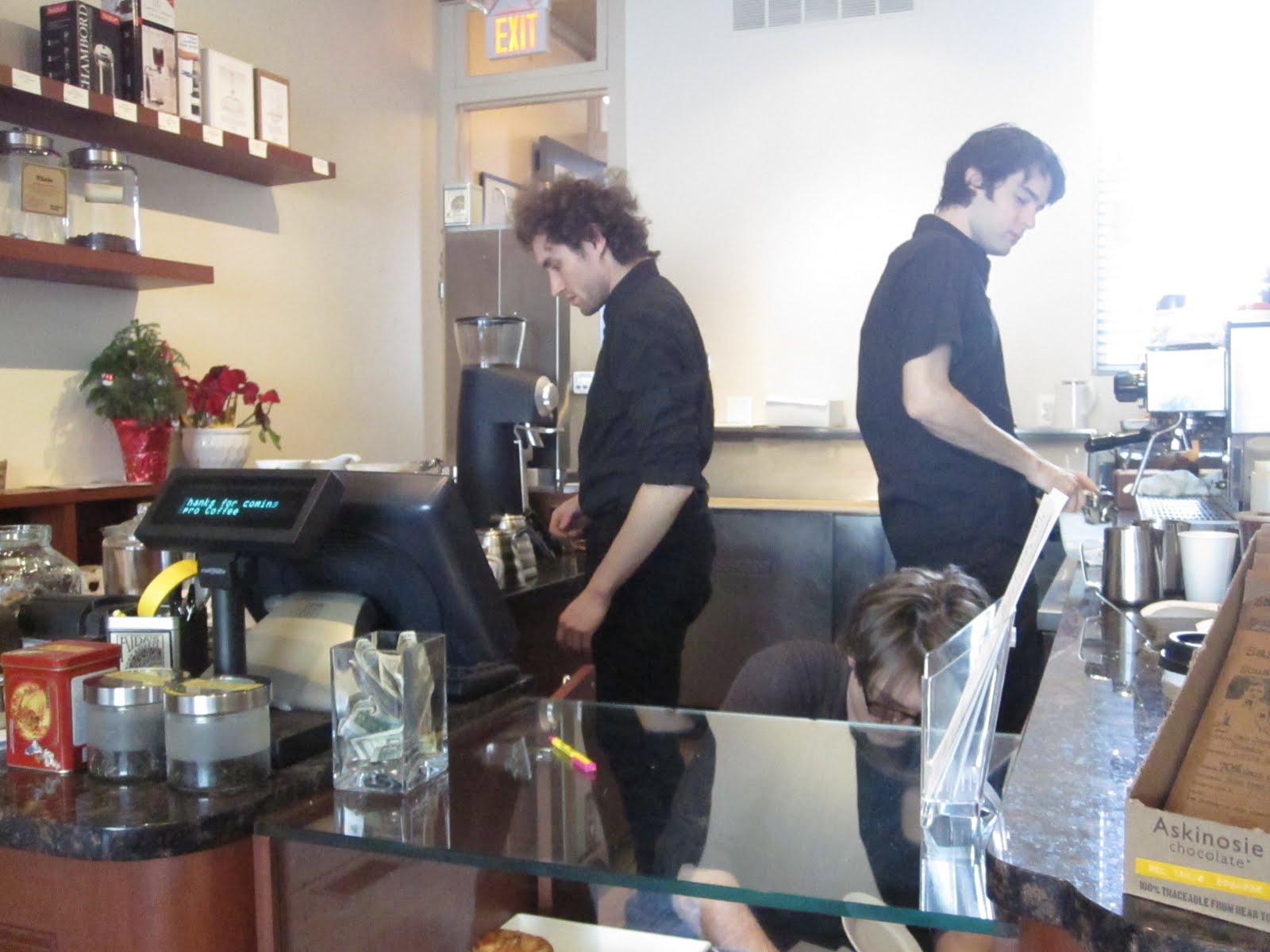
Jeremy, Devlin and Martin manning the bar.
I'm sitting here in the main room at Spro watching the action. The tables in the front are filled, one table (of two) in the back are filled and a steady stream of guests come in and out as the morning gets busier.
What I notice most is the happy banter of friends from the tables. Everything else is quiet. The three baristas working the bar (Jeremy, Devlin & Martin) work quietly and efficiently. They greet customers, answer questions and quietly communicate amongst each other. Their movements are calculated and anticipatory of each other. Without realizing it, their dance has begun and it's a brilliant moment.
As the guest count increases, they must keep track not only of the guests standing in front of them waiting for their orders but they're also keeping track of which guest receives what item wherever they decided to sit.
For me it's actually thrilling to watch. It's a ballet. The quiet concentration, the focus, the passion. Amazing and I'm very proud of their work.
Hours pass and the intensity remains. The service level is friendly and welcoming. Comfortable without being overtly familiar.
It's really what I always hoped for at Spro.
Sunday, January 09, 2011

Saturday, December 11, 2010
Intelligent v60???

Head-to-Head brewing: Intelli on the left, Spro on the right.
From what I've been told, the Fabulous LaTourell was in the house last Sunday while I was in Italy. He came by for a visit and brought along some lovely coffees from Intelligentsia and Coffee Collective for us to sample, and he offered a tutorial in v60 brewing: Intelli Style.
I've been a little critical lately of the way the v60 drip brewer has been implemented industry wide and I'm sure there's a little bit of a challenge to that position with David's visit. It's all good.

Spro Method grinds.
I'm not the sort of chap who really believes too much in his own dogma, so I'm willing to try other methodologies to see what kind of improvements to our product line we can deliver to our customers. Jeremy was working that day and was the beneficiary of the Intelligentsia tutorial.
With that in mind, we set off to do side-by-side brews with the v60 and see if one method was indeed "better" than the other. For this brew test, we used Stumptown's Colombia El Jordan, roasted on November 30, 2010 in New York City.
According to Stumptown's card: "Warm aromatics of nutmeg and cinnamon segue into mouth-watering flavors of satsuma orange and ripe blackberry which finish with notes of honey and brown sugar."
For this brew test, the coffee was ground using a Compak R80 grinder at the "30" grind setting and we used 24 grams of coffee to make a 12z cup.
According to Jeremy, the method prescribed by Intelligentsia is a finer grind with a 2z initial pour of water for a one minute bloom before adding an additional 12z of water and allowing it to flow naturally through the brewer. Total brew time for our test: two minutes and thirty seconds. Jeremy used a scale to measure the water volume.
On my side of the bar, I used the TruBru brewing stand and free poured the water. Starting off with roughly two ounces of water and a bloom time of 45 seconds, I then slow poured the water into the v60 brewer to control the flow rate with a target time betweem 3:30 and 4:00. Actual brew flow time for this test: 4:53 - I ended up pouring a bit slower than my target.

Intelli Method grinds.
In a side-by-side comparison, the Intelli Method produced a cup that was brighter and highlighted with bitter notes. The Spro Method demonstrated a cup with strong cocoa notes and no bitter/bright tones. For these variations, we preferred the Spro Method over the Intelli Method.
But David had told Jeremy that their method performed best at grinds finer than the typical drip setting, so we readjusted the grind to "25" and used up the last of the El Jordan to make an 8z cup, using the same Intelli Methodology and a finish brew time of two minutes.
Where the "30" cup of Intelli was bitter and acidic, the "25" setting dropped the bitters and really punched through with a nice acidity that was very reminiscent of citrus fruits. A nice cup but also a drastically different cup than the Spro Method.

The Three Finished Brews: Intelli "25", Intelli "30" and Spro "30".
Being someone who prefers chocolate and fruit toned coffees, I would prefer the Spro Method cup of the El Jordan, but this in no way dismisses the Intelli "25" brew. The Intelli "30" was definitely the least liked of the three, the remaining two were both good but quite different.
Here I think it is the difference that introduces the conundrum. So many of us in the business are hell-bent on demonstrating who/which is "right" and that others are "wrong." These two methods produced dramatically different results from exactly the same coffee. Both were tasty cups of coffee, so can either of them be truly "wrong"? I don't think so.
For me, this highlights something I've been thinking more about with the latest push in the industry for conformity and adherence to "acceptably right" brewing methods and refractometer readings - and that is, I want to find differences when I go to different coffee places. The fact that the Intelli Method and Spro Method produce dramatically different results in the cup from the same coffee is a desirable condition.
Both coffees were good and tasty, but were very different. This is to be celebrated because I would hope that our interpretation of the coffee is different than Intelligentsia's interpretation. I would find it a sad condition to travel all the way to Chicago or Los Angeles just to have a cup of the same old, same old coffee I can have at home. That would mean there is little to no difference between shops and that we have homogenous products. That would suck.
There's still more testing that can be done before anyone can draw any sort of conclusion but I'm enjoying drinking my rethinking on v60 brewing methods.
Sunday, November 21, 2010
Koffee Kampala

Welcome to Cafe Pap.
At 11:30am this morning, Claire called to check up on me. I was still sleeping. Holy crap, it's eleven thirty! I tell her I'll call her in about an hour.
One of the "problems" with staying at the Kampala Serena Hotel is the very comfy king-sized bed and the excellent heavy curtains. I'm essentially cocooned in darkness and have no idea what time it is. Normally, I never sleep this late. Even when tired, I rely on the sun to roust me from slumber. Good thing today is a non-scheduled day!
By the time I really wake up, get ready, call Claire and she comes to meet me, it's easily 2pm and the day is lazily passing away. She's here to brief me on the week's schedule and we negotiate some of the days, trading setup time for training time and strategize on just what we're going to do this week.

Cafe Pap Espresso.
Right now, it's two days of barista training and a half day of setup and half day training judges. Initially, I think there's too much time for barista training and not enough time for judges training. But it's all good and we work things out amicably.
Barista training immediately before a competition. On one hand, it sounds like a great idea. On the other, it's fraught with peril since I'm going to presume these baristas have been training for months and these sessions might cause them to change what they're comfortable doing to the point where it throws off their game and they don't present themselves in the best possible light.
But the opportunity here is great. Unlike other trainers who work exclusively with one barista, therefore, giving an advantage to only one person, I get to work with a field of baristas and share with them thoughts and strategies to improve their scores.

Cafe Pap Macchiato.
There's probably some out there who will disagree with my assessment on improving their scores, but this is a competition whose winner is decided on who gets the most points - and well, why not help them maximize their point potential? The by-product of this is that they improve their skills, make better drinks and, hopefully, make themselves more valuable to their employers (or other employers) which may command better compensation.
On the competition side, it hopefully results in better competitors which raises the bar of the WBC style competitions. To my mind, this is a win-win-win situation.
One of the things the International Judges remarked upon while training judges in Bogota last month was the diversity in tastes amongst the local judges. What we, as International Judges, deemed excellent was different than the local judges. One thing we acknowledged was that we were unable to take the time to explore the local cafe scene to see just what kinds of coffees the local judges were used to drinking.
With that in mind, I asked Claire to take me on a tour of Kampala's finer coffee shops.

How much the average Ugandan barista makes a month.
So, we toured Kampala's coffee shops and luckily, three of the four of them were in the same shopping center. And the fourth was in the shopping center next door. This made for simple touring where we could spend time sitting, drinking and chatting with the baristas and coffee people about their coffees and their lives.
In the process, we ended up having brunch with Louis at Boda Boda, named after Kampala's famous motorcycle transportation services whose fearless drivers transport up to two passengers on a hair-raising ride through the city's notorious traffic. Louis is a Kenyan transplant with great personality and will be the emcee for the barista competition. Can't wait to see him in action.
We also took some time to do one of my favorite travel things: visit a local grocery store. There are always lots of fascinating things to discover about a place in their supermarkets. Their choices in food, fruit, drinks, snacks and foods are always interesting and I didn't come away disappointed. I also came away with some foodstuffs to ease my paying burden at the hotel.

Cafe Pap Cappuccino. Thanks Anthony!
I won't go much into the coffees we drank because I don't want it to seem like I'm influenced by my tasting experiences here. Today wasn't about judging coffees. It was about exploring the local coffee culture and seeing just what that culture is like.
Like anywhere else, I'm concerned about the baristas and their future. What is the average wage for baristas in Uganda? Can they make a living on that wage? More importantly, can they have a future as a barista? Meaning, is their wage appropriate for buying a place to live, getting married and having children? Basically, the same issues I deal with as the owner of Spro.
Without a doubt, the wages earned by Ugandan baristas seems un-Godly low and the wages of American baristas seem incredibly high. But put into context and they're still in essentially the same boat. They need higher wages to make it work.

Cafe Pap Almond Croissant. Different.
The coffee scene is relatively young in this country. True specialty coffee didn't really emerge until about 2008 and in discussing the future with Steven Banya, the owner of Bancafe Coffee, there's still much work to go. A coffee scene must learn to walk before it can run.
Luckily, the coffee scene here isn't unfamiliar with terms like "macchiato" meaning a three ounce beverage of espresso and steamed milk. There's none of that 16z "macchiato" nonsense going on here, but the large lattes and frappuccinos of the American coffee scene are also a staple here.
Another aspect of the coffee shop scene is the need for food. A food menu in Uganda goes hand-in-hand with the coffee menu. Think you're a coffee purist who only wants to serve a coffee menu of espresso in six different variations? Then either remain content with very low sales figures (at least you can rent a livable house here for US$100/month) or add food and make millions a day (in Ugandan Shillings). The choice is up to you.

Going to Boda Boda for Sunday Brunch.
And if you come to Kampala in search of that fabled V60 brew bar that's all the rage in the United States, you're not going to find that here - hey, remember their coffee scene is only a couple years old and they're already ahead of the curve with their macchiatos.
Not to mention that Uganda is not a coffee drinking nation. True, they grow coffee and some of it is truly wonderful, but their main drink here is tea - a remnant of their days under British subjugation, but at least they're not holding on to that. One thing of note is that while Uganda's main coffee crop is the robusta, their exports of arabica coffee has declined over the past year due to greater internal consumption. Evidently, Uganda is one exporting nation that does not export all of its' best coffees.
I'll follow up more as the week progresses.

Fried eggs, rice, green beans, carrots, bacon, chips, tomatoes, red onions, fried tilapia, beef and a croissant.

Louis and Claire discuss the finer points of Life in Kampala.

Star Coffee - Uganda's most famous coffee.

Safari Tea - Uganda's most famous tea. Mix equal amounts water, milk, a spoon of tea and boil.

Bell Lager - Sander's and Shaner's favorite.

Tea Masala - add to your favorite black tea and you have chai!

Glucose on the grocer's shelves. Surprising.

Cafe Java's - probably the busiest cafe in Uganda. Estimated daily revenue: approx. USh 6,000,000.

Cafe Java's macchiato.

The Bar at Cafe Java's.

The Bar at Mokka Terrace.

Talking coffee at Mokka Terrace.

Serving our macchiatos.

Mokka Terrace - Macchiato.

Brenda and her barista at Bancafe

Bancafe Coffee - Macchiato.

Steer's - a local fast food joint.

Two piece fried chicken, fries and salad with russian dressing.
Subscribe to:
Posts (Atom)