Wednesday, October 05, 2011

Adobo The World


General ingredients for Sunday Meal.

Yes, I can cook.

It's times like these when I get myself into trouble.

Perhaps it's time that I start to think like a normal guy: I don't know how to cook. I just want to sit on the couch watching The Game and talk player stats while guzzling six-packs of beer.

Instead, I find myself on a Sunday late morning at the local supermarket looking for ingredients to make "something Filipino."


Making "medium grain" rice with a 50/50 mixture of long grain and short grain rices. It worked!

Earlier this year, I had the notion of going out to eat Filipino food in Mexico City. A google search for "Filipino restaurants Mexico City" returned nothing, so I contacted the Philippine Embassy in Mexico City, asking them for guidance on where to eat traditional Filipino food in the city.

Surely, in a city of 20 million people, some Filipinos would have found their way to these shores (consider the old Manila-Mexico-Spain trade route) and opened up a carinderia.

A couple of days later, a reply from the Consul General was telling: no Filipino restaurants in Mexico City. No Filipino restaurants in all of Mexico, for that matter. Huh???


Pork Adobo Battle Ingredients: pork ribs, butter, white onion, garlic, soy sauce, vinegar, red wine & jalapeno.

I couldn't believe it. There's Filipinos and their restaurants everywhere. Wherever there's work and the chance to send remittances back home, Filipinos have landed. How is it this mighty city has none. Am I the only Filipino in the city (along with the embassy staff)?

No Filipino restaurants. No Filipino food. If I move here, I could be in trouble. That's right when the girls had the idea that I should cook Sunday meal. But not just any meal. They wanted to try real Filipino food. Whatever that was.


Seared, stewed and ready to serve.

As to be expected, when it comes to fresh Mexican ingredients, Mexico is all aces. When it comes to assembling the ingredients needed to make authentic, traditional Filipino (or general Asian) food, that's where Mexico starts to stumble.

Of course, it could be just that I don't know the lay of the land. Maybe there's some secret mercado filled with Asian foodstuffs longing for my discovery - like that little Chinese market on Puente Alvarado in Tabacalera.

At one point, I thought seriously about making Kare Kare but a quick search at the supermarket left some key ingredients out. Ixnay the Kare Kare. Enter Pork Adobo.


Monday morning breakfast: pan fried pork adobo, Sinaag fried rice and some eggs.

In the world of Filipino cookery, Adobo is the ubiquitous traditional dish. Everyone knows it. Everyone can make it. Sorta. Everyone has their own twist. Take a drive across just Luzon and you'll find thousands of different variations of Adobo. Talk to your friends and each of them has their own preferred way. Some like it dry. Others fried. Some like it with sabaw (or sauce). Others hate it that way.

Then the ingredients can get kinda crazy and esoteric - some of which fly completely in the face of what you know as "adobo". Like that dude who talked about putting coconut milk in his adobo: Heretic. Or peppers. Or fish. Strange and odd stuff, but all under that known as adobo.

And it's completely different than Mexican Adobo. Actually, I don't even know what Mexican Adobo is, but to this Filipino boy: it ain't Adobo to me.

For Sunday Meal, I just took the simple route, with a little twist. Pork ribs with some butter, onion and red wine to add to the traditional ingredients of garlic, black pepper, bay leaves, soy sauce and vinegar. After some careful searing and some long stewing, it was ready to eat and enjoyed by all.

Like many dishes around the world, Adobo enjoys a little age. So, the next day, all by myself, I indulged myself in a little treat. Pan fried pork adobo with some eggs and garlic fried rice.

Not a bad way to remember the flavors of home while off in a distant land.

Sunday, October 02, 2011

Shines Like The Top Of The Chrysler Building


I've returned again to New York City where I've secured a (relatively) cheap room at the Gran Hyatt Grand Central for a couple of nights and where I'm reminded that scale is a bit different in NYC. Thirty-three stories above 42nd Street and I can barely see out the winder and only the very top of the Chrysler Building...

Wednesday, September 28, 2011

Looking For Your Bags On USAirways


Maybe that's your bag that didn't make it to Ka'anapali.

Ever wonder how baggage gets lost in transit? Especially in this world of "high security", TSA screenings and everything designed to "protect" us from harm, you'd think they would be able to track your baggage with a high degree of accuracy - not to mention that they now charge you for the "privilege" of checking your baggage.

In a discussion with a Charlotte Douglas Airport representative downstairs in the US Immigration "sterile zone", I was informed that despite the lack of Global Entry machines, Charlotte is the 7th busiest airport in the nation.

Seventh busiest. You'd think that at the seventh busiest airport one of the US Airways baggage handlers would notice that five bags were lying in the main passage lane from the terminal to the tarmac.

My vantage point in the USAirways lounge overlooked the lost baggage. Handler after handler drove past, some with empty carts, most of them slowed down to look at the baggage in the lane. Others actually looked like they were considering stoppping, but perhaps that would be too much trouble - afterall, they're getting paid so there's no need to make sure the passengers get their luggage on time.

Finally, after about fifteen minutes (which is a large enough window for your plane to leave without your baggage), and literally fifty passing handlers, a supervisor in a golf cart finally swung by, picked up the luggage and took them back to the terminal.

Traveling around the world, I hear a lot of maligning of USAirways. This can only contribute to the loss of confidence I hear many people share.

Saturday, September 24, 2011

The Little Pambazos of Ben Franklin


Everybody's working at Los Pambacitos.

Right before we went to Hamburguesas Montaner, Ana asked me if I had tried pambazos. Of course, I've tried pambazos - that ubiquitous Mexico City bolillo sandwich that's sauteed in salsa rojo. Actually, I've never had it here, only at the fabled Fiesta Mexicana in Baltimore, but it's pretty authentic.

But, as she noted, I hadn't had these pambazos.

We were in the neighborhood to try the bandillos and I was a bit weary of having a big pambazo after eating at Hamburguesas Montaner, thinking that we were going to try a different twist on the typical pambazo. Maybe we can get one to go and that we can share.

Ana knew better.


The mother and her son.

Los Pambacitos de Ben Franklin is on a quiet residential street in Colonia Escandon. At night, it's like an oasis on the quiet and dark Calle Progreso. Why it's called Benjamin Franklin I have no idea. At first, I thought it might be on Calle Benjamin Franklin, but no so I have no idea why, but then again, it really doesn't matter.

Forget what you know about pambazos, this place is something different. Instead of the traditional bolillo, they have racks behind the counter of flattened out dough ovals that are dropped into a fryer once you place your order. Suddenly, you realize that this really is going to be different.


Frijoles and Carne Deshabrada Pambacitos.

The dough comes out light and fluffy on the inside and slightly crispy on the outside. It's like fried dough heaven and you have arrived. And it's fried by the matronly mother (or maybe grandmother) who carefully fries the dough, slices it open and fills it with your choice of filling. She's deliberate and methodical in her work and you quickly realize (so long as you're paying attention) that she's a master of her craft and you're about to experience it first-hand.

For ten pesos, you can have a pambacito with your choice of filling: carne deshebrada, salpicon, papa con chorizo, frijoles, chicharron, chile cuaresmeno, jamon and mole. Combinations can be made for a peso more. And they have pozole and atole available as well. I would have liked to induge but that would have been lunacy.

I had the simple carne deshebrada or shredded beef. Ana had the frijoles. Both were just perfect. Little bites of meat (or beans) properly seasoned with the alternating crispy and soft texture of the bread. Fantastic.

But while it was a good experience, I have to recommend that one goes there on an empty stomach and prepares oneself for the complete tour. A menu such as this, with small pambazos, deserves further and deeper exploration. One of each should suffice, along with a bowl of pozole and a side of the delicious-looking strawberry atole (though I suspect the flavor of atole changes regularly).

I will return.


Los Pambacitos de Benjamin Franklin
Calle Progreso
Near the corner of Calle Francisco Murgia
Colonia Escandon
Mexico DF

Hamburguesas Montaner


Bienvenidos a Hamburguesas Montaner.

"Have you ever tried bandillos?", asked Ana.

Bandillos. Something that only proper bandits ate? Sounded interesting. But she wanted a definitive answer but I had no idea what bandillos were and she had taken me to try so many different things that maybe I had already tried them and didn't realize it. Afterall, I could be a proper Bandito...

In Colonia Escandon, at the southeast corner of Jose Marti and Patriotismo, is a small cluster of food stands. There you will find Hamburguesas Montaner and the famous bandillo.


Cheese and sausage bandillos.

I had been in the city for a couple of days and was starting to feel a certain withdrawal from french fries. As much as I may love tacos, tacos al pastor and the assortment of wonderful Mexican fare, I can't help but to think how much powerful that pastor experience would be with a side of salted papas fritas.

Knowing me all too well, she asked me if I wanted to have some fries and then we were off to Montaner.


Getting inside the sausage.

Most of the food stalls in Mexico City are small, mom and pop affairs. There's pop grilling the burgers, mom frying everything else and maybe their son taking money. And it all happens in what must be an eight foot long by four foot deep metal stand.

The best thing about Mexico City is that it's populated by places like Montaner, selling just about everything Mexican you could ever dream of eating. And they're everywhere, which means that there are plenty of places that are just so-so and some that are stellar. They key is driving around a seeing which stands have the longest lines.


Papas Fritas piled high with cheese, mayo, ketchup and Valentina. Darn good.

As received our order of fries and bandillos, I realized that I had never had these before in Mexico City and what was once unknown and mysterious, was suddenly familiar and comforting. Think "corn dogs" and you've pretty much got what a bandillo is all about. However, in this case, the batter isn't thick, it's thin and light, and makes for a nice treat when slathered with mayo, ketchup, mustard and a side of pureed jalapeno peppers.

Ana's favorite is the cheese version and I have to agree that I think it's better. Better mouthfeel and a nice chewiness that goes well with the batter.


Montaner's Hawaiian Hamburger.

But since this is "Hamburguesas Montaner", I had to try a sample of their hamburger. Ana ordered the Hawaiian which is their burger with a slice ring of pineapple, lightly griddled. I'm guessing it's canned pineapple since most people don't cut rings that perfect by hand!

The burger was pretty decent. Simple, basic fare. Piled high with toppings and condiments, it's a messy burger but quite satisfying.


Hamburguesas Montaner
Patriotismo 85
Colonia Escandon
Mexico DF

Tuesday, September 06, 2011

Let Me Show You...


Sometimes my day takes a slightly turn for the strange.

After heading downtown to pick up some supplies, I decided at the last minute to swing by a local pasticceria for a scoop of gelato. Upon arriving and having a look at the gelato selection, which was looking a bit wet, I decided to just grab a cookie instead.

That's exactly when the chef/owner decided that I must come try the new cookie that's cooling on the racks in the kitchen. So, back into the kitchen we went. Now, I must say, the kitchen was pretty nice. Very clean, well organized - essentially the kind of place that I wouldn't mind working.

After showing me the new batch of butter cookies with powdered sugar topping and a hint of lemon, the chef decides to show me his (new?) pastry machine. This unit measures, portions and dispenses a variety of pastry items based on how you program it. Cookies, eclairs, sheets, anything and everything for the proper Italian pastry chef.

The thing is that the kitchen crew has gone home for the day and he's cleaning the unit. With the main hopper detached from the machine, he really needs someone to help him move the hopper and put it back in place. The hopper is stainless steel and probably weighs two hundred pounds.

Basically, for a few cookies and a tour of the kitchen, I've been drafted into moving this massive, heavy hopper. Not that I mind so much since we sit around talking shop and I get the opportunity to learn a bit about Italian pasty making from someone who's a true master of the craft. All in exchange for a little brute labor.

And I got a few cookies to boot!

Monday, August 29, 2011

Roasting Illustrated


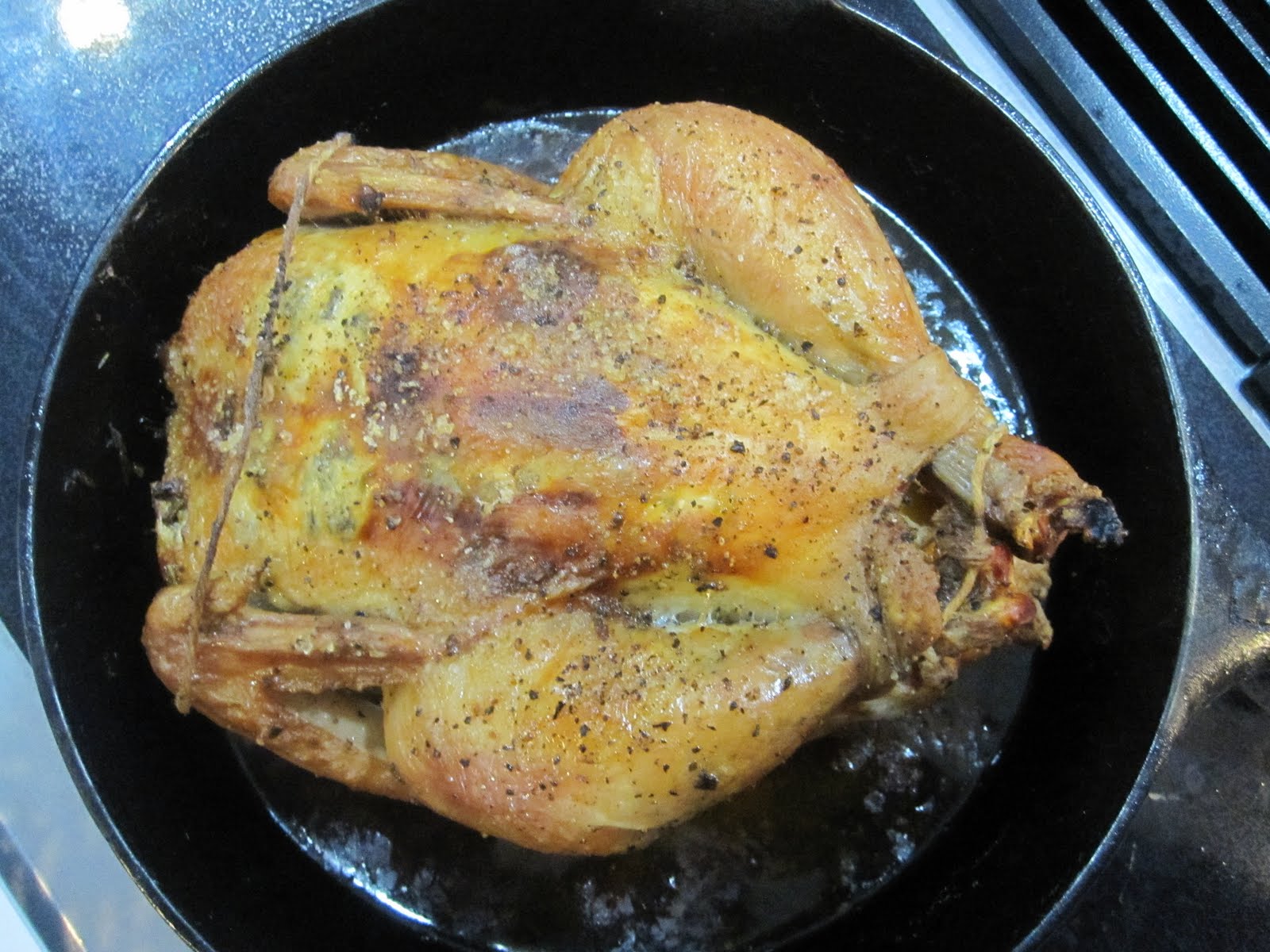
French Heirloom Chicken ready to go.

Perusing the latest issue of Cook's Illustrated, I came across their quick roast technique for roasted chicken and decided to give it a try. The key is to heat a skillet first, placing the chicken on the skillet and the dark meat to cook with conduction while the rest of the bird is heated with convection.

Cook's Illustrated gives a different preparation of the meat for those trying to jam a roasted chicken in after work and in time for dinner, but I wanted to go with a more traditional method of seasoning. A little softened butter, rosemary, lemon, sweet onion, salt and pepper. And since I'm not really in a rush, a pop in the refrigerator to dry out the skin a little.


Into the skillet.

After a very successful test a couple of weeks ago at Vanessa's, I grabbed another French heirloom chicken from KCC Natural Farms in Forest Hill, Maryland. I had come across KCC at the Towson Farmer's Market and the thought of a French heritage bird intrigued me. The flavor was so good that I grabbed a couple more.

If you're used to grocery store, commercial chickens, these will look positively anemic. Afterall, they're only about three pounds. Those grocery store Purdue suckers are upwards of five pounds with massive breast meat that comes from a short life sitting in your own feces.


Fresh from the oven.

With the bird in hand and a solid helping of minced rosemary in butter, separate the skin from the meat with your hand, starting by the tail bone. Rub the butter into the space between the skin and the meat and be very liberal with your butter.

From there, it's a simple squeeze of lemon over the skin then a stuffing of the remaining lemon half and half an onion in the body cavity before trussing legs and wings. You want to truss the legs together and the wings to the body to prevent scorching (with the wing tips) and even cooking. Good results can also be had by leaving the legs dangling but it doesn't make for a nice presentation.


A little bit closer.

After a brief spell in the refrigerator to dry out the skin a little, select a skillet that is just wide enough to hold the bird and high-walled enough to contain the juices that will emanate from the meat. Place the skillet on the center rack of the oven then preheat the oven to 450F.

Once at temperature, remove skillet and place bird in center. It should sizzle nicely. Place the bird in skillet back into oven and roast for 25-30 minutes (the bigger the bird, the longer the time). Once the time has been reached, DO NOT OPEN THE DOOR and shut the heat off, allowing the residual heat contained in the oven to continue cooking the bird. Do not open the door at all.


Eat with a pan sauce.

After another 30 minutes in the oven, remove bird from skillet and allow to rest for 20 minutes. During this time, you can make a pan sauce by deglazing the pan of fond with some onions, white wine and whatever else you feel like putting into your sauce then mounting it with a little butter.

Finally, it's time to carve and eat. I recommend the use of hands.

Wednesday, August 24, 2011

Nice & Shiny


In certain circles, it's impolite to ask one's age.

To my mind, the craft is about attention to detail. It's something I try to instill into each and everyone on our staff. Much of this manifests itself in details that the guest may never see or notice. Take this steaming pitcher, for example. Take a close look and tell me how old you think it is.

It is clean. Polished. Shiny. If one were so inclined, one could use it as a steaming pitcher in a barista competition. It looks nearly as good as one straight out of the box. To note, this isn't a display pitcher or one that we use for dressing. It's the main pitcher that our baristas use day in and day out. Lattes, cappuccinos and chais are steamed in this vessel all the time. It is washed between each use. It is a demonstration as to why I think Spro baristas are some of the greatest working baristas in the industry today.

This pitcher that has worked every day making all sorts of drinks, under constant use by our baristas...

Is now five years old.

Sunday, August 21, 2011

Cold In-Fusion


Adding cold water to the coffee.

I've been thinking about cold infusions lately. Infusions that don't require heat and are not destructive (changing) to the ingredients used. Heat up the ingredients and a change occurs. What ways can we move to infuse liquids while trying to capture the vibrancy of the natural ingredients?

A technique developed by Dave Arnold at the French Culinary Institute described using an iSi Whip Charger to infuse flavors. At its most basic, the iSi is widely used to make whipped cream. Insert cream, add a little sugar, seal and charge with a nitrogen cartridge and you've got ready made whipped cream.


Double-charged and three minutes.

The whipper is a great tool and I've used it before to make foams and played a little with them to inject carbon dioxide into products - "Strawberry Soda", anyone?

All of this started the other night while I was lying in bed thinking about mole - that ubiquitous Mexican dish of spices, chiles, nuts and cocoa. How might we be able to create a drink that represented mole?


Straining the liquid infusion.

Originally, I pondered this similar question four years ago and didn't get very far. The complex and powerful flavors of the mole, not to mention the gritty paste (for a drink) that serves as the base, made it difficult to work with and I soon abandoned that idea for others (the "Breakfast In Bed" concept).

Fast forward four years and I'm back in the same situation, considering the options. This time, the potential lies in being able to take the ingredients and infuse them into a liquid to carry the flavor and combine that with coffee (or espresso). And maybe Dave's idea of cold infusion might work.


Still a bit cloudy.

But without the necessary ingredients at the ready to make a proper mole, I decided to give it a conceptual try using whatever we had on hand - namely coffee. Stumptown's Finca San Vicente coffee from Honduras has been performing brilliantly this week with notes of vanilla, cinnamon, caramel, hops and macadamia nuts and would make for an interesting test subject. What kind of notes and nuances might we be able to extract from the coffee with this method?

As a baseline, we took 24 grams of the San Vicente and ground it coarser than for french press on a Compak R80 grinder (roughly the 90 setting). Placed that in the iSi Whipper along with 14 ounces of cold water. Screw the top on tight and charge with two (2) nitrogen cartridges, making sure to wait a few moments to allow the nitrogen to absorb into the liquid and shake well between charges.


Through a paper filter.

Once charged, we waited about three (3) minutes for the infusion to take place, being sure to note the fact that if we had simply brewed the coffee it would have taken the same amount of time.

Degas the whipper by holding it upright and using a container to catch any liquid that may come through the nozzle. Slowly allow the gas to escape and then unscrew the top. You'll notice that the liquid looks like it's boiling. This is perfectly normal. After straining the liquid, we noticed that there were still quite a bit of particulates in the liquid and then passed it through a paper coffee filter. Note: it will be more efficient to stir the liquid in the whipper and then pour the entire contents through the paper filter instead of using the strainer first. Passing strained coffee liquid through a paper filter always results in too many fines clogging the filter and slowing the process immensely.


Gassed up.

We tasted the liquid and it was light, fruity with a slight tartiness. Jacked it up with a little simple syrup and the liquid became vibrant. What were just a moment ago light and elusive fruit flavors were now dominate notes of tamarind - both sweet and tarty.

But it needed something more to give it a kick. Back into the iSi, we hit it with one charge of carbon dioxide, degassed and then poured it out.

Something to keep in mind about carbonation: you want the liquid to be cold. CO2 does not hold in warm temperatures. It simply gasses out into the environment. Which is why warm Coke goes flat at alarming rates. The colder the better. We added ice cubes to the iSi to chill down the liquid and keep it as cold as possible.


Finished. Sort of.

Degas the whipper in the same manner as before and we found a lovely amber colored liquid with lovely notes of tamarind and that refreshing carbon dioxide kick. It really brought it to life.

Next week: time to give it a try with actual mole ingredients!

Saturday, August 20, 2011

100g of Calibrating Power


One of the coolest things I picked up yesterday at the gem show was a calibration weight. Perfectly tuned to 100 grams, this weight is used to calibrate your scales and make sure they're in sync.

At home and at work, I use gram scales all the time and the gem show is one of the few places where I can go, buy a gram scale and not have funny or "knowing" looks between me and the person selling me the scale. In America, it seems that the only people using gram scales are gem dealers and drug dealers. In a way, they're all scam artists selling highly addictive products.

Come to think of it, baristas, jewelers and drug dealers all seem to have this in common. Go figure.

And, as any dealer (drugs, gems or otherwise) will tell you: we live and die by the scale, so it has to be accurate and on the money. A couple of grams off and you're talking profit or loss. In the millions. So, a calibration weight is a handy tool.

Some of our scales have been in constant use for nearly two years now. They're dropped on the floor, plopped into drawers, tossed around, slammed around, weigh continuously and are subject to a wet environment. I was almost sure that one of them would be off but when I placed the weight on the scales, they all read "100" grams.

Even the new scales I picked up yesterday were on the money - though the one that weighs to the hundreth of a gram measured "100.12" grams. Hmmm, I'm starting to worry about that .12 gram.

I'm now on the lookout for a proper Bentley so I can join the ranks of dealers worldwide.

Friday, August 19, 2011

Tooling At The Gem Show


This is what I see at a gem show.

I really must be a simple creature. All around me, I'm surrounded by gold, jade, emeralds, rubies, gold, silver, Rolexes, Breitlings and diamonds galore - all I can see are tools.

Every few months or so, my mom enlists me to drive her to a gem show somewhere. Today, we're in Chantilly, Virginia - just a few minutes from Dulles airport and a nearly two hour drive (damn that NoVa/DC traffic) from home.

For me, it's a non-issue but the array and selection of jewelry is amazing. Everything and more that you've never seen at Zales or Jared. If there's some kind of jewelry that you want, they probably have it here. Need to find the perfect engagement ring and wreck yourself of $15,000? They are only too happy to help. Want to find that right estate (read:used) watch (preferably a gold and platinum, diamond encrusted Rolex Daytona)? They've got plenty.

What you don't have (read:I) is the experience and knowledge to take advantage of the situation. It reminds me of antiquing - that honored practice of going out on weekends on antique furniture hunts only to be taken by the smarmy dealer with the pencil moustache whose studio artists have demonstrated their mastery of distressing techniques.

Color, cut, clarity - who the hell knows and understands these things??? To pass the time, I ask a vendor to show me a 1.15 carat diamond. He tells me it's $6,500. Huh? Are you serious? He encourages me to look at it through a 10x loupe and I see flaws. Nothing too dramatic but flaws nonetheless.

In the parlance of diamonds (and I presume emeralds, sapphires and tanzanite), they're called inclusions and those, along with color, clarity and weight determine just how much the diamond will cost you. To me, these prices are outrageous and a total extortion.

Diamond lovers (and their sellers) will tell you that it's one of the world's most rare and exotic gems. Complete and total hogwash. Diamonds are a dime a dozen. If that weren't true, you wouldn't be able to buy a diamond encrusted saw blade on the internet for thirty bucks. It would cost you thousands.

Let's face it. Diamonds are everywhere and the psychosis that is DeBeers has invaded our mindset. The saying goes that you should be able to afford two months salary. That's 24% of your yearly pay. Does that sound reasonable?

But I digress.

Bewildered by the prices of diamonds, I walk around the show and find a booth that I haven't seen before: the jeweler's tool vendor. This guy has it all - anything and everything you need to work on jewelry. Mini anvils, tiny pliers and tweezers, the cool-looking loupe that diamond dealer was using to show me the flaws. I like this place. It brings me comfort in a sea of over-priced diamonds and bead-crazed women.

Like Home Depot, I want to go nuts here. All sorts of weird and exotic tools that I could use in the kitchen. Take that ultrasonic bath - how can I use that? It's only $150. Or that weird contraption that I don't even know what it is. I want to use it. Heck, I need to use it.

In the end, I leave with a bag of goodies. A couple of close out gram scales that were downright cheap, a loupe so I can posture like I know what I'm taking about when I talk about H color, and a couple of other items that will make a fine addition to my tool kit.

I leave the show for the long drive home with a bag of tools from a gem show. About right.

Sunday, August 07, 2011

Sunday BBQ


The Secret Weapon: Velveeta.

At my core, I'm a very simple creature. I grew up in 70s and 80s America. An immigrant family, we ate cheaply and I grew up with very simple fare: Lipton iced tea, cheap cuts of meat and Kraft macaroni and cheese. For many years, I didn't know one could have a mac-n-cheese that wasn't orange.

So, when I finally got around to learning about food and cuisine, I found the upscale mac-n-cheeses, with their fancy cheeses, to be interesting and good but not as soul satisfying as that commercial orange mac-n-cheese. Yes, one could make a deliciously tasty mac-n-cheese with a bechamel base, four cheeses, lardons and penne pasta, and I can whip that up without a second thought, but it's the orange mac that's eluded me.


A smoker full of barbecue.

Eluded in the fact that the world now revolves around easy to make macs, like Easy Mac or instant mac-n-cheese. And while those can be decent enough, nothing is quite like the days of boiling the noodles, adding butter and milk and that orange cheese powder. Now, that's Classic Americana!

I've always fantasized about making the true down home, could be nasty and definitely bad for you, mac-n-cheese but never had the opportunity, until now. With a group of our friends guaranteed to eat it, we set out to making this Ultimate Mac-N-Cheese: One large block of Velveeta, 3 liters of macaroni, half a stick of butter and 1/2 cup whole milk. Stir it all together and eat with a spoon!


Smoked skirt steak.

From there, it's barbecue and more barbecue. With the smoker running at full blast, it doesn't make sense to cook anything any other way. Some kind of protein? Into the smoker! Old shoe? Into the smoker too!

On order for the evening is a taste of the old school Ono Grill. Some baby back ribs, a little brisket, a sirloin and a skirt steak and it's nearly non-stop meat. Want some veg? Does Velveeta Mac-N-Cheese count? As it goes, it's a couple of slices of this, a scoop of mac and a drink. A little while later, it's a scoop of rice and a couple of ribs and some sauce. Want dessert? There's more Mac-N-Cheese, and I think there's some cold, sliced watermelon somewhere nearby.


Making the Mac-N-Cheese.


Skirt Steak: All Sliced Up!


Gerry's fancy broiled breaded mac-n-cheese.


The girls watch Yo Gabba Gabba!


Smoked sirloin, beef brisket and racks of short ribs.

Friday, August 05, 2011

Baltimore Battle Baguette


Baguettes (or Ficelle) from (top to bottom): Bonaparte, Stone Mill Ficelle, Atwater's and Stone Mill 7 Grain.

In Paris, I have my favorite baguette baker: Stephane Secco. Just a block and a half from my hotel in the 7th, in the space formerly occupied by the famed Jean-Luc Poujauran, is Secco and his brilliant bread. So in love with his baguette that I extended a trip to Paris in 2008 so that I could be there an extra day (a Tuesday, he's closed Monday) to fill my luggage with his baguettes.

When I arrived in Paris again last summer, I was ready to defend Secco and my penchant for his bread - even when I heard about the gran prix winner Djibril Bodian of Le Grenier a Pain Abbesses in Montmartre. Off to the Metro we went to seek out the long lines leading to Le Grenier. With Monsieur Bodian's baguette (or 3) in hand, warm and fresh from the oven at three in the afternoon, I tore off a piece and gave it a taste. Woah - the gran prix? Truly, an amazing baguette.

Return now to Washington DC where an April lunch at Central starts off with a plate of bread landing on our table. It's crusty and light, and chewy, and airy - utter bread perfection. I dream that be kissed by God to make bread this good.

In each of these cases, the results were stark and clear: amazing. No ambiguity. No guessing. No "it's pretty good". None of that "I think it's decent" wishy-washy-ness. Stellar examples of undeniable bread genius. Genius that stands out and demands your attention. No questions. No guesses. Absolute authority.

I'm reminded of this as I scour our little city for a baguette to use at Spro. Where is that baguette? Who are the masters of baguette in this town? A year ago, I asked a French patisserie friend this very question and the answer was sobering. Non.

But I believe in our little city. I believe that someone here has got to be producing stellar baguette. Perhaps not exactly like Secco, Poujauran or Bodian, but maybe something tasty, something remotely close? Please???


Left to Right: Stone Mill 7 Grain, Atwater's, Stone Mill Ficelle & Bonaparte.

For the tasting, I rounded up all the baguettes I could find in Baltimore. I excluded the grocery stores and any sort of chain store and looked for bakers with wholesale arms that could deliver. This left us with Atwater's, Stone Mill and Bonaparte. I purchased the bread at Stone Mill's cafe, Atwater's booth at the Catonsville Farmers Market and Bonaparte from their retailer The Wine Source in Hampden.

By the time I got to Stone Mill Cafe at 10am, they had already sold out of their baguette, leaving only their ficelle. Assured that the recipe and bread is the same as the baguette, just a different, thinner shape, I went with one for $3.25 and a seven grain baguette for $3.95. Note: if at all possible, avoid the Greenspring Station, their clientele is pushy and difficult.

The interesting thing about Atwater's is that their baguette ($2.00) is cheaper at the Farmers Market than at their Belvedere Market location ($2.85). At The Wine Source, a Bonaparte baguette can be had for $2.75 each.

Once back in the kitchen, we tore into the bread. They ranged from light to slightly dense, slightly chewy to more "bread like". By this time, it had been many hours since they were baked so we tossed them into the oven to heat and see how they would perform. The Atwater's baguette turned out to be chewy and rubbery before giving way. The ficelle was light and lovely. Bonaparte's example had the thickest and most angry-looking crust. But the surprise was the seven grain baguette. It had an airy texture with a nutty flavor that I found surprisingly appealing.

All in all, decent efforts from our local bakers, but not quite that medium crunchy crustiness with light and chewy interior that begs for a slathering of butter. These baguettes called for butter because they needed it to enhance the experience. The ideal baguette doesn't need the butter but you spread it on because it makes what is already sky high, ethereal.

In the end, I'm sad to say that any choice in Baltimore baguette today is a compromise. They're decently good but not wicked. They satisfy the need for crusty bread but don't inspire. At Central in DC, I desire to eat there for the bread alone. In fact, I could eat just the bread and butter and be completely inspired.

And isn't that what we really want in a baguette?

Thursday, August 04, 2011

Kiddie Sized Perfection


Kiddie sized chocolate snowball with marshmallow.

I guess this is one of those signs that an era has truly passed.

We closed down main operations of Jays Shave Ice at the end of 2006. For the next four years, Jays Shave Ice operated during the Artscape festival in downtown Baltimore. 2011 was the first Artscape that we missed in eleven seasons. I was just tired.

The company is still technically called "Jays Shave Ice" but the shave ice component is no longer our focus. And while we've been focused on coffee for nearly five years, I knew that a turning point had been reached when I stopped by a friends snowball stand for a yearly taste of the flavors I had known for so long.


The perfect way to enjoy vanilla soft serve.

Quite simply, after you've operated a well-regarded shave ice company, most of the stuff that passes as snowballs and syrup just isn't up to scratch. Everywhere I turn this summer it seems that I'm surrounded by people serving a lower quality product that isn't fit for consumption. I know that's a bit of an arrogant thing to say but it just tastes terrible.

Hence my stop at Kavern's Tastee Zone in Catonsville during my market tour this week. Here the ice is shaved and fluffy. Not as fluffy as our old product but as close as I'm going to get without hauling out the gear and doing myself. I sat there and made a little glutton of myself.


A kiddie sized canteloupe snowball. Lovely.

A kiddie sized chocolate with marshmallow - originally a combination I thought was disgusting, it wasn't until about 2002 that I really got into it after trying it one cold winter. For me, everything is a kiddie size. I never ate the medium or large shave ices we made, it was just too much. A kiddie size was perfect, just a little bit to when the palate and satiate the desire. Today, much of the same.

Between courses was a cake cone just barely filled with vanilla soft serve ice cream. That was truly my secret delight. Just enough ice cream to fill the cone. A balance between crispy cake cone and icy vanilla dairy. Perfection.

Lastly, a kiddie sized canteloupe snowball. I don't know why, but canteloupe become one of my personal favorites. I had to have it.

And that was it. Just a few bites and I was on my way once again. Until next year...

Wednesday, August 03, 2011

Killing Myself By The Numbers


Losing my mind in a sea of numbers.

Sometime today I started to lose it. Calculating the various details and expenses of each menu item was starting to get to me. All around me a cacophony of activity carried on. Prepping, cooking, washing, cleaning, the clomp clomp clomp of people going up and down the stairs, the acrid aroma of roasting garlic, footsteps above my head signaling the continuous stream of guests coming and going, the high-pitched squeal of the espresso grinders, the dull clunk of portafilters hitting the knockbox and I'm sitting there trying to figure out just how much that teaspoon of piquin pepper adds to the cost of the terrine.

Somewhere out there sits a smug, crisply pressed white jacketed chef with a binder filled with perfectly calculated menu item costs. Each item is perfectly accounted for, by ingredient, to the gram, to arrive at a precise and logical menu price. Someday, I would like to meet this person and slap him with my HAACP binder (presuming that I someday actually finish writing it).

It's been a busy week. Tomorrow, after two years of thinking about it, we're launching a food menu at Spro Hampden. Nothing too fancy or out of control, just some nice and solid items composed of fresh, local and healthy ingredients. Since Cynthia decided to close Soup's On across the street, Lauren has decided to come join us and bring forth our vision of food for the people.

Longtime readers of this blog might be expecting a menu heavily laden with fattening meats and cheeses and gobs of Mexican dishes. This outing is a bit more delicate than that. Light and fresh items that are thoughtfully sourced without being too precious or pretentious.

It's been a hectic day of calculating costs, sampling menu items and rushing to get everything done and prepped before the 7pm menu tasting with the entire Spro Hampden staff. Add a big bottle of Belgian ale, an assortment of chicken salad sandwiches and the entire menu and it makes for a nice evening before tomorrow's storm.

Menu starts tomorrow at 11am.

Saturday, July 30, 2011

Blues BBQ


Inside Blues BBQ and a peek at their pressure smoker.

According to what I've read, Blues BBQ is the best bbq in Charleston. But read through the reviews and the comments and a bit of a controversy erupts. Evidently, Blues BBQ pressure cooks their ribs. To bbq purists this is akin to an uncircumsized Semite running through 1942 Berlin wearing a pig meat outfit.

Putting that controversy to the side, I decided to check out Blues - especially since one of the commenters assured that Blues was not pressure cooking their ribs. As for myself, I'm a firm believer in wood smoked bbq but I certainly can appreciate the virtues of boiled ribs (looking at you The Corner Stable in Cockeysville, MD) - though stating that might be grounds for the KCBS to revoke my BBQ Judge status.


Samples of their Williamsburg and Blues style pulled pork.

Located in a simple building on Jefferson Road outside of South Charleston, it's easy to drive past Blues without noticing but once inside, it's true bbq style. Inside, Blues is old and a bit worn and rundown. Formica booths and old posters share the patina of wear that's reassuring in a bbq joint. There's even a large ice cream dipping cabinet sitting in the middle of the seating area. Odd and disjointed, it's kind of what bbq joints are all about. Fancy dining this place ain't.

The lady with the black hair is friendly and takes me on a tasting tour of the two types of pulled pork they offer. There's the original Blues pulled pork that's sweeter with hints of molasses, then there's the Williamsburg style that's acidic and vinegary with some spice. There's also two choices of cole slaw - a sweeter one with mayo and a spicy, vinegar based without mayo. While I like the Williamsburg style better on its own, I decide on the Blues style to balance out the vinegary spice of the non-mayo cole slaw for the pulled pork sandwich.


The pulled pork sandwich with baked beans and spicy cole slaw.

BBQ purists desire to shame all those who disagree (or merely have different) with their viewpoints and preferences. So rabid these purists can be that I'm surprised they aren't protesting outside Blues door. Inside, the very nice lady is more than happy and proud about how they cook their bbq: it's pressure smoked and she's happy to point out the pressure smoker that's in plain sight from the front counter.

A little Internet research showed that a small box of wood chips is placed in the bottom of the pressure chamber, then the meat is hung inside the chamber before being sealed and cooked under pressure. It's kind of weird to think about but I'm open to different as long as its good. The lady is proud of her cooker but it looks small to me and I wonder how many ribs they can cook. Four at a time and it takes just over an hour to cook.


Inside the pulled pork sandwich.

I think back to my summer making commercial bbq and four at a time seems like lunacy. You'd kill yourself trying to produce enough ribs when you can only do four at a time. Of course, it only takes about an hour and in the time that it would take me to smoke ribs the traditional way, you could run 16-20 racks in the pressure smoker.

The people at Blues BBQ are so friendly that it's no wonder they've been in business for ten years and have gone through three pressure smokers. I depart with a large bag stuffed with ribs, pulled pork, cole slaw, baked beans and fries for a late afternoon meal at the hotel.


A rack of ribs with dinner rolls.

I find the pulled pork to be very tasty. Deep, dark and lusty, I note spices, hints of dark chocolate and sweet molasses that's contrasted brilliantly by the spicy cole slaw. The sesame seed bun is soft and chewy. The baked beans are more of the same. Deep, smoky and molasses sweet. I like.

My brother is a big fan of the boiled style of ribs. Tender and falling off the bone is his style of ribs and he would be a big fan of the Blues rib. Fork tender and falling off the bone, you could easily suck the meat down Extremely tender and bathed in a sweet bbq sauce, I found the ribs to be a bit lacking.


Closeup with the pressure smoked ribs.

As much as I may try, I guess deep down inside, I'm a wood smoked rib lover. My palate is searching for that deep luster of wood flavor but can't find it. Visually, I'd like to see that reddish smoke ring but instead find an even color of pork grey under the sauce. The pressure smoker may add smoke but even under pressure, with such a short exposure time, it seems that the meat doesn't have enough time to meld its flavors with the smoke.

Where I would hope to find depth and complexity, the ribs come up short. I'm hoping for complex ribs but they're a bit one dimensional. I wonder if bathing the ribs in bbq sauce then charring them on the grill would develop greater complexity and that sugary Maillard reaction that might give these ribs that extra ooomph.

Of course, Blues has been around ten years and is very popular with the locals. The staff is very friendly and welcoming and the pulled pork is certainly worth the effort.


Blues BBQ
1109 Jefferson Road
South Charleston, WV 25309-9780
(304) 744-8335