Showing posts with label equipment. Show all posts

Friday, January 20, 2012

Bona Vita Electric Kettle


Starting off with cold water.

During last year's coffee industry trade show, I ran across a small booth with one guy. He was hawking a new drip coffee brewer that was supposed to deliver water at 200F - the ideal temperature for coffee brewing. We talked and I was very interested in bringing these brewers to our customers but they wouldn't be ready for a few months due to UL listing, importation and whatever ills plagues the import manufacturer.

Fast-foward to a couple of weeks ago and Todd finally made it out to see us with some gifts in tow: the aforementioned coffee brewer, along with their new electric water kettle. In case you haven't been following, hand pour water kettles have been all the rage in the barista ranks for the last few years. And while there are a few nice ones on the market, they're usually pretty pricey and are subject to thermal loss during use. HarioUSA has been threatening for a couple of years to import their electic Buono kettle but they've been lazy to do so, and it's such a pain in the butt to do business with Hario distributors that it's easier to just abandon their line altogether - especially when there are easier options available.

The Bona Vita Electric Kettle is one such option.

Manufactured in China, the BVEK features stainless steel construction, a nice tapered pouring nozzle, simple electronics and ease of use. The lid fits securely to the top and features pressure relief holes that can double as an orifice for your temperature probe.

The bottom of the kettle and the base are made from high-impact plastics and feature a switch, located beneath the handle, and a red indicator light to let you know when the thing is "on". Overall, construction is nice and it feels good, though the finger relief on the handle for ergonomics isn't as comfortable as you'd prefer.


Brewing a pour over with the Bona Vita.

Originally I thought I would conduct these tests in the real world of Spro, but it can be so darn busy in there that it's easier for me to take the unit elsewhere where I have the time and space to concentrate and give it a try.

The unit itself is compact and smart-looking. The design has just the right blend of stainless and black plastic, making it pleasing in the workspace. For the home user, it's absolutely brilliant. For the professional barista considering its deployment in a shop environment, there are a few things to consider.

First off, it's reasonably well-built and I do expect it to take a bit of a beating, and if you can avoid dropping the kettle, it should last quite some time. My concern lies with the number of cycles the unit is designed to take. If you're serving 100 cups per day and heating each batch of water to order (or reheating), you could be talking 75,000 cycles per year. It might take the home user a lifetime to reach that many cycles.

But that's not to discredit the Little Kettle That Can. In the few days that I've been playing with it, and the week prior being mauled by the Spro baristas, the BVEK seems like a winner. The construction is good, the design is pleasant and the price point blows even the regular Hario non-electric Buono Kettle away.

For the purposes of this test, I used the BVEK to heat 32 ounces of water from 60.7F to boiling point (212F) and the auto shut off of the unit. With an ambient temperature of 68F, the kettle started steaming (145F) around three minutes and reached 212F at 6 minutes 2 seconds. Not bad performance for a little 120volt kettle. Though, if you were using this in a professional environment, six minutes is quite a long stretch that could be mitigated by running multiple kettles constantly heating.

At Spro, we only serve 12 ounce brewed coffees. For these kinds of situations, how does the kettle perform with lower volumes of water? Typically, a 12 ounce coffee absorbs two ounces of water in the brew cycle. The next test involved heating 14 ounces of water (65.4F) to boiling, resulting in a time of two minutes and fifty-three seconds. Definitely this heating time is well within striking range of any brew cycle, roughly halving the 32 ounce time.

However, heating 14 ounces of water does not allow for cup preheating or hot rinsing of the paper filter. A twenty ounce sample of water (65.1F) took just under four minutes (3:57) to reach the boiling point.


The overall look of the handsome Bona Vita Kettle.

From an operational standpoint, there are a few more things to consider. If you're pulling your water from a hot water tank and using the kettle to stabilize temperature, then you'll experience much quicker heat times. Also, the test times here are run to the boiling point when the kettle's auto-shutoff feature kicks in. With a thermometer in hand, and the 200F goal, you should be able to shave off up to 30 seconds (or more) from the heat times.

While not as finely tapered as the Hario Buono kettle, the Bona Vita's taper provides for smooth pouring action, as well as fine stream control. Those of you used to the Buono will find the transition quite easy.

One concern that I do have with the Bona Vita is the bottom of the kettle and it's electrical contacts. Even though they are recessed and probably designed as best as possible to reduce shock, my concern is for use in wet and messy environments - especially those run by messy, disorganized baristas. Stray grounds may get into the contacts and muck things up, which is more reason for every barista to run a clean station.

Another potential problem, though a minor one, is the length of the electric cord. At 29 inches, it's plenty long for use on a kitchen counter or backbar, but if your electrical requirements require a bit of a run underneath the counter (as it is at Spro), you will need an extension cord.

In summary, the Bona Vita Electric Kettle is a winner. Either for the home user (excellent) or the professional coffee shop (very good). We will be stocking them at Spro and while they are simple on/off kettles, the next generation Todd promises me will have programmable temperature controls so that you can offer a variety of water temperatures for coffee or tea.

Wednesday, August 24, 2011

Nice & Shiny


In certain circles, it's impolite to ask one's age.

To my mind, the craft is about attention to detail. It's something I try to instill into each and everyone on our staff. Much of this manifests itself in details that the guest may never see or notice. Take this steaming pitcher, for example. Take a close look and tell me how old you think it is.

It is clean. Polished. Shiny. If one were so inclined, one could use it as a steaming pitcher in a barista competition. It looks nearly as good as one straight out of the box. To note, this isn't a display pitcher or one that we use for dressing. It's the main pitcher that our baristas use day in and day out. Lattes, cappuccinos and chais are steamed in this vessel all the time. It is washed between each use. It is a demonstration as to why I think Spro baristas are some of the greatest working baristas in the industry today.

This pitcher that has worked every day making all sorts of drinks, under constant use by our baristas...

Is now five years old.

Saturday, August 20, 2011

100g of Calibrating Power


One of the coolest things I picked up yesterday at the gem show was a calibration weight. Perfectly tuned to 100 grams, this weight is used to calibrate your scales and make sure they're in sync.

At home and at work, I use gram scales all the time and the gem show is one of the few places where I can go, buy a gram scale and not have funny or "knowing" looks between me and the person selling me the scale. In America, it seems that the only people using gram scales are gem dealers and drug dealers. In a way, they're all scam artists selling highly addictive products.

Come to think of it, baristas, jewelers and drug dealers all seem to have this in common. Go figure.

And, as any dealer (drugs, gems or otherwise) will tell you: we live and die by the scale, so it has to be accurate and on the money. A couple of grams off and you're talking profit or loss. In the millions. So, a calibration weight is a handy tool.

Some of our scales have been in constant use for nearly two years now. They're dropped on the floor, plopped into drawers, tossed around, slammed around, weigh continuously and are subject to a wet environment. I was almost sure that one of them would be off but when I placed the weight on the scales, they all read "100" grams.

Even the new scales I picked up yesterday were on the money - though the one that weighs to the hundreth of a gram measured "100.12" grams. Hmmm, I'm starting to worry about that .12 gram.

I'm now on the lookout for a proper Bentley so I can join the ranks of dealers worldwide.

Saturday, July 30, 2011

Blues BBQ


Inside Blues BBQ and a peek at their pressure smoker.

According to what I've read, Blues BBQ is the best bbq in Charleston. But read through the reviews and the comments and a bit of a controversy erupts. Evidently, Blues BBQ pressure cooks their ribs. To bbq purists this is akin to an uncircumsized Semite running through 1942 Berlin wearing a pig meat outfit.

Putting that controversy to the side, I decided to check out Blues - especially since one of the commenters assured that Blues was not pressure cooking their ribs. As for myself, I'm a firm believer in wood smoked bbq but I certainly can appreciate the virtues of boiled ribs (looking at you The Corner Stable in Cockeysville, MD) - though stating that might be grounds for the KCBS to revoke my BBQ Judge status.


Samples of their Williamsburg and Blues style pulled pork.

Located in a simple building on Jefferson Road outside of South Charleston, it's easy to drive past Blues without noticing but once inside, it's true bbq style. Inside, Blues is old and a bit worn and rundown. Formica booths and old posters share the patina of wear that's reassuring in a bbq joint. There's even a large ice cream dipping cabinet sitting in the middle of the seating area. Odd and disjointed, it's kind of what bbq joints are all about. Fancy dining this place ain't.

The lady with the black hair is friendly and takes me on a tasting tour of the two types of pulled pork they offer. There's the original Blues pulled pork that's sweeter with hints of molasses, then there's the Williamsburg style that's acidic and vinegary with some spice. There's also two choices of cole slaw - a sweeter one with mayo and a spicy, vinegar based without mayo. While I like the Williamsburg style better on its own, I decide on the Blues style to balance out the vinegary spice of the non-mayo cole slaw for the pulled pork sandwich.


The pulled pork sandwich with baked beans and spicy cole slaw.

BBQ purists desire to shame all those who disagree (or merely have different) with their viewpoints and preferences. So rabid these purists can be that I'm surprised they aren't protesting outside Blues door. Inside, the very nice lady is more than happy and proud about how they cook their bbq: it's pressure smoked and she's happy to point out the pressure smoker that's in plain sight from the front counter.

A little Internet research showed that a small box of wood chips is placed in the bottom of the pressure chamber, then the meat is hung inside the chamber before being sealed and cooked under pressure. It's kind of weird to think about but I'm open to different as long as its good. The lady is proud of her cooker but it looks small to me and I wonder how many ribs they can cook. Four at a time and it takes just over an hour to cook.


Inside the pulled pork sandwich.

I think back to my summer making commercial bbq and four at a time seems like lunacy. You'd kill yourself trying to produce enough ribs when you can only do four at a time. Of course, it only takes about an hour and in the time that it would take me to smoke ribs the traditional way, you could run 16-20 racks in the pressure smoker.

The people at Blues BBQ are so friendly that it's no wonder they've been in business for ten years and have gone through three pressure smokers. I depart with a large bag stuffed with ribs, pulled pork, cole slaw, baked beans and fries for a late afternoon meal at the hotel.


A rack of ribs with dinner rolls.

I find the pulled pork to be very tasty. Deep, dark and lusty, I note spices, hints of dark chocolate and sweet molasses that's contrasted brilliantly by the spicy cole slaw. The sesame seed bun is soft and chewy. The baked beans are more of the same. Deep, smoky and molasses sweet. I like.

My brother is a big fan of the boiled style of ribs. Tender and falling off the bone is his style of ribs and he would be a big fan of the Blues rib. Fork tender and falling off the bone, you could easily suck the meat down Extremely tender and bathed in a sweet bbq sauce, I found the ribs to be a bit lacking.


Closeup with the pressure smoked ribs.

As much as I may try, I guess deep down inside, I'm a wood smoked rib lover. My palate is searching for that deep luster of wood flavor but can't find it. Visually, I'd like to see that reddish smoke ring but instead find an even color of pork grey under the sauce. The pressure smoker may add smoke but even under pressure, with such a short exposure time, it seems that the meat doesn't have enough time to meld its flavors with the smoke.

Where I would hope to find depth and complexity, the ribs come up short. I'm hoping for complex ribs but they're a bit one dimensional. I wonder if bathing the ribs in bbq sauce then charring them on the grill would develop greater complexity and that sugary Maillard reaction that might give these ribs that extra ooomph.

Of course, Blues has been around ten years and is very popular with the locals. The staff is very friendly and welcoming and the pulled pork is certainly worth the effort.


Blues BBQ
1109 Jefferson Road
South Charleston, WV 25309-9780
(304) 744-8335

Wednesday, July 27, 2011

Strada-ling DC


Scott and The Boys latest album cover art.

I'm in DC for the day to hang with friends and take the La Marzocco Strada EP espresso machine technicians course, ostensibly one of the final hurdles before La Marzocco will allow me to have one of the new machines for Spro Hampden.

For as advanced and high-tech as the Strada EP really is, it's actually quite simple, and seemingly easy, to service. Pump rebuilds, firmware updates, potentiometer replacements all seem so much simpler than the Linea or GB5 series of machines. It's also vastly different than its sister MP version, with the MP being closer to a GB5 than the EP.


Inside the Strada EP paddle.

After an afternoon with Chris and the rest of the guys jockeying for a new Strada EP, I headed over with Rashid to check out his place, Filter. I had heard quite a lot about Filter from other baristas and chef Mark Furstenburg. Actually, it was really Mark's recommendation that made Filter the first on my list of coffee shops to visit in Washington DC and it just so happened that Rashid was taking the tech class as well.

Breaking away from the typical coffee supplier of the area, Rashid has decided to go with Annapolis' Pronto Coffee, who just so happens to buy some coffees from the same source I buy coffees - meaning they've got great coffees and I was interested to see their interpretation of the Ardi Ethiopia. Fruity, round and lovely. Paired that with a Hawthorne Bakery blueberry muffin and it was indeed a treat.


A little Ethiopian Ardi at Filter.

Filter itself is a smaller shop with seating for about 13 on the inside and a few more chairs (and lots of stoops) outside. At 4pm on a Wednesday, the place was full and humming along - one of the better reasons to investigate opening a shop in DC. Filled with colors of orange and brown, the space gives off a warm feeling and everyone seemed happily running along drinking coffee, eating pastries and surfing the internet on the free wi-fi.

For drink making, there's a La Marzocco GB5, a row of pourover brewers, a large hot water tower and a bunch of french presses for making coffee during the "busy morning rush".


Frisee Salad and Frites at Bistrot du Coin.

After departing Filter and not having eaten since my breakfast at Chick-Fil-A many hours before, I headed over to Bistrot du Coin for a little mid-afternoon meal. I've been to du Coin before and found it to be decent, in spite of some of my friends constantly raving about it.

I had the frisee salad and a side of frites. The salad was good but was a bit light on the acidity which would have popped it and really make it stand out. The frites were decent enough but slightly limp and didn't have that crisp that I really enjoy in a well-made frite. Numerous menu offerings such as blanquette du veau, curry mussels, steak tartare and the onglet made me wish for a phalanx of friends to order en masse for a sampling, which just means I will have to return at a later date.


It's Julie's last week as a District resident.

From there it was back to the La Marzocco event, this time it was for anyone interested in learning more about the Strada EP. I got to hang a bit with Samuel Demisse and see Julie Housh before she left DC and moves to the West Coast. Otherwise, I only hung out for less than an hour before heading off to dinner.

Saturday, June 18, 2011

Handmade Totalmente


Two bottles of Gahara Vanilla Syrup starting their journey.

So far, 2011 has been a busy year. I've been back and forth to Central and South America, as well as southern North America several times. My times at home have been short and it wasn't until last month when I actually had time to slow down and return to my roots, so to speak.

In May, I was home for 22 days. Time to slow down. Time to focus. Time to work. Time to re-connect with my baristas and get back to what we do best. People think I'm lucky because I am given the opportunity to travel. I think I'm lucky because I return to a great team focused on making fantastic products for our guests.

For the past couple of days, after recovering from the haze that was the World Barista Championship in Bogota, Colombia, I've been working in the bowels of Spro working with ingredients, tasting coffees and whipping up new batches of handmade this and that. I've been back on the farmers market circuit seeing what's new and available, and planning new menu items for the heat of summer.

It brings me back to the aspect of barista that I like the most: preparing everything handmade. I'm happy to say that nothing at Spro is commercially processed. We prepare everything in-house or work with purveyors who share our same passion for doing things "the hard way." From making the coffees individually to order to the handmade syrups to the traditionally made agua fresca to the quirky take on classic sorbets whipped up in the PacoJet. Everything is sourced thoughtfully and carefully. Everything is tasted and vetted before we present it to our guests.

I'm fortunate to have the opportunity to travel the world, work with baristas and judge barista competitions. I meet wonderful people and make incredible friends. But at the end of the day, I find myself inspired most by the very people I work day in and day out - the team at Spro.

Tuesday, December 21, 2010

The Sound of Silence

For such a long time, there's been a low humming sound that has slowly been driving me crazy. And last night it finally got to me.

Unlike most people who simply go out and buy some sort of sound system for their computer, I've cobbled mine together from years of leftover equipment. From the computer (a ten year old Mac G4/500 dual processor) into a Numark PPD mixer that feeds to an Audio Source graphic equalizer to a Furman crossover that splits the signal into multiple amps that feed either a Toa concert subwoofer and Tannoy near-field reference studio monitors.

For such a simple setup, the sound is quite clean and the performance impressive. House shaking decibel levels are possible and when I pump up Nuttin' But A G Thang by Dr. Dre you can feel the bass hit your eardrums like a slug to your head...

The problem has been this incessant humming that I've noticed recently. Like most professionals I know, the home rig is always fraught with little bugs that never get resolved because most of the work is done in the real world and the home world is just a little less than perfect.

So rather than go through the system and debug, I've simply lived with it. Until this morning.

When it finally got to me and I started trying to isolate the source of the hum. Off went the Tannoys, off went the amp and the hum remained. Shut down the entire audio system and the hum remained. Now, it's getting irritating.

In the end, I discovered the incessant hum wasn't from the audio system - surprisingly, the system runs clean, it was from the ten year old Mac G4/500MP.

Unbelievable how loud that machine is. Time for a new one.

Friday, December 03, 2010

La Mecca-zocco


The machine that started it all.

Quite some time ago, someone asked me what I thought of espresso in Italy. Is it better than America? Is it really "the best"?

Truth is, I had never been to Italy. Never tasted "real" Italian espresso. So I had no idea what the difference, if any, that existed. But I figured that someday I would end up in Italy and find out.


The Boiler Room.

So when the opportunity came up to travel to Africa, I decided to tack on a couple of days in Europe to see what the fuss was all about. Certainly, the coffee in France is terrible, maybe it would be better in the land where espresso originated: Italia.

Which is how I found myself zooming north along the A1 Autostrade in an attempt to find a little town called Burgo di San Lorenzo. I was making the journey to my own espresso mecca: La Marzocco.


Insulated Strada boilers.

Those who know me in the coffee business know that I'm very hardcore about La Marzocco espresso machines. I really won't have any other. Yes, there are lots of great machines made by great people out there, but to me, the La Marzocco is the Ferrari of espresso machines. Porsche and Lamborghini make great autos, but they will never steal that luster (yes, I mean as in "lust", it's not a typo) for La Marzocco.

Before leaving the States, I made a call to Kent Bakke about visiting. Turns out he wouldn't be in Florence during my trip but that Mary would take care of my needs. The plan was to arrive in Florence and make the drive to countryside, arriving at La Marozocco by 2pm. With all the problems in flights and baggage, I didn't get to the factory until 4pm and it was getting dark.


Top Secret stuff with the first production Strada EP.


Over a year ago, La Marzocco built a new facility that's much larger and nicer than the original - or so they say. The main entrance features an old coffee roaster and some vintage equipment from the original factory. Upstairs is the museum slash coffee bar, along with offices, training center, conference room and classroom.

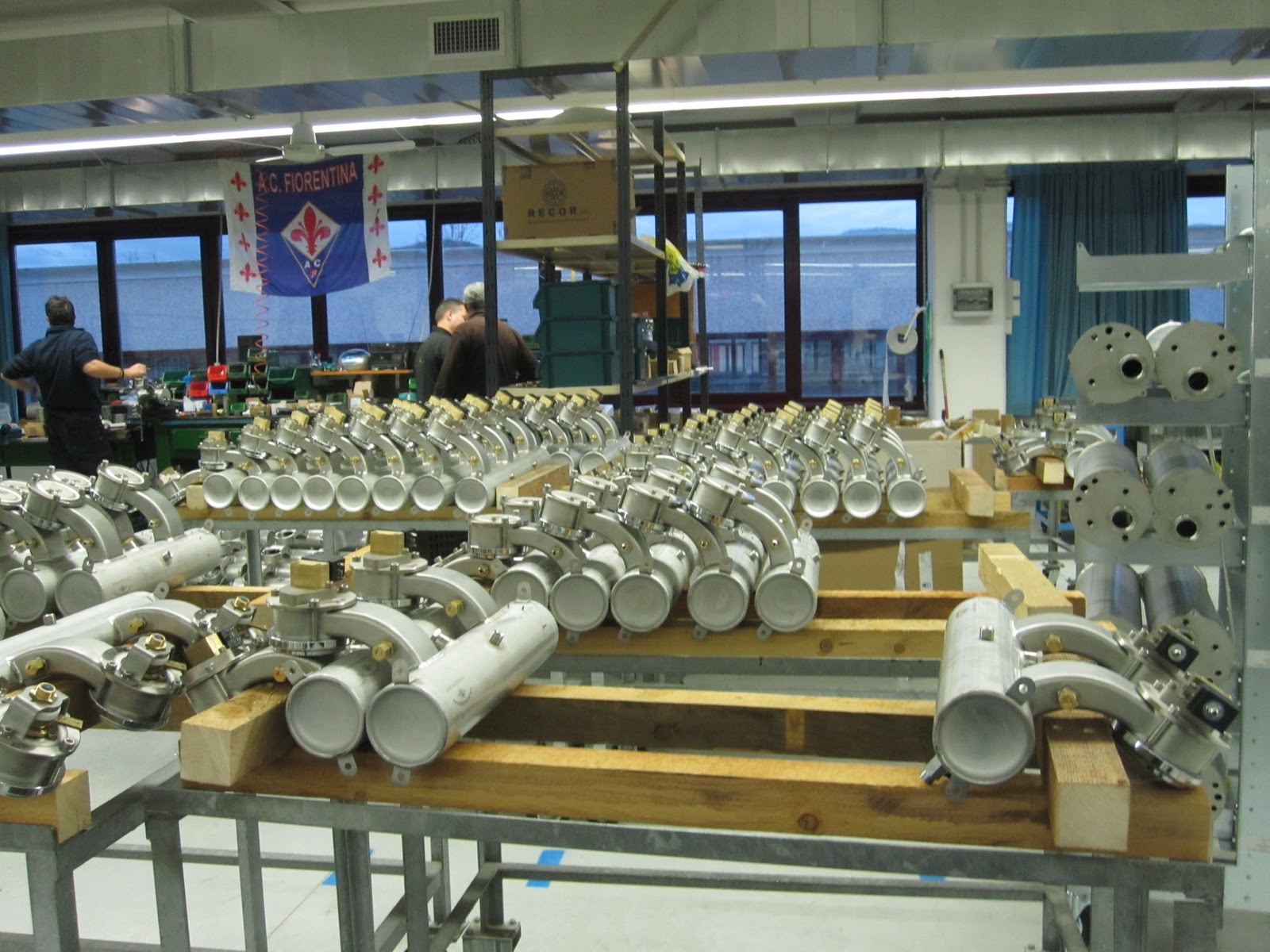
Downstairs is where the fun happens: manufacturing. Over fifty people work here at La Marzocco where they produce a few thousand machines a year. Looking around it really is La Marzocco mecca. Machines of every model and size are everywhere. It's a spare parts orgasm. I'd like to pick up supplies but really I'm a bit overwhelmed.


Mary Diamond and the GS3 production line.


They've just started the production of the first ten Strada EP machines and we bump into Roberto who's trying to fix a problem with Strada EP Number One. I'd tell you what the problem was but I've been placed in the Cone Of Silence about what I saw with the new Strada but I did manage a photo to show you (it's been redacted due to WikiLeaks).

Sadly, my visit to La Marzocco was limited. My flights were late, I arrived late, it's Friday and of course, everyone wants to go home for the weekend, but I did get to see Piero Bambi for a moment or two. It was a short visit but a good one and I look forward to returning on another trip.


Ah, La Marzocco Heaven.


Seattle mural on the conference room wall.


Custom GS3 machines.


A custom painted FB80.


The ubiquitous plastic La Marzocco tamper, in stainless steel.


The bar with custom brass cased FB80, Swift grinder and new Volcano grinder.


From the front.


The Conference Room

Monday, September 27, 2010

We Are Wendelboe


Bex and Devlin brews while Jeremy reads Coffee with Tim Wendelboe.

Bex is back from the Nordic Barista Cup and she's brought back a few goodies with her: a bottle of Cascara beer, some Nordic Barista Cup Cupping Cups, coffee from Stockfleth's, coffee from Tim Wendelboe and the Tim Wendelboe Coffee Book.

When she left for Norway, I sent her off with one command: "Go forth, seek Wendelboe, and take lots of pictures!"

The report: coffee in a reserved and refined environment, iced coffee in martini glasses, iced cappuccino via a spindle mixer and two chairs.

Two chairs??? Really??

That Wendelboe... the things he gets away with... Two chairs....hmph!

With the book in hand and a bag of Mugaga Kenya coffee, we start brewing. Evidently, Kenyan coffees are Tim's favorite. Evidently, he writes that statement three times in his book. Evidently, Tim likes Kenya.


According to the label, this coffee comes from the Kiamabara factory in Nyeri, Kenya and features SL28 and SL34 varietals of arabica coffee, with "Vasket" (I have no idea what that means). Harvested in January 2010 and roasted September 21st. Tim's coffees are uniformly good and while I can't say I've had a lot of his coffees, everything that I've sampled from Tim Wendelboe (the company and not necessarily the man) has been very good indeed. Like that Ethiopian he had last year that was searingly good.

With Chemex and Coffee with Tim Wendelboe in hand we start brewing.

The Kenya is fruity, bright and a bit tannic. It seriously reminds me of cascara tea. It's likeable and tasty but is quite a departure from other Kenyans I've tried recently. Vastly different than Counter Culture's Thiriku, the Mugaga is decidedly on the fruit but more like the dried cascara fruit than a berry kind of fruit.

Tomorrow, it will be time to sample that Panama Hacienda Esmeralda from Stockfleth's - that is, unless my staff has drank it all by then...

Wednesday, September 22, 2010

International Chefs Congress 2010


Cheryl from Montreal's Toque! prepares fish.

I'm in New York City, amidst the gridlock that accompanies the General Session of the United Nations General Assembly to attend the annual Star Chefs International Chefs Congress - a three day event of all things cuisine. This is my second year attending and it's just like last year: a bit of a pain in the butt because of the odd logistics but a conference jam-packed with knowledgeable chefs that it's all worthwhile.

The sessions range from panel discussions to culinary demonstrations to world-class chefs simply showing videos. The approach and techniques presented are wide and varied and I'm learning a lot. On the other side of the stage, the show floor displays the latest and greatest in equipment and I'm still in serious need of a custom Randell refrigeration setup, and an Irinox Blast Chiller, more Polyscience immersion circulators, a Winston C-Vap, and a convection oven from Waring would be nice too.


Dan Barber's Charcoal.

Also on the show floor are tastings of nearly everything from seafood to meats to cheese and cocktails and wine. There's even free beer from Stella Artois. All of this means that you can spend three days hovering over inebriation, eating samples of Australian wagyu beef, Canadian pork and New Zealand oysters while trying to digest what Keller is saying about craft over cuisine.

Chefs are everywhere. From the famous to the notorious to the tv chefs to the yet to be known. I sit next to Jay Santos from Hell's Kitchen and get some questions answered on how long it takes to shoot the show (two months) and when they shot the show (nearly two years ago). I see old friends on both sides of the trade show and even get a moment to meet Shuna Fish Lydon of Eggbeater fame. Eggbeater is a blog I've been following for some time now and Shuna writes clearly and concisely about the craft of cooking, the professionalism of cooking and has tremendous thoughts to offer. I highly recommend reading her blog as a "must read" for any culinary professional.


Jordan Kahn discusses (sort of) his creations.

All in all, a great time with so much information to digest that it takes me a couple of weeks to synthesize it all into something coherent.

But I'll be here next year for sure.


The Brothers Voltaggio square off with "Tongue and Cheek"


El Bulli's Albert Adria...

Monday, September 13, 2010

Hickory Dickory Capp


PolySciene Smoking Gun with Hickory dust.

The relatively simple idea hit me as I was sitting at the computer the other day looking at the Internets. Infuse milk with smoke and see what happens: The Hickory Dickory Capp.

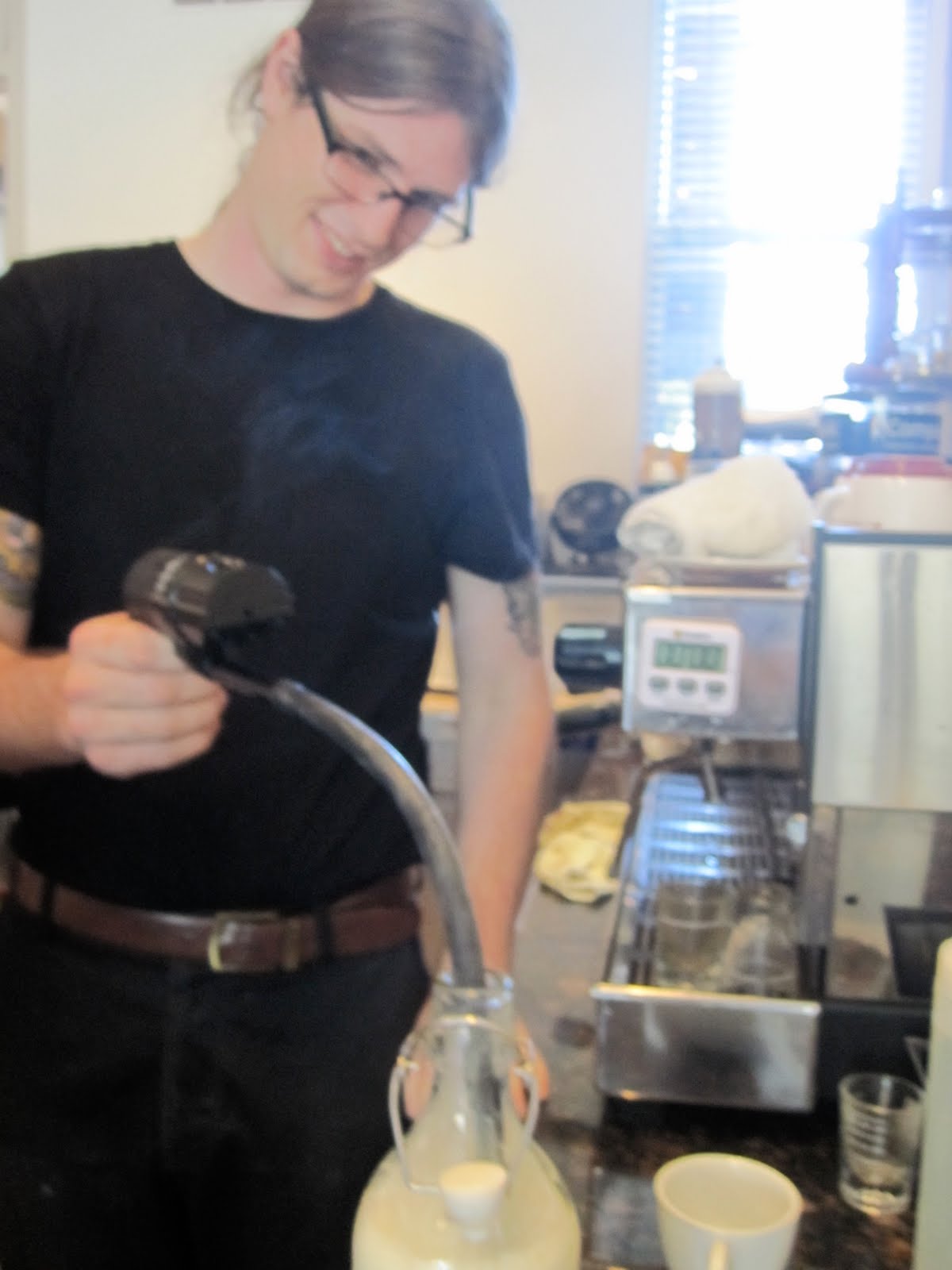
But how to do it? Luckily, I've got a Smoking Gun from Polyscience in the lab. The procedure would be relatively simple: shove the tube into the milk and smoke. A few whirring moments later and the milk bottle was bubbling up with hickory smoke.


Devlin gives it a go.

We let the smoke infuse into the milk overnight and then set out to make a very simple and straight cappuccino. Half the group couldn't really pick out the smoke, the other half thought the smoke was a bit light and I thought it just tasted kinda nasty with notes of rubber, tar and general unpleasantness.

That's when another variation popped into mind: The Hickory Chicory Capp...


The Hickory Dickory Capp

More to come.

Thursday, August 26, 2010

Vacuum Cold Brew


Jeremy and Linsday prepare the coffee.

Some discussions the other day over the internet prompted me to ponder the potential for vacuum brewing cold coffee. If marinades could be infused into proteins, pickling juice into vegetables and compression to fruits, what possibilities would vac bagging coffee yield? Could it lead to properly extracted cold coffee in a short time period?

With that in mind, we gathered the Ethiopian Yirgacheffe from Origins Organic Coffee that we're brewing at Spro in the cold brew tower. It's become our de facto standard iced coffee this summer with a crisp fresh flavor profile featuring notes of citrus and a reassuring familiar taste of "coffee." It's light and easy to drink and has been the panacea in Hampden for our hot Baltimore summer.


Ready for the chamber vacuum.

For this initial test, we chose relatively simple parameters: 48 grams coffee, 24 ounces cold water, vac bag at 31 mbar and just wait.

Initially, I was planning on leaving the bagged coffee overnight and then pull it out to see the effect. The concern there was that if I was going to let it steep overnight, then it doesn't really offer much of an advantage over the brew tower or other long-term brew methods.


Water temp 70.3F but I it feels cooler.

Instead, I opted to let the bag steep for ten minutes and then pull a sample. While the thermometer shown displays 70.3F I'm hard pressed to believe its accuracy because it was pretty cool to the touch.

Perhaps I should note that while it is possible to bag water and coffee with a Food Saver type of vacuum sealer, it is difficult and chances are that you won't get the proper flush of air from the bag, nor will you be able to set the vac pressure. A proper chamber vac allows greater control of the vacuum environment as well as a complete vacuum being set over the liquid.


Filtering the coffee with Hario V60 and AeroPress.

After ten minutes it was time to cut the bag open and give it a taste. However, the coffee needed to be filtered and we tried two different filtration methods: simple paper filter in a V60 Pourover and a pressurized filtration through an AeroPress.

The problem with pouring out steeped coffee are the sediments which gather in the filter. Normally, these are dispersed throughout the coffee bed, but lacking the coarse ground coffee, the fine sediment clogs the paper filters. The pressure from the AeroPress only improved filtration speed slightly.


V60 and AeroPress filtered with the brew tower control sample.

The results themselves were less than stellar but proved insightful. At ten minutes under pressure, the coffee had been extracted but was still underextracted. The color variations in the samples above demonstrate this. The flavor show hints of the tower brew but was very faint.

No conclusions as there's still much to be tested and tried, but it's a good start. Some thoughts were to go with hotter (100F) water or longer times. In the coming weeks we'll sample more and see how it goes.

Tuesday, August 24, 2010

Living The LB Loca


Bex, Martin, Jeremy, Lindsay and Devlin ponder the meaning of hot water.

Received a message the other day that Ben and Andrew were going to be in town for a day and perhaps we might be interested in having a look see at their LB-1 Water Delivery System prototype.

As you'll see in the photos, this iteration of the LB-1 is a bit more industrial looking with design cues that reminds me of the Slayer espresso machine. Large, brushed metal panels, polymer ribs and a style that looks chunky while remaining quite svelte. Spro Hampden is a muted space with cream colored walls, mahogany cabinetry and dark granite countertops but the LB-1's industrial look surprisingly did not look out of place on the brew bar.

The model we played with today is the second generation prototype. Being a prototype, there are some kinks to work out and who knows what the final production model will look like and feature. This one however sports large brush metal side panels and drip tray. The unit is essentially two pieces: the main body and the drip tray. Assembly is surprisingly easy and the unit lightweight and low-profile.

One of the ideals behind the unit is to make it easy for an existing shop to add a by-the-cup brewing device. All the LB-1 needs is a standard water line and a 125v 15a socket and you're good to go. Tapping a T off the hand sink water line took a couple of minutes, plug it in and we were ready to rock and roll.


Andrew and Ben talking the points.

Unlike hot water boilers in the coffee industry today, the LB-1 heats water on demand and we were pulling at temperature water essentially the moment the machine was powered on. Impressive.

Somewhere in the sleek casing of the LB-1 is the heating device, which will either run cold line water through the system or heated water to a tenth of a degree. Simply turn the dial, select the temperature and squeeze the nozzle-mounted button and away it goes. A full screen menu allows you to brew manually or select preset brewing profiles.

Beyond simply controlling water temperature, the LB-1 also allows you to control water flow rate from a trickle to 11 ounces per minute. I've been told there is potential to increase the flow rate but that would also require a power increase. The unit does not allow the operator to set a flow rate faster than the machine can heat the water accurately.

The cell phone import screen is bright, crisp and clear and is hands-down the current best control screen in the coffee brewing marketplace. If only other manufacturers would get into 2007 with GUI screens, then we might have something to get excited about.


Up close and brewing.

The LB-1 GUI is relatively simple and straightforward. A press of the main knob selects the menu options from Presets to parameters and then a twist of the knob inputs the values. A separate, mechanical knob controls the water flow rate - which is displayed on the screen.

A separate button controls additional timer and flow calculation functions but the button had been damaged in transit from Boston and wasn't operative today.

Currently, the presets are limited to straight time and flow. Brewing complexities such as 30 seconds, 2 ounces, stop, then flow 11 ounces for 3 minutes 30 seconds are not possible at this time. It would be a nice feature if the software allowed for complex brewing parameters at varying intervals. Ideally, a barista would be able to select from a menu of presets that are operator labeled. Then you could program the unit with parameters for methods like: "V60", "Clever", "Chemex", etc.


Devlin and Bex work the V60 pour overs.

During one of the tests, I was able to approximate a pseudo-complex brew by programming the unit to flow at a rate of 3.4 ounces per minute, which would result in a brew time of roughly 4 minutes for 12.8 ounces of water into a Beehouse pourover. It worked well enough and lent a good idea the potential for the unit.

The actual brewing is actuated by a button on the control nozzle. Click it once and the unit starts to brew either in manual mode (click once to start and again to stop) or preset mode (click once to start the preset and the unit stops according to the set parameters), hold the button down and it flows on demand - meaning that the flow stops when you release the button.

It's a good idea and works pretty decently but the prototype button demonstrated some difficulty knowing when to start and stop when wet. The nozzle features a nice, ergonomic contour but those used to using a Hario Buono (or similar) kettle will notice right away this prototype's need for a more refined nozzle tip. It's shape means the water stream droops and is a bit messy.

Dispersion of water across the coffee bed is achieved by manually maneuvering the nozzle around and saturating the coffee. This is where we started to see that the unit needs to be "higher" in clearance. Stack a scale, ceramic cup and V60 pourover on the drip tray and you're snaking your hand into the clearance between the lip of the V60 and the bottom edge of the LB-1's top. Want to brew a double 24z Chemex with the unit? Not going to happen - not enough clearance.

Though I should note that the necessity of a scale will probably not be an issue since the unit measures water volume - negating the need for a scale to weigh dispensed water.


Comparative Chemex Brewing.

While we're used to pouring water over the coffee bed by hand, I'm wondering if there is a way to create some sort of "showerhead" that will disperse the water over the coffee bed evenly. As we were brewing, I noticed different patterns in the "crema" of the brewing methods, as well as the way the coffee rested on the filters as the coffee drained through.

Our first test brew was to pit hand brewed V60 pour over of Barefoot Coffee's San Jose Rojo versus the LB-1. One of the potential problems we face in the current state of by-the-cup brewing is the constant loss of water temperature throughout the brew cycle. The LB-1 delivered water at a constant 92C for this test and the LB-1 brew was the everyone's choice as "better" than the hand-brewed.

With that in mind, it's easy to think that the LB-1's flat temperature profile is the trump card, but I'm not so sure about that. Differences in agitation, water temperature and flow rate may have skewed the results. One of the biggest concerns I have with the Hario V60 is probably the reason why baristas nationwide seem to prefer it: it can brew coffee faster than the Beehouse.

The V60's large orifice and turbofan design means that you can brew a 12z cup of coffee in under two minutes. The restricted orifices of the Beehouse forces a longer brew time. Certainly an argument can be made that a skilled barista will time their V60 brew out to 3-4 minutes, but the pressure a line can too easily translate into fast brews.


Presetting Beehouse brew parameters.

The difference in taste between the two cups was dramatic and I have to admit that it was the first time I have ever thought that the Extract Mojo would have come in handy. It would have been helpful to test the brews and see the differences in solids extraction.

Before anything definitive can be stated, it's going to require more thorough investigation and testing with the unit, but the results so far are at the very minimum "interesting" if not outright "promising."

Bringing the LB-1 into a working service environment proved useful in a number of ways. Not only were we able to "play" with the machine but we were also able to brew coffees for customers under the pressure of a surprisingly peppy afternoon service.


Letting it flow at 3.4 ounces per minute.

While we only had the machine on the brew station for a couple of hours, some thoughts come to mind specifically for service at Spro. Since my experience with the LB-1 at SCAA Anaheim and the Uber Boiler at LM Out of the Box, I've been a bit skeptical about the applicability of these brewing units in our service environment.

First off is cost. At just under six thousand dollars and a boiler that takes 4 minutes 16 seconds to recover after dispensing only twenty percent of it's capacity and rendering the unit useless during the recovery period, the Marco Uber Boiler can prove to be a customer killer. It's simply an eternity in the heat of service for a machine to be down for that long - and since it's unlikely that a barista will recharge the system after only using a liter's worth of water, chances are that the barista will run the boiler down to 10% capacity before recharging. And if 20% took just over four minutes, I cringe to think how long 90% will take to recover.

Here the LB-1 has an edge. Current estimates project the LB-1's MSRP to be roughly half that of the Uber Boiler. Add the on-demand water feature with no recovery time and the LB-1 has another edge over the Marco. Smaller footprint and lower power requirements both best the Uber Boiler again.

But this really isn't about the LB-1 beating the Uber. Compared to a Fetco FWB-5, they're both expensive and a considerable investment. Neither can match the flow rate of the Fetco (or any standard water tower, for that matter), but they do offer greater control.


Ben and Andrew with Matt from Gizmodo.

One of the biggest problems with either the LB-1 or the Uber is that they can only brew one coffee at a time. If you're a shop offering only by-the-cup brewing, you could be screwed. The pundits will tell you that it's easy to overcome by purchasing more units. At six thousand dollars a pop for each Uber Boiler, that's craziness. Not everyone has Intelligentsia kind of money.

And where counter space is a premium (read: every shop I know), does anyone really have the space to drop two or more Uber Boilers into their operations? Consider that the Uber demands not only the counter space but the cabinet space below it as well.

In these situations, the LB-1 might have the edge as well. It's sort-of modular design means that they can design a multiple head drip tray and you simply bolt the additional brew units into place. It could be narrower saving counter space and since it's completely tabletop you don't lose cabinet space below. While cost is always a factor, the theory is that you could get two LB-1s for the price of one Uber Boiler. I don't know if that's really a bargain but it sounds pretty good.

The concern here is whether or not these kinds of brewers can keep up with service. In an environment where one (or two) brew methods are utilized, this can be a considerable problem.

Let's say that your shop offers all coffees brewed with a V60 pourover, and let's say your brew time per cup is four minutes. We'll presume that each cup is brewed to order using either the LB-1 or the Uber Boiler. Now let's say that there are ten people in line who want a brewed coffee. My first thought is: you're screwed.

The simple math says that tenth person is line is going to have to wait 40 minutes for his coffee. God help him if anyone in line orders more than one cup. Add two brewers and his wait is cut to twenty minutes. Tell someone in line that they're going to have to wait twenty minutes for their cup and chances are they're going to walk out the door.

Even if you don't say anything and they do wait, you'll quickly get the reputation that it takes a long time to make their coffee at your shop. At least Starbucks has coffee on demand.

At Spro Hampden, this potential problem is mitigated by the fact that we offer seven different brewing methods, with only a few of them that can take advantage of the LB-1 or Uber Boiler. Methods such as French Press, AeroPress and Vac Pot have no use for those kinds of boilers and take the pressure off both the boiler and the barista.

Our mix of brew methods lends itself well to the notion of placing one of these water delivery systems on the brew bar. However, in our situation, it does not replace the existing hot water tower. At least the LB-1 looks good and fits comfortably on our brew bar.

That said, the LB-1 is still in the prototype stage and there's so much more to develop and refine before the unit is ready for public release. One of the things I'm most intrigued about the LB-1 is its ability to deliver consistent water temperature. Our community has always discussed the "need" for temperature stability but it's been pretty much non-existent until now. Initial tests prove interesting and I look forward to playing around more with the LB-1 to see just where it might be able to take us.