Showing posts with label science. Show all posts

Sunday, August 21, 2011

Cold In-Fusion


Adding cold water to the coffee.

I've been thinking about cold infusions lately. Infusions that don't require heat and are not destructive (changing) to the ingredients used. Heat up the ingredients and a change occurs. What ways can we move to infuse liquids while trying to capture the vibrancy of the natural ingredients?

A technique developed by Dave Arnold at the French Culinary Institute described using an iSi Whip Charger to infuse flavors. At its most basic, the iSi is widely used to make whipped cream. Insert cream, add a little sugar, seal and charge with a nitrogen cartridge and you've got ready made whipped cream.


Double-charged and three minutes.

The whipper is a great tool and I've used it before to make foams and played a little with them to inject carbon dioxide into products - "Strawberry Soda", anyone?

All of this started the other night while I was lying in bed thinking about mole - that ubiquitous Mexican dish of spices, chiles, nuts and cocoa. How might we be able to create a drink that represented mole?


Straining the liquid infusion.

Originally, I pondered this similar question four years ago and didn't get very far. The complex and powerful flavors of the mole, not to mention the gritty paste (for a drink) that serves as the base, made it difficult to work with and I soon abandoned that idea for others (the "Breakfast In Bed" concept).

Fast forward four years and I'm back in the same situation, considering the options. This time, the potential lies in being able to take the ingredients and infuse them into a liquid to carry the flavor and combine that with coffee (or espresso). And maybe Dave's idea of cold infusion might work.


Still a bit cloudy.

But without the necessary ingredients at the ready to make a proper mole, I decided to give it a conceptual try using whatever we had on hand - namely coffee. Stumptown's Finca San Vicente coffee from Honduras has been performing brilliantly this week with notes of vanilla, cinnamon, caramel, hops and macadamia nuts and would make for an interesting test subject. What kind of notes and nuances might we be able to extract from the coffee with this method?

As a baseline, we took 24 grams of the San Vicente and ground it coarser than for french press on a Compak R80 grinder (roughly the 90 setting). Placed that in the iSi Whipper along with 14 ounces of cold water. Screw the top on tight and charge with two (2) nitrogen cartridges, making sure to wait a few moments to allow the nitrogen to absorb into the liquid and shake well between charges.


Through a paper filter.

Once charged, we waited about three (3) minutes for the infusion to take place, being sure to note the fact that if we had simply brewed the coffee it would have taken the same amount of time.

Degas the whipper by holding it upright and using a container to catch any liquid that may come through the nozzle. Slowly allow the gas to escape and then unscrew the top. You'll notice that the liquid looks like it's boiling. This is perfectly normal. After straining the liquid, we noticed that there were still quite a bit of particulates in the liquid and then passed it through a paper coffee filter. Note: it will be more efficient to stir the liquid in the whipper and then pour the entire contents through the paper filter instead of using the strainer first. Passing strained coffee liquid through a paper filter always results in too many fines clogging the filter and slowing the process immensely.


Gassed up.

We tasted the liquid and it was light, fruity with a slight tartiness. Jacked it up with a little simple syrup and the liquid became vibrant. What were just a moment ago light and elusive fruit flavors were now dominate notes of tamarind - both sweet and tarty.

But it needed something more to give it a kick. Back into the iSi, we hit it with one charge of carbon dioxide, degassed and then poured it out.

Something to keep in mind about carbonation: you want the liquid to be cold. CO2 does not hold in warm temperatures. It simply gasses out into the environment. Which is why warm Coke goes flat at alarming rates. The colder the better. We added ice cubes to the iSi to chill down the liquid and keep it as cold as possible.


Finished. Sort of.

Degas the whipper in the same manner as before and we found a lovely amber colored liquid with lovely notes of tamarind and that refreshing carbon dioxide kick. It really brought it to life.

Next week: time to give it a try with actual mole ingredients!

Saturday, August 20, 2011

100g of Calibrating Power


One of the coolest things I picked up yesterday at the gem show was a calibration weight. Perfectly tuned to 100 grams, this weight is used to calibrate your scales and make sure they're in sync.

At home and at work, I use gram scales all the time and the gem show is one of the few places where I can go, buy a gram scale and not have funny or "knowing" looks between me and the person selling me the scale. In America, it seems that the only people using gram scales are gem dealers and drug dealers. In a way, they're all scam artists selling highly addictive products.

Come to think of it, baristas, jewelers and drug dealers all seem to have this in common. Go figure.

And, as any dealer (drugs, gems or otherwise) will tell you: we live and die by the scale, so it has to be accurate and on the money. A couple of grams off and you're talking profit or loss. In the millions. So, a calibration weight is a handy tool.

Some of our scales have been in constant use for nearly two years now. They're dropped on the floor, plopped into drawers, tossed around, slammed around, weigh continuously and are subject to a wet environment. I was almost sure that one of them would be off but when I placed the weight on the scales, they all read "100" grams.

Even the new scales I picked up yesterday were on the money - though the one that weighs to the hundreth of a gram measured "100.12" grams. Hmmm, I'm starting to worry about that .12 gram.

I'm now on the lookout for a proper Bentley so I can join the ranks of dealers worldwide.

Monday, October 25, 2010

Touring The FNC


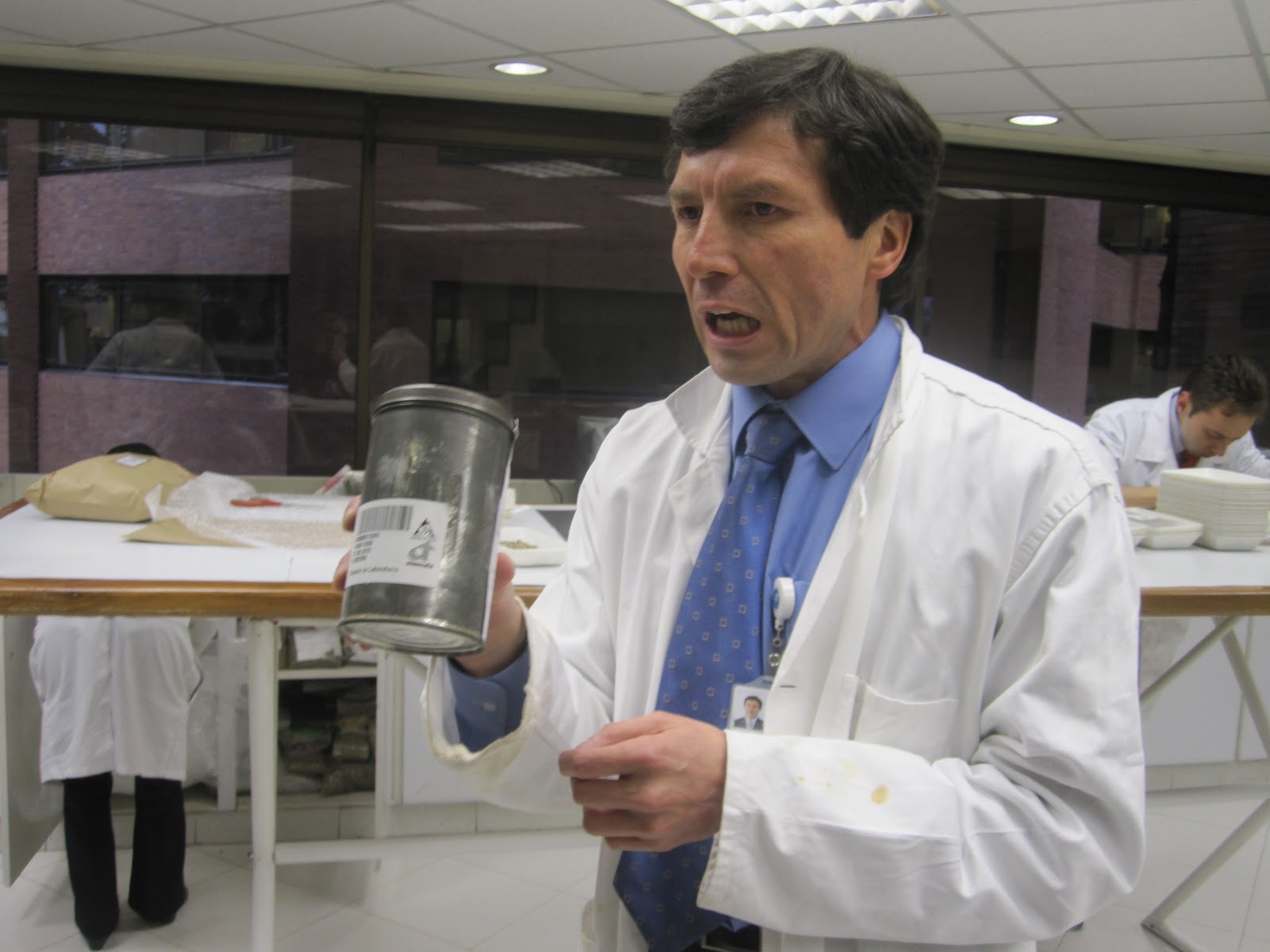
Discussing the categorization of the coffees.

The FNC. Federacion Nacional de Cafeteros de Colombia. The Juan Valdez people. In a nutshell, the FNC controls most of the coffee in Colombia. Even though they only purchase 25% of production, they seem to have their hands in all of it somehow.

Which is not a bad thing. It is what it is.

Luis Fernando has arranged a tour of the FNC laboratories for us and we're eager to see what goes on behind the coffee colored curtain. Will we see the Wizard? Or will we find more coffee?

Last year, we enjoyed the hospitality of Alirio Laguna at the Tolima Comite of the FNC. The labs in Ibague are a bit smaller and less high-tech than here at headquarters and the scope of what is done here turns out to be quite impressive.


The main cupping room - where upwards of 64 samples of each coffee may be tested.

Those of us in the niche of specialty coffee like to throw around the quote that coffee is the second largest commodity after oil. Whether that's true or not is really irrelevant. What we do seem to forget in our niche is that this means that coffee is Big Business.

National coffee organizations, like the FNC, may find the specialty trade interesting, curious and beneficial, but they probably don't consider it significant. What's at stake here is the export trade of the entire nation and the FNC has its control over critical components of that trade.

For example, all coffees are inspected and graded by the FNC. Any Colombian coffee for export must meet certain criteria as established by the FNC. This is to ensure general uniformity and consistency of "Colombian Coffee" and this is where the FNC runs into opposition with specialty.


The roasting lab.

Within the niche of specialty, operators like myself, want to see the uniqueness of a farm or process in a cup. One may wonder how a natural processed Colombian will taste - the FNC and the system in Colombia is designed to prevent that from happening because it's not specified as Colombian Coffee.

At first, it's easy to take offense but as our tour of the facility continues, one sees that all of this is in the interests of commerce and producing a traceable, consistent and predictable supply of coffee.

While companies like Intelligentsia may roast two million pounds this year, it's still peanuts compared to commercial roasters. Coca-Cola alone may purchase two million pounds of solely Colombian coffee, dwarfing the production of specialty darlings like Counter Culture.

And when Coca-Cola is buying coffee for use in it's Georgia brand of coffee beverages, or as a component for Coke itself, it's looking for a decidedly consistent and predictable flavor profile. Unlike the specialty niche where we celebrate the seasonal differences in coffee, companies like Coke demand a consistent flavor profile year to year for their products.

And let's be honest, if Coke changed flavor slightly year to year because of these seasonal differences, you'd be unhappy about it too.


My expertise is called upon to settle a production issue.

A massive part of the FNC is to aggregate the years coffee crop, identify, quantify, categorize and track so that their customers can be delivered a consistent product. Everything going on in this laboratory is designed to facilitate that mission. And to me, it's massively impressive.

Impressive that anyone can take a crop that changes from year to year and cultivate results that are consistent from year to year. Some may think that this is terrible commercial industrialism (and it probably is) but I tend to view it as the artisans at the great Champagne houses in France who blend wines together year to year to produce a consistently great champagne. The work is truly remarkable.


Ian cupping for a second opinion.

So much is going on that it's difficult to absorb it all. Since my days developing syrup flavors for Jays Shave Ice and making cabernet sauvignon in the backyard, I've always admired and been fascinated by this kind of work. Perhaps one day, when I own Coca Cola, I too will return to cup coffees and place our order for ten million pounds of high grade, pure Colombian.


Luis Fernando demonstrates the new packaging.

Saturday, September 25, 2010

Cascara Testing


Five preparations of Cascara.

We've received a shipment of Cascara from Finca Mauritania this week at Spro and we're trying to figure out what to do with it.

Cascara is the outer hull of the coffee cherry that has been washed and allowed to dry out in the sun (presumably). And since, at some point in time, humans like to put just about everything in their mouths (to see whether or not it will kill them), someone came up with the idea of drying out what has been traditionally discarded for compost, steeping it in water and drinking it.

Luckily (for that person), the resultant "tea" wasn't poisonous and a new revenue stream was discovered.

Cascara has the potential to be sweet and fruity, but handled improperly it becomes tannic and bitter. So we're trying to see just how we can bring this to our menu in a positive way (meaning: eliminating the tannins and bitters). Hot brew, cold brew, multiple hot brews, mixing hot brews - it's all very un-scientific but yields (sometimes) tasty and highly caffeinated results.

Speaking of caffeine, there will be no "decaf" Cascara for the foreseeable future.

More to come as they develop.

Monday, September 13, 2010

Hickory Dickory Capp


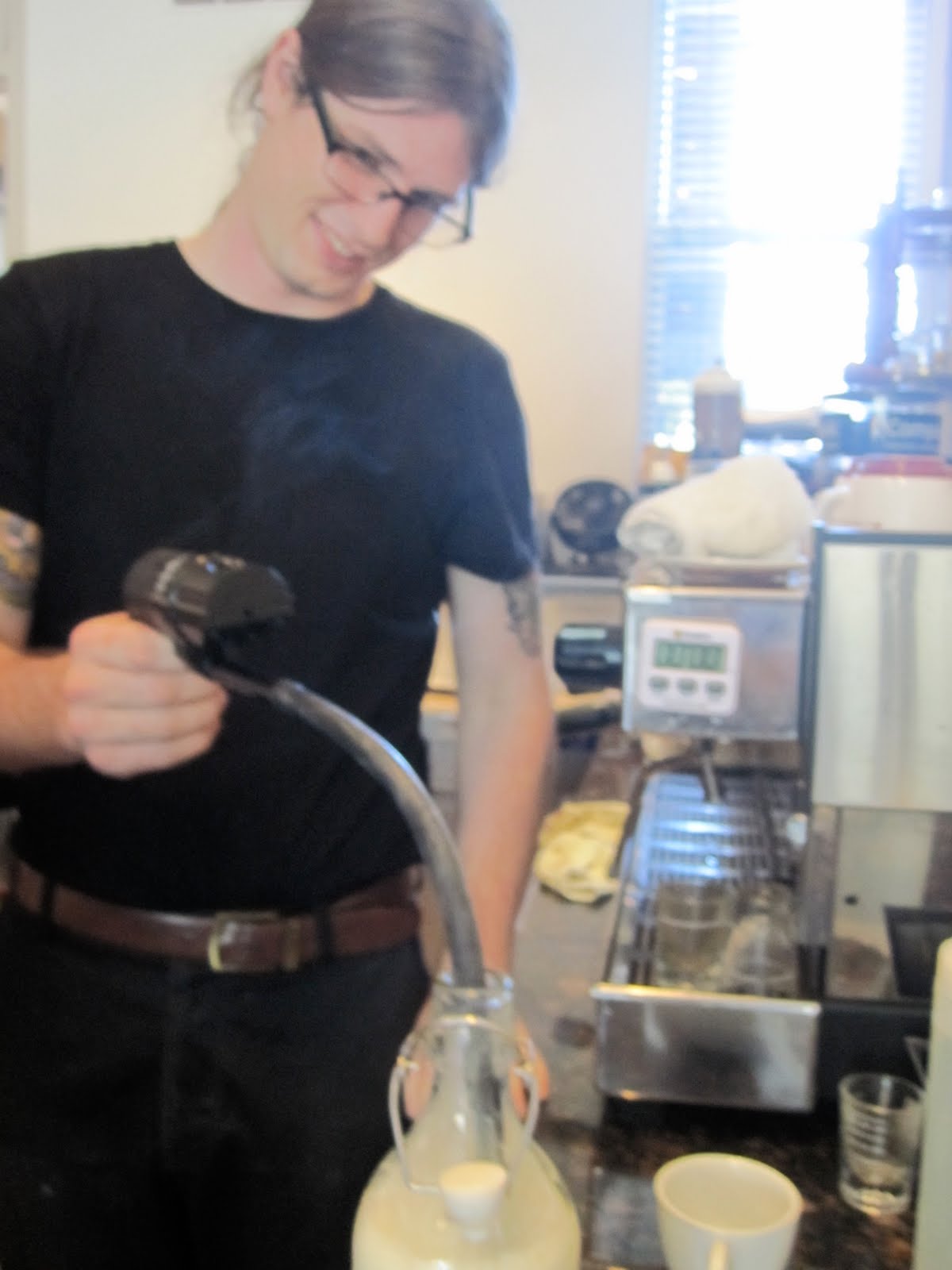
PolySciene Smoking Gun with Hickory dust.

The relatively simple idea hit me as I was sitting at the computer the other day looking at the Internets. Infuse milk with smoke and see what happens: The Hickory Dickory Capp.

But how to do it? Luckily, I've got a Smoking Gun from Polyscience in the lab. The procedure would be relatively simple: shove the tube into the milk and smoke. A few whirring moments later and the milk bottle was bubbling up with hickory smoke.


Devlin gives it a go.

We let the smoke infuse into the milk overnight and then set out to make a very simple and straight cappuccino. Half the group couldn't really pick out the smoke, the other half thought the smoke was a bit light and I thought it just tasted kinda nasty with notes of rubber, tar and general unpleasantness.

That's when another variation popped into mind: The Hickory Chicory Capp...


The Hickory Dickory Capp

More to come.

Thursday, August 26, 2010

Vacuum Cold Brew


Jeremy and Linsday prepare the coffee.

Some discussions the other day over the internet prompted me to ponder the potential for vacuum brewing cold coffee. If marinades could be infused into proteins, pickling juice into vegetables and compression to fruits, what possibilities would vac bagging coffee yield? Could it lead to properly extracted cold coffee in a short time period?

With that in mind, we gathered the Ethiopian Yirgacheffe from Origins Organic Coffee that we're brewing at Spro in the cold brew tower. It's become our de facto standard iced coffee this summer with a crisp fresh flavor profile featuring notes of citrus and a reassuring familiar taste of "coffee." It's light and easy to drink and has been the panacea in Hampden for our hot Baltimore summer.


Ready for the chamber vacuum.

For this initial test, we chose relatively simple parameters: 48 grams coffee, 24 ounces cold water, vac bag at 31 mbar and just wait.

Initially, I was planning on leaving the bagged coffee overnight and then pull it out to see the effect. The concern there was that if I was going to let it steep overnight, then it doesn't really offer much of an advantage over the brew tower or other long-term brew methods.


Water temp 70.3F but I it feels cooler.

Instead, I opted to let the bag steep for ten minutes and then pull a sample. While the thermometer shown displays 70.3F I'm hard pressed to believe its accuracy because it was pretty cool to the touch.

Perhaps I should note that while it is possible to bag water and coffee with a Food Saver type of vacuum sealer, it is difficult and chances are that you won't get the proper flush of air from the bag, nor will you be able to set the vac pressure. A proper chamber vac allows greater control of the vacuum environment as well as a complete vacuum being set over the liquid.


Filtering the coffee with Hario V60 and AeroPress.

After ten minutes it was time to cut the bag open and give it a taste. However, the coffee needed to be filtered and we tried two different filtration methods: simple paper filter in a V60 Pourover and a pressurized filtration through an AeroPress.

The problem with pouring out steeped coffee are the sediments which gather in the filter. Normally, these are dispersed throughout the coffee bed, but lacking the coarse ground coffee, the fine sediment clogs the paper filters. The pressure from the AeroPress only improved filtration speed slightly.


V60 and AeroPress filtered with the brew tower control sample.

The results themselves were less than stellar but proved insightful. At ten minutes under pressure, the coffee had been extracted but was still underextracted. The color variations in the samples above demonstrate this. The flavor show hints of the tower brew but was very faint.

No conclusions as there's still much to be tested and tried, but it's a good start. Some thoughts were to go with hotter (100F) water or longer times. In the coming weeks we'll sample more and see how it goes.

Saturday, May 22, 2010

Going Metal


Vac Pot filtered coffee going to head-to-head.

In Japan, sophisticated syphon bars utilize a type of metal filter in their vac pots that screw together allowing you to use either cloth or paper filters with quick change ability. In America, intrepid baristas have found a way to use a La Marzocco dispersion screen in lieu of the cloth or paper filters. An intriguing idea but an unusual challenge to find a U.S. based source of these seemingly elusive metal screw filters.

Finally got a (small) stack of these filters with the thought of them replacing our cloth filters for vac pot service. Matched with new metal dispersion screens, these contraptions promise the hope of simplicity and ease of cleaning - which should make bar life slightly easier.


Metal filter on the left, cloth on the right.

The experiment is simple enough: take one metal filter and one cloth based filter and brew head-to-head comparison coffees and see which one is best. For the test, we used the Honduras San Vicente Micro Lot from Origins Organic Coffee of Vancouver. Same ratio, same technique, same coffee - different filter. I was surprised by the results.

In a perfect world, the metal filter would produce the exact same results as the cloth filters without the mess or fuss of cleaning between usages. In this world however, the results were surprisingly different.

Looking back in retrospect, it probably should be a surprise since the La Marzocco dispersion screen is not as fine as the cloth filter and one should then expect sediment. Whatever the case, the resulting sediment was unexpected in my mind resulting in a coffee with more body that reminded me of press pot coffee and a distinct departure from the clarity typically found in a vac pot brewed coffee.

My initial reaction is that I didn't like the resulting coffee. I prefer the clarity of vac pot when brewing vac pot. If I wanted the body and murkiness of pressed coffee, I might as well use a french press. That said, some of the Spro baristas liked the alternative results of the metal filter and we're giving it a run this weekend to see how it performs in a service environment and check feedback from customers.

So if you want to see the latest in vac pot brewing by intrepid baristas, have a visit this weekend.

Monday, February 22, 2010

ph: Thinking Oysters


This shell is on fire.

Last Friday I conducted a workshop on signature drinks and their development. One thing that I noted to the class is that there truly are no "original" ideas. Everything comes from inspiration or evolution. Without a base of knowledge to work from, it becomes very difficult, if not impossible, to springboard something different.

And while a number of the signature drinks I have done for competitions has garnered attention and a "wow" factor, none of them are truly original. All of them were springboarded off the work of someone else, then forged with the collaboration of friends and experts.

Take the Coffee and a Cigarette drink I used for the 2006 United States Barista Championship. Lots of people were "wowed" by that one, but it's nothing original. In fact, it's something that I derived after reading about lots of Thomas Keller and using one of his recipes as a jumping off point.

Even last years "Lobspro" was inspired and derived from elsewhere: Eric Ripert of Le Bernardin. Without seeing his "Lobster Cappuccino" it wouldn't have occurred to me to pair coffee with lobster (even though his execution did not actually incorporate coffee into the dish).


A mold prototype.

Back in September, I attended a demonstration by Spanish wizard Paco Torreblanca and was absolutely blown away by his method of making chocolate oysters. Simply create a mold from a real oyster shell, mold chocolate and then you're done. Amazing.

Since that time, I've been nurturing the oysters in the back of my mind and collecting nice shell examples that might work for what I have in mind. Today I started to figure out how to mold those shells for chocolate work.

It's not too difficult but I immediately see the need for welding gloves to protect my soft, supple hands. After a couple of tries, I think we're getting closer to the right technique.

And while you won't be able to check this "signature" drink out at the USBC (since I'm not planning on competing), you will be able to visit us at the new Spro Hampden and order it off of our menu in the spring.

Wednesday, February 03, 2010

Jetting For Paco


The ingredients for Paco Jet Ice Cream.

Back in the Jays Shave Ice days, we used to make soft serve ice cream. I loved it. The luscious texture of the ice cream fresh from the freezer - I used to fill the cake cones just to the edge for my evil treats.

Every once in a while, I would take a tub, fill it with soft serve, mix it with aggregate (like chips, honey or snickers) and freeze, creating a sort of hard-packed ice cream. Then when Spike opened Woodberry Kitchen, I would hang out observing Isaiah making fresh ice cream in a Lab 100, and if it spun too long, turn into butter.

Later, I would reflect wondering how our then commercial mixes at Jays Shave Ice avoided the butter stage even after churning in the soft serve machine for hours on end. It just didn't make sense to me that we could make an in-house soft serve ice cream that would not churn into butter. And it confounded me that David Chang was doing his own soft serve at Momofuku.

From there, I turned to Arbuckle's book on ice cream and found a bit of information that didn't quite make sense to my non-science oriented mind. For my food chemist aunt who gave me the book, it must be easy peasy, but to my filmmakers background, I was swimming.

Arbuckle talked of stabilizers and industrial processes and it just seemed out of my league. I just wanted to make a high fat content soft serve that was delicious, thoughtfully sourced and wouldn't churn into butter, because it really sucks to clean out freezer barrels that have chunky butter stuck inside.

It wasn't until reading Kriss Harvey's Paco Jet centric blog that I started to "get it" that the key to proper ice cream is controlling the fat content and utilizing "industrial" stabilizers to keep everything copacetic.


Stick blending the mix with a Waring (thanks Giuliana!).

Fast forward to tonight where I've returned to the secret workshop of Woodberry Kitchen to whip up some of Kriss Harvey's Paco Jet ice cream recipes.

The basic recipe is relatively simple. Milk, cream, egg yolk, vanilla beans, milk powder, atomized glucose and Cremodan 30 stabilizer. The last two ingredients sound scary but they're really not. They're all food-based derivatives.

Heat, mix, strain, cool and freeze into the beakers. I'll be back over the weekend to spin the ice cream and see just how they turn out.

Saturday, January 30, 2010

ph: The Saturday Jet


Morning coffee service drills at project hampden.

Lately Saturday mornings at project hampden have come to mean brewing drills and coffee service. Anyone finding themselves in the vicinity of project hampden have been invited via Facebook (and the evil Twitter) to stop by and have a coffee on us. With the espresso machine finally installed and (most) of the plumbing completed, we're ready, willing and able to rock-n-roll with most of the drink menu.

Whether it's Aeropress, French Press, Clever, Chemex, Vac Pot, Eva Solo, Pour Over or espresso, cappuccino or latte you crave, project hampden is ready to deliver.


Artichoke Sorbet.

The basic drill goes like this: the crew breaks up into teams of three or four and the rest act as customers ordering coffee. Of course, the friends who find their way here are tossed into the mix. The "rush" lasts about fifteen minutes and then the team can concentrate on getting all the drinks out. It's a decent way of conditioning the teams for service, but I'm concerned that the narrow "rush" window is inadequate. What we're doing with project hampden is unprecedented: six coffees and seven brewing methods - all done by hand, to order, a la minute and by the cup.

In the drills, the person designated at the register takes the orders then passes them on to the rest of the team. Once that person has taken all the orders, she can then help the others completing those orders. But in a sustained rush, with real customers on a time schedule, that luxury disappears. The only way to test their ability to deal with a sustained rush is to open and wait for the tidal wave to hit.


Tasting the results.

Meanwhile, we had some beakers freezing at Anisha's since our freezers haven't arrived yet. Thursday nigh, Lindsay whipped up some tests of Chocolate Ice Cream, Brown Sugar & Cinnamon Ice Cream and Artichoke Sorbet. After 24 hours in a deep freeze, they're ready to play.

First up was the Artichoke Sorbet. Crazy strange. And the texture was too powdery. Needs work. Brown Sugar & Cinnamon had too much sugar and was loose and runny after being "Pacotized." And while the Chocolate whipped into a luscious looking cream, it was both too airy and too fatty and didn't have the proper ice cream texture. More like a thick, smooth semi-freddo mousse than a proper ice cream.


Chocolate ice cream.

Certainly, none of the three tests were ready for the menu but they were a step in the right direction. From my readings, the formulation for PacoJet ice cream is a bit different than one you would toss into a batch freezer. Tighter control of the fats, for one. More experimentation is sure to come.

But where else in the coffee business do you get your hair and makeup done for a photo shoot one day, then eat ice cream all day the next?


Brown Sugar and Cinnamon ice cream.

Wednesday, December 02, 2009

Egging It On


The sous vide versus the pan stirred.

A bit of time ago, I attempted to recreate Alex and Aki's Scrambled Eggs and met with disaster. After some coaching from Alex and a water bath running a 48 hour short rib run, I decided to try the egg thing once more.

This time I decided to forgo the problem of the eggs solidifying in the ISI Whip Charger and just vac bagged the mixture of eggs, butter and sour cream. This way, if the eggs solidified, I wouldn't have such a task cleaning out the whip charger - just toss the bag and it would be done.


62C not looking too promising.

After an hour of cooking in 62C water, the eggs were not looking too promising. They seemed cooked but the texture looked like coagulated broken milk in coffee. To say that it didn't look appetizing would be an overstatement and the thought of salmonella or some kind of other food poisoning due to improper handling came to mind.

But since I'm an intrepid kind of chap, who's too foolish to heed his own cautions about food poisoning, I thought I would still give it a try. Afterall, I spent the past hour waiting for this thing to cook.


Scrambled Egg Foam - not quite the result I was looking for.

I should note here that under other circumstances, like me giving you advice on the preparation of this dish, I would tell you to quickly throw the bagged eggs in the trash and start again with a different approach. Under no circumstances would I ever recommend to anyone that they attempt to consume this potentially hazardous/lethal product.

But it was breakfast time and I was a bit on the hungry side, so full speed ahead as I toast to Living Fast and Dying Young.


Scrambled Eggs and Scrambled Egg Foam. Could be an Eggs Two Ways kind of dish...

Happily, as evidenced by my writing of this post, I was not debilitated, poisoned or killed due to my reckless nonchalance with the eggs. After yet another phone call with Alex, I realized my error. Since I hadn't consulted either my own notes or the previous blog entry, I didn't realize that 62C is simply too cool to cook the eggs properly. I had just gone gonzo and winged it - which could have resulted in my being sent to the hospital. Not smart.

Since Hope Springs Eternal, I lived another day to try more of this sous vide eggery foolishness and proceeded to heed Alex's recommendations of cooking the eggs for 25 minutes at 75C.


Scrambled Huevos Otra Vez!

Into the bath went two eggs, two tablespoons of butter and a dollop of sour cream. Wait, wait, wait and then it was time.

Pulling the bag from the bath and already I could see something different. It looked much better than the 62C eggs but still kinda was separate from the eggs and the cream. In spots, the eggs had clotted together. This was remedied by a thorough mixing of the ingredients by mushing the bag over and over again until the mix had combined.


Looking promising in the bag.

From there, it was just a matter of cutting open the bag, seasoning with salt and then layering over a piece of toasted Struan bread from Atwater's Bakery. Lovely.

Perhaps a topping of dill would suffice but I'm thinking that maybe shavings of bacon instead of the slices shown below might make for a fun presentation. Imagine someone coming to the table with a hunk of bacon and shaving slices/pieces of bacon over the eggs. Fun!


Success!


Sous Vide Scrambled Eggs on Struan bread with applewood smoked bacon, and Kenya Gaturiri from Stumptown Coffee.

Wednesday, October 28, 2009

Too Black, Too Strong

"It's just like when you've got some coffee that's too black, which means it's too strong. What do you do? You integrate it with cream, you make it weak. But if you pour too much cream in it, you won't even know you ever had coffee. It used to be hot, it becomes cool. It used to be strong, it becomes weak. It used to wake you up, now it puts you to sleep."
- Malcolm X

Tuesday, September 22, 2009

Clarifying Coffee


Clarified Coffee.

While out last night at Les Halles, I mentioned to Philip that I've been interested in clarifying coffee. Truth is, I think coffee is a very unfortunate ingredient. It's so brown. So very dark brown that the color interferes or destroys anything and everything mixed with it. It's God-awfully ugly and a real challenge to utilize and create into a color that's actually appealing.

I've tried using a gelatin suspension to create a clear coffee but all it did was clarify the brown liquid. James Hoffmann has attempted to clarify coffee using a centrifuge with mixed results. Philip suggested we give it a go utilizing the rotary distiller.

The next day, an Americano goes into the chamber and starts spinning. The idea behind the device is to distill liquids by using a vacuum to lower the boiling point. Our first results were less than appealing but that was more due to not having the proper facilities to clean the apparatus at the conference than anything else.


The rotary evaporator distiller makes its' move.

The day before, they had been distilling Meyer Lemons and the lemon residue remained resulting in a clear coffee liquid with a strong and definitive lemon character.

More testing will ensue in the coming months but the initial test looks promising. I'll report more once the distiller is installed at The Spro.

Star Chefs 2009


Mike Love doing a demo at the VitaMix booth.

I've been in New York City attending the annual Star Chefs International Chefs Congress - a three day exposition of chefs and cuisine. Overall, it's an amazing experience that puts you in close proximity to some of the greatest modern-day chefs. This weekend, I've listened to people like Pierre Gagnaire, Juan Mari Arzak, Paco Torreblanca, Daniel Boulud and Grant Achatz discuss and demonstrate their philosophies and techniques. Just watching them in action has helped to prod and invigorate my own thoughts on processes.

Perhaps unsurprisingly, a number of the presenting chefs were a bit unbalanced and even downright poor showmen, meaning that while they can cook, not many of them are great in front of an audience. Jose Andres and Masaharu Morimoto, however, were brilliant showmen. Both commanded the main stage in their own distinct style. Andres was clearly the more experienced entertainer of the two, not only engaging the audience with humor and philosophies on cooking, but also directing the cameraman towards what he wanted us to see, not whatever random imagery the cameraman and technical director were cooking up.


Yoshihiro Murata discussing aspects of umami.

Which brings me to the weirder aspects of Star Chefs. The camera work was absolutely horrible. In a main stage presentation where the audience is up to a hundred fifty feet away from the dish that's being prepared, good camera work is crucial. Following the narrative of the presenting chef and the action is critical. It's completely infuriating that the camera is off watching water boil (literally) while Morimoto is discussing and demonstrating the intricacies of cutting a tuna.

Then there were the seats. Bleacher style seating with these molded plastic "chairs" that were uncomfortable to sit on. Sitting on them for any amount of time was excruciatingly painful - and the hosts kept asking everyone to stay.


April Bloomfield caresses the pig before butchering it.

By now, I've been to a lot of shows and events and I was struck at Star Chefs how the event hosts saved the front and center seats for themselves, as if they were the stars of the show. Never mind the guest attendees, they can sit in the back. The hosts seemed more concerned about hob-nobbing with the famous chefs and placing themselves front and center for everyone to see and adore than actually taking care of guests.

This was most evident when one of the lighting fixtures blew up overhead and cascaded various bits of lighting and glass on a part of the audience. The hosts, sitting no more than twenty feet away couldn't be bothered to investigate or check on the attendees who had been showered with glass. Instead, they sat there pretending that nothing had transpired. Certainly these two were not hospitality people.


Gifts from April.

After the first day, it struck me that these were like some of the coffee geeks I had observed in the coffee world - outsiders obsessed with wanting to be considered "insiders" and therefore, "cool." I remarked to a friend that this is how a coffee event would be if a particular coffee geek had been the one staging it. My friend noted that it would be even worse.

Speaking of which, I'm disappointed that I didn't see baristas at the event. No one from our end of the world was in attendance. Here, we have an amazing gathering of chefs from around the world discussing their philosophies and techniques and no baristas. All that lip service we give about product and there's no one else here exploring techniques and ingredients? I just don't get it.


Pierre Gagnaire!

Of course, the only other coffee person there was notable rabble-rouser and Man Critical of Coffee Cronies in the SCAA, Mike Love - former chef and owner of Coffee Labs. In a sea of cooks and chefs, Mike and I were the only coffee people. Sad.

What might have been worse was the espresso from La Colombe. I tasted a shot of espresso from their booth and tossed it after a couple of sips. My adventure was rewarded with forty minutes of charcoal in my mouth - and this from one of the most touted restaurant coffee roasters. We still have a long way to go.


Jose Andres commanding the stage.

Otherwise, it was a great time. Most of the chefs gave great presentations and I it's always great to catch up with industry friends like Philip and Jason from PolyScience, Giuliana from Waring Commercial, Howard from Winston Industries, Greg from the NRA and Alex from Ideas in Food.

One chef that did not disappoint was Paco Torreblanca. Perhaps you've read his book (and you should) but he came out to demonstrate his technique for making oysters out of white chocolate, acetate and some powders and it was absolutely amazing. I was furiously punching notes into my iPhone the whole time. The man is a wizard.

In spite of the weirdness and oddities, I'll definitely be back next year 'cause where else can you go and be surrounded by such talent? Plus, the official book of the event is killer and worth the price of admission alone.


Masaharu Morimoto showing his yellowfin technique.


Josh Emett saw through a lamb - New Zealand, of course.


Daniel Boulud, Grant Achatz and Pierre Gagnaire waxing.


Paco Torreblanca ripping it up with chocolate oysters.