Sunday, January 22, 2012

The Waiting Game


2842 - perhaps not the fastest way to the Super Bowl.

Somewhere along the line, I seem to have gone off and into the End Zone.

Years ago, I couldn't stand football, or "football" as we called it (don't ask). Then, around 2004, I secured season tickets and started going to the games. Back then, the Ravens just didn't fare too well and by 2006, I was so inundated with work I ended up only attending two games that year. Not good.

But for whatever reason, I've gotten back into Ravens Football again and decided that I should buy myself a PSL (personal seat license) for the right to buy season tickets. Even today (as in 1996 when it started), I still find it foolish for people to pay cold money for the "right" to buy tickets. It's really just absurd. But seeing that Fan is short for "fanatic" it makes sense. You have to be fanatical to spend that much money.

Prices for PSLs today have skyrocketed into the stratosphere. People are asking for twenty grand for centerfield seats. That's crazy.

With a fan base as crazy as the Ravens enjoy, PSLs have been sold out for years, but you can get a new one (or one that someone else has given up) by joining The Wait List.

The Wait List is a limited list of 3,000 people who pay fifty bucks to join, plus twenty-five dollars per year to maintain their position on The List. By the way, that price is per seat. So for a four seat position, one pays $200 upfront and $100 each year to maintain position. Of course, all the money you paid to the Ravens will be applied to your eventual purchase of the PSLs.

Signing the paperwork reminded me of a buddy in Northern Virginia. An American chap with a lifelong love for cricket. An avid player, he petitioned to join in his twenties and won his entry into the club almost ten years ago. He was on their wait list for thirty years.

Talking to my Ravens representative, who tried to steer me towards the PSL Marketplace to quickly (and expensively) purchase a PSL, told me that my wait time on the list would probably be fifteen years.

Guess that's better than thirty...

Saturday, January 21, 2012

Herr Swengler's Kraut


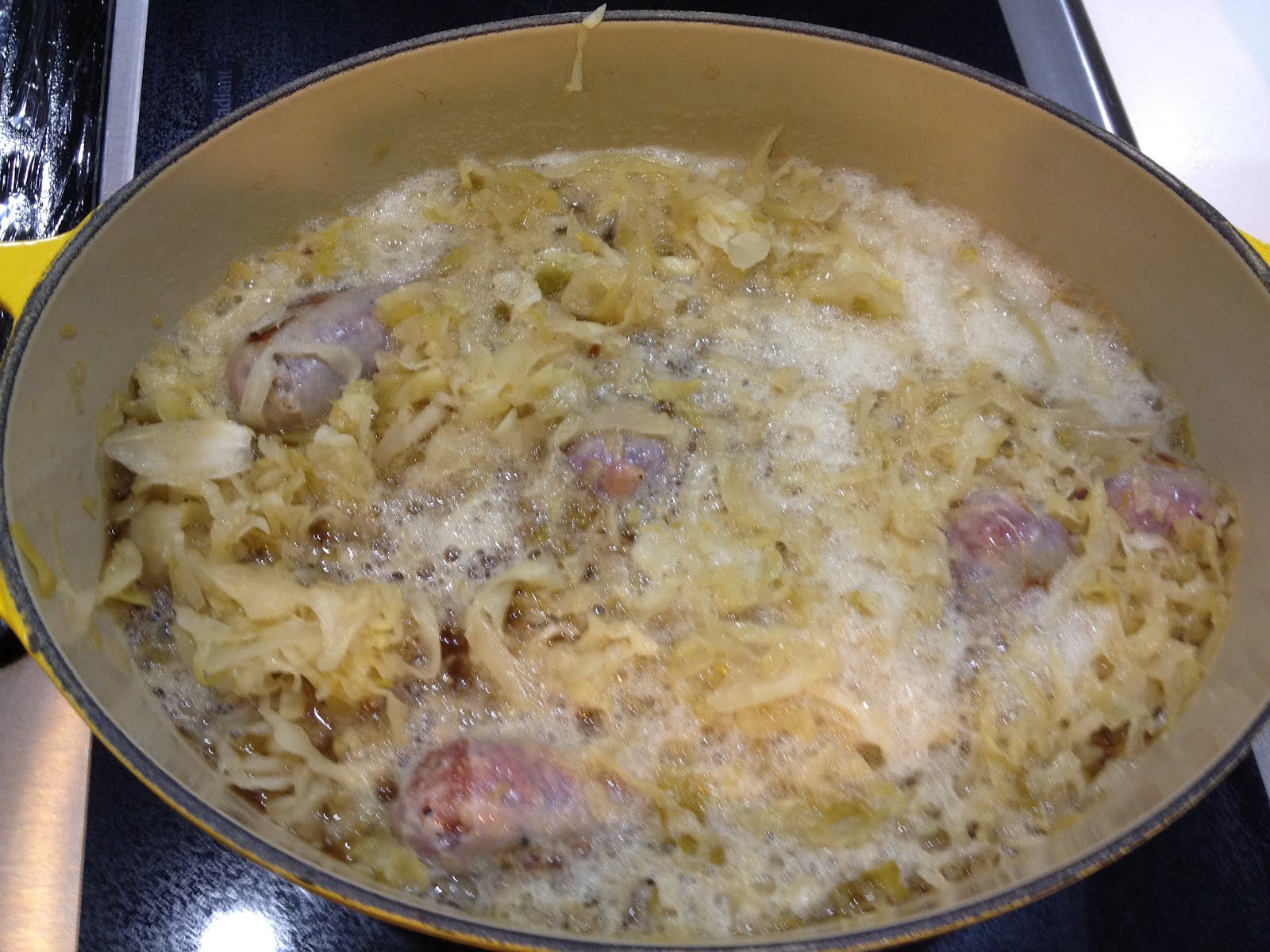
Aventius Doppelbock, Binkert's Bavarian Bratwurst and Herr Swengler's Kraut.

One thing I know for sure after a week touring across Germany is that I don't know anything at all about German food. Sure, the sausage are ubiquitous and the Nurnberger sausage is the precursor to the American breakfast sausage link, but other than SigSauer and sauerkraut, I know nothing except that I enjoyed the food of Germany.

Knowing this, Dai San brought me back some of Herr Swengler's (his dad) homemade sauerkraut to try. This was the real deal. The homemade stuff and none of that nonsense you find in canned jars at the grocery store. Fermented and salty, he said. Beware.


Simmering in the mix.

The directions were simple enough: simmer bratwurst (though I could use kielbasa), sauerkraut and dark beer in a pot until the sausage is cooked through then eat over steamed rice (Dai San is half-Japanese and half-German - or Whole Axis), this of course, appeals to my Filipino side - and I was going to add rice anyway...

While I do have some lovely Ostrowski's Polish Kielbasa at home, a proper German sauerkraut needs a proper German sausage, causing me to trek out to Binkert's German Sausage where I think they only begrudgingly speak English, are unabashed about their meats and they don't accept credit cards - NEIN DU DUMMKOPF!!! Or something to that effect.

A stop off to see Austin at the wine shop and a bottle of Aventius Doppelbock and we're off to the races. A little browning of the sausage to begin with (though you don't have to), several ounces of doppelbock for the pot (and more for myself), Herr Swengler's sauerkraut and just let it simmer.


A simple meal for a cold evening.

One blog post and thirty minutes later, the mix is ready to eat. With rice. Of course.

Pulling a sample from the pot and the sauerkraut is a beast. The texture is firm and slightly crunchy (unlike other krauts I've tried) with a mellow flavor, slight sourness and in your face saltiness. Like I said, it's a Beast. This is sauerkraut, you know it and it's unrelenting.

The white rice helps tone down the salt and the Diet Coke's acid cuts it like a knife. Large spoonfuls of sauerkraut are rewarded with a lovely flavor, just before a mouth-smashing punch of salt. Add a slice of the sausage into the mix and you're rewarded with strong notes of garlic, black pepper and pork to balance out the kraut saltiness on the neutral rice canvas.

Not a bad way to stay in on a cold Saturday night.

Friday, January 20, 2012

Bona Vita Electric Kettle


Starting off with cold water.

During last year's coffee industry trade show, I ran across a small booth with one guy. He was hawking a new drip coffee brewer that was supposed to deliver water at 200F - the ideal temperature for coffee brewing. We talked and I was very interested in bringing these brewers to our customers but they wouldn't be ready for a few months due to UL listing, importation and whatever ills plagues the import manufacturer.

Fast-foward to a couple of weeks ago and Todd finally made it out to see us with some gifts in tow: the aforementioned coffee brewer, along with their new electric water kettle. In case you haven't been following, hand pour water kettles have been all the rage in the barista ranks for the last few years. And while there are a few nice ones on the market, they're usually pretty pricey and are subject to thermal loss during use. HarioUSA has been threatening for a couple of years to import their electic Buono kettle but they've been lazy to do so, and it's such a pain in the butt to do business with Hario distributors that it's easier to just abandon their line altogether - especially when there are easier options available.

The Bona Vita Electric Kettle is one such option.

Manufactured in China, the BVEK features stainless steel construction, a nice tapered pouring nozzle, simple electronics and ease of use. The lid fits securely to the top and features pressure relief holes that can double as an orifice for your temperature probe.

The bottom of the kettle and the base are made from high-impact plastics and feature a switch, located beneath the handle, and a red indicator light to let you know when the thing is "on". Overall, construction is nice and it feels good, though the finger relief on the handle for ergonomics isn't as comfortable as you'd prefer.


Brewing a pour over with the Bona Vita.

Originally I thought I would conduct these tests in the real world of Spro, but it can be so darn busy in there that it's easier for me to take the unit elsewhere where I have the time and space to concentrate and give it a try.

The unit itself is compact and smart-looking. The design has just the right blend of stainless and black plastic, making it pleasing in the workspace. For the home user, it's absolutely brilliant. For the professional barista considering its deployment in a shop environment, there are a few things to consider.

First off, it's reasonably well-built and I do expect it to take a bit of a beating, and if you can avoid dropping the kettle, it should last quite some time. My concern lies with the number of cycles the unit is designed to take. If you're serving 100 cups per day and heating each batch of water to order (or reheating), you could be talking 75,000 cycles per year. It might take the home user a lifetime to reach that many cycles.

But that's not to discredit the Little Kettle That Can. In the few days that I've been playing with it, and the week prior being mauled by the Spro baristas, the BVEK seems like a winner. The construction is good, the design is pleasant and the price point blows even the regular Hario non-electric Buono Kettle away.

For the purposes of this test, I used the BVEK to heat 32 ounces of water from 60.7F to boiling point (212F) and the auto shut off of the unit. With an ambient temperature of 68F, the kettle started steaming (145F) around three minutes and reached 212F at 6 minutes 2 seconds. Not bad performance for a little 120volt kettle. Though, if you were using this in a professional environment, six minutes is quite a long stretch that could be mitigated by running multiple kettles constantly heating.

At Spro, we only serve 12 ounce brewed coffees. For these kinds of situations, how does the kettle perform with lower volumes of water? Typically, a 12 ounce coffee absorbs two ounces of water in the brew cycle. The next test involved heating 14 ounces of water (65.4F) to boiling, resulting in a time of two minutes and fifty-three seconds. Definitely this heating time is well within striking range of any brew cycle, roughly halving the 32 ounce time.

However, heating 14 ounces of water does not allow for cup preheating or hot rinsing of the paper filter. A twenty ounce sample of water (65.1F) took just under four minutes (3:57) to reach the boiling point.


The overall look of the handsome Bona Vita Kettle.

From an operational standpoint, there are a few more things to consider. If you're pulling your water from a hot water tank and using the kettle to stabilize temperature, then you'll experience much quicker heat times. Also, the test times here are run to the boiling point when the kettle's auto-shutoff feature kicks in. With a thermometer in hand, and the 200F goal, you should be able to shave off up to 30 seconds (or more) from the heat times.

While not as finely tapered as the Hario Buono kettle, the Bona Vita's taper provides for smooth pouring action, as well as fine stream control. Those of you used to the Buono will find the transition quite easy.

One concern that I do have with the Bona Vita is the bottom of the kettle and it's electrical contacts. Even though they are recessed and probably designed as best as possible to reduce shock, my concern is for use in wet and messy environments - especially those run by messy, disorganized baristas. Stray grounds may get into the contacts and muck things up, which is more reason for every barista to run a clean station.

Another potential problem, though a minor one, is the length of the electric cord. At 29 inches, it's plenty long for use on a kitchen counter or backbar, but if your electrical requirements require a bit of a run underneath the counter (as it is at Spro), you will need an extension cord.

In summary, the Bona Vita Electric Kettle is a winner. Either for the home user (excellent) or the professional coffee shop (very good). We will be stocking them at Spro and while they are simple on/off kettles, the next generation Todd promises me will have programmable temperature controls so that you can offer a variety of water temperatures for coffee or tea.

Wednesday, January 18, 2012

Letter to a Friend

Just recently, one of my friends in New York City was dumped by his girlfriend (who is also a friend of mine), in that painful, bewildering time following a breakup, when men feel the gamut of emotions from elation, betrayal, anger, rage, intense love, regret and much more, he asked me for help. I've been there before (many, many times, it seems) and wanted to offer him the kind of tough love I wish I had been given years ago.  Thought I would share that letter with everyone here.


Brother, let's be honest. The only reason you want to go on a date with that girl is because you think it will help you win your ex back. It won't. It only makes you look stupid. Don't be pathetic.

I know you're in pain over the breakup. As guys, we want to win. At all costs. If a girl dumps us, we want to show her that she's losing out on the prize. Truth is, the more you play up to the ex, the more you look the chump and she stays the prize. What you want is to turn that around and that requires discipline.

As men, we want to conquer and be masculine. We want the women to fawn over us. We want them to think we're gods. When they break up with us, we want them to feel pain too. More importantly, we want to strike back in a way that demonstrates that they've lost out on the greatest thing that's ever happened to them.

Well, the more you try to tell your ex that message, you just confirm her decision to leave you.

What you need to be is strategic. Walk away. Don't call her. Don't text her. Don't be available for her. Women love attention. They want us fawning over them - even if they don't have intentions to take it further. That lavishing of attention confirms that they are the prize. You want to strike back? Demonstrate that she no longer is the prize and you've moved on (presumably to someone hotter, sexier and nicer).

The only way to achieve this is to walk away. Cold Turkey. Hard science. No lingering around, or phone calls to see how you're doing. Nothing. This of course doesn't mean that you act like a jerk to her. That only makes you look like an asshole and confirms that she's the prize and you're the lout she (correctly) dumped. Be nice. Be pleasant. Be respectful. But don't extend or accept an invitation. For anything.

And, God forbid, don't start trying to date someone that she knows because everyone knows that's just you trying to get back at her - and that makes you look pathetic.

Maybe your end game is to get her back. This is the way to do it. Demonstrate to her that your life continues on. You live a magical life that she removed herself from. She'll wonder about you. She might even call you. But the moment you lose it and act like a lout, you've confirmed her decision to leave you. The more brilliant your live is after her, the more she will question her decision - and if you want to get her back in the future, this is exactly the question you want forming in her head.

So, get out there and live. Do the things you want to do. Do the girls you want to do. The hunt is on and the world is your oyster. Date hot girls. Date nice girls. Date bad girls. But never tell her directly - even if she asks. And she will, because every girl desires to be (or to have been) the brightest star in your horizon - and if she isn't, and you're surrounded by girls who are perceived hotter than her, she'll regret it.

But the truth is, soon you'll find yourself doing amazing without her. You'll meet another girl who is more in sync and in tune with what you want in life. In time, this ex will be a fond memory in your life. A component of your life that's part of the whole that makes you. Chances are, you won't think of going back.

On the other hand, maybe the time will come when time has passed, you've lived your life, she's lived hers and then you find each other again. It will be better. It always is better.

Tuesday, December 06, 2011

Autobahning


Just a leisurely cruise on the Autobahn.

It occurred to me a couple of days ago on the four hour drive from Bamberg to Berlin just what this trip was all about.

The night before, I made my way down to the Christmas Market in Bamberg and found an unlikely ally in the form of the roasted chestnut guy. Ended up hanging with him for most of the evening, talking story and learning the finer points of roasting chestnuts on an open fire. I had heard it before when he mentioned the Japanese and Chinese tourists who came to Germany.

Evidently, they come to Germany (and ostensibly the rest of Europe) on some sort of Power Tourist trip where they rush frantically across the nation in the span of four days, jump out at the tourist spots, snap photos of themselves at the spot, jump back on the bus and drive off to the next photo op.

I started thinking: am I one of these Power Tourists? I mean really, I'm only in each city a superficially short time. Yes, I'm visiting the places that I want to visit, but can I really get a feel for any place if I'm just jumping cities every night?

It wasn't until the next morning, about an hour up the A9 autobahn that I realized: this trip was never about going to any one city and soaking up the culture. This was about Auto Culture. This was about no holds barred driving pleasure, sprinkled with a nightly Christmas Market and auto manufacturer tour.


My favorite road sign.

I had rented a nice car, the BMW 118i, that could power down the autobahn easily at 180kph and hold pace at 210kph. I could roll with the larger cars on the autobahn. This was about pure driving pleasure.

I mean, where else in the world can you drive no holds barred? Germany is famed for its Autobahns. Hundreds of miles of unadulterated roadway spotted with runs marked by the white circle and three hash marks that means "all restrictions lifted" - it's automotive glory.

Naysayers (and probably my mom) will say that it's unsafe and dangerous to drive at those speeds. And certainly a crash at 130mph will do some serious damage to you, but these Germans have got everyone else beat.

I'll admit, when I first pulled onto the famed Autobahns, I was a bit scared. In America, the maximum speed limit is 75mph - and even then you're talking about potential fines and even arrest. I imagined that the Autobahns would be populated with crazy drivers bulletin past at insane speeds. That I would be blitzed by a constant procession of Ferraris, Lamborghinis and God knows what else. That my little BMW would be pushed to the side by a barrage of cars whizzing by at dizzying speeds and me fighting in their wake turbulence.

Truth be told, much of the Autobahn runs at 130kph or 80mph, it even drops down to 80kph in many places. So many of the legends of unadulterated speed were just that: legends. But when that white circle with the hash marks came up, oh boy!


Even the rain doesn't slow down the Autobahn.

It took me about an hour to get acclimated to cruising at 130kph. Then, with a little encouragement of some enthusiastic VW Golf drivers, we were suddenly pushing 180kph, then 190kph and then 200kph.

Before I knew it, that 130kph had transformed itself into 130mph.

At the car rental counter, the pretty agent told me that for 65 euros more she would rent me a BMW 650 convertible. Tempting. But I knew I would be visiting the center cities in Germany and a long, slender (and fast) car seemed impractical for street parking. The BMW 118i would suffice.

It's smart thinking for city commuting, but on the Autobahn you start to wonder what it would be like to boom past 200kph with a commanding roar of Bavarian power.

Past 180kph, the 118i pulled steadily to 200kph. But to push it up to 210kph took a bit longer, and then to push it past 210kph showed that it would take longer that I had steely nerve or available roadway.

Even at 200kph, the occasional Mercedes or Audi, or even Skoda, would blow by me with serious vengeance.

At a steady cruise at 200kph, I started to wonder: what are my tires rated? You hear stories of tire ratings and how tires can fail at prolonged high speeds. Could these sustained speeds cause the wear and destruction of my tires? What kind of injuries (or pernicious death) would I suffer with a blowout at 130mph?

I then started to wonder if I should have checked my tire pressure too before taking off today. Even as all these nervous thoughts filled my mind, I pushed them back with the notion that the engineers at BMW have anticipated all of this. They're used to driving at these speeds across their nation, they would have taken this into account and designed the car (and its tires) for just this kind of automotive exercise. I wonder just how much farther than 210kph I can take this...

The night before, I was sitting in the passenger seat of Wolfram's Audi S6 station wagon after a night of big, German beef and lovely wines. We were blasting along a two-lane divided highway, in the dense fog, at 250kph (that's about 155mph). I gripped the "Oh, Jesus" steps and feigned indifference.

During our conversation on that wild ride home, Wolfram related to me why this wasn't just okay but actually safe. Each highway side marker was spaced ten meters apart. Even in the dense fog, we could see five markers at a time, meaning that our visibility was 50 meters. Perfectly fine for our sustained speed.

He also explained the training involved in order to earn your German drivers license. Months of training and education, combined with a thorough understanding of the driving characteristics and physics of other road vehicles, such as trucks, busses and motorcycles. Add to that the insanely strict driving laws and very tough enforcement, which translates into Germany producing what is arguably the best and most disciplined drivers in the world.

For example, there's no passing on the right in Germany. Put the law aside, people go absolutely apeshit if you pass them on the right because it's insanely unsafe. And the speed limits are non-negotiable. As the limit drops, so do the drivers. 80kph means everyone is driving 80kph. A few kilometers over the speed limit can easily mean a 30-day license suspension. A few violations could mean revocation. The Germans are serious about their driving laws.


Pushing 210kph in the little BMW 118i.

In America, driving 130mph isn't inherently dangerous. In fact, I'm not worried about driving at speeds pushing 100mph. But what scares me at those speeds are the rest of the idiots on the road. Check out the jag-off in the left lane cruising at 55mph. He's there and he's going to stay there because, in America, driving is an entitlement.

Not to mention the driver in the right lane who's not paying attention and is not just going to move to the center lane, he's going all the way to the left without looking. It's his God-given right to do whatever he damn well pleases and when you crash into him at 95mph, you're dead.

In Germany, no one cruises in the left lane. Trucks, big vehicles and slow vehicles are required to remain in the right lane. Dudes who's cars can't get past 200kph stay in the center lane, and anyone who strays into the left lane knows to keep their eyes open on their rear and to get the hell out of the way.

On the Autobahn, you know that those vehicles are going to stay to the right. They're not moving left, and if they are, they're going to be looking for you. 200kph is no problem.

But it takes an enormous amount of focus and energy to drive at plus 200kph speeds. You've got to be on point and completely aware of everything and everyone around you. One wrong move and it's Game Over.

One might think that at 210kph, it'd be peachy keen in the left lane. Not so. At 210kph, you're still not the fastest vehicle on the Autobahn. Just outside of Hannover one night, I was passing on the left lane at about 200kph when I was blitzed from seemingly out of nowhere by a hyped up 5 Series BMW. He was coming at me so fast that I barely had time to process what I was seeing in the rearview mirror and move the hell out of his way.

Wolfram, who routinely cruises at dizzying speeds, agreed with me. It's fatiguing to drive at those speeds but, he noted, that at speeds above 240kph, you mainly focus on what's in front of you - because the cars cruising at plus 250kph are few and far between.

Needless to say, I didn't experience that on my trip.

Wednesday, November 30, 2011

In The Rainforest


Welcome to The Rainforest Lodge.

At the beginning of the day, I said to everyone: "No hiking or trekking." I just wasn't in the mood. I'm not up to the challenge.

But the girls wanted to go into the rainforest. Me? I'm not too keen on being in a place where animals and insects can crawl all over you. I enjoyed camping in the woods when I was younger, had my Land Rover and carried a gun.


In another life (or maybe this one), I think Isaiah was/is a tribal leader.

Instead, we've got Clare's Toyota Corona and Isaiah is navigating it along a rutted and sometimes rocky dirt road - the kind of road that I would relish driving my Land Rover on but not a five person saloon. We slide, bump, grind and crunch our way up the hills, around corners and up to the Rainforest Lodge, an eco-friendly resort in the middle of the rainforest.

It's actually a lovely place with dining facilities, pool and nice huts outfitted with all the necessities. You'd think you were an old-time Englishman on a safari in Africa - it's that nice. But what they don't have is television, telephones or internet.


Clare chooses Fanta.

The resort is broken down into sets of suites in individual buildings separated by stone walkways through the rainforest. They're not close together so you can get a feeling of privacy and then gather at the communal areas for food, drink and fireside gabbing.

I think it's pretty cool and imagine Nacho, CapSwell, TheSeed, BrowserMetrics and our families taking over the resort. Would be cool.


And so does Daphne and Alice.

Of course, the downside is that it's also The Rainforest. Meaning that there's all sorts of wildlife to watch and that are watching you, sensing who is the weakest of the group and when everyone's backs are turned, they strike!

I told Alice, if that Leopard comes running, I just have to stay ahead of you!

Source Of The Nile


Oh yeah, just moving a tank. In three pieces. No problem.

I've spent a week now on Kampala's slow-moving, traffic-jammed streets and the feeling of rocketing along Jinja Road at 100kph is slightly unnerving - especially when the pavement is pocketed with potholes, wavy surfaces, debris, people and the little Toyota Corona is packed with five of us and we're careening past hawkers, buses, livestock and even overwide trucks hauling massive tanks in three sections.

Once we break out of metropolitan Kampala, the road opens up and Isaiah (my driver) is gunning it for all its worth. By any estimate, 100kph isn't that fast, but here in Uganda, as we pass wreckages of other vehicles simply abandoned on the side of the road, I wonder if it isn't a death wish. I probably wouldn't drive this fast here.


Police recruits - at The Source Of The Nile.

Maybe it's because I've started off on the wrong foot. After the mornings' thunderstorm explosion, it's been pouring in the capital and when faced with a two hour one-way drive across the country or lounging and being catered to by world-class staff, I think I'd rather stay at home.

Outside the city, the weather clears up and it's bright and sunny. Gorgeous. Large fields of sugar cane blow lazily in the wind, ready for harvest. I miss seeing sugar cane. Years ago, back in Hawaii, we used to see sugar cane growing all the time, until American labor rates, combined with government subsidies for corn made sugar an unprofitable business in America and brought High Fructose Corn Syrup to dominance.

I wonder if they harvest the sugar like they did in Hawaii: by burning it. That's when I spot a crew in the field, hacking away at the cane with their machetes. In Uganda, they do it the old-fashioned way: hard labor. The workers strip the leaves from the cane and then chop each stalk, piling them onto a truck. It has to be grueling, physical work. But in a world where labor is cheap, sugar is still profitable.


Daphne doesn't want to go in the boat.

After the sugar comes tea trees (or perhaps tea shrubbery) planted in long rows. I've never seen tea before and I'm fascinated. My understanding is that they simply pick the top leaves and let the tree (shrubbery) continue to grow. They look manicured to me. These trees are for black tea - evidently the only tea that matters here in Africa. God Save The Queen!

From there it's miles of dense rainforest, pocketed by outposts of humanity. It's not the wild jungle you expect like along the Amazon but more forest looking. And unlike American forests, there are leopards in here awaiting the forlorn Muzungu tourist wandering about.


Clare is unafraid and ready for the boat.

After a few mis-guided directions from grumpy Boda Boda drivers, we find our way to The Source Of The Nile. It's a quiet tourist spot with not many tourists: mainly our group and a squadron of Uganda Police recruits whose female sergeant is constantly trying to get her troops to stop taking pictures and get back to the bus.

It's a bit of a walk down a stretch from the parking lot to the landing, along the way vendors sell all sorts of handicrafts and what seems to be decent prices. I'd like to buy some items but I'm very conscious of baggage limits when traveling.


Mahatma Ghandi assures us the boat is safe.

While this is The Source of the Nile, it's not actually "The Source". To see that, you have to rent a boat from anywhere between 150,000 to 250,000 Shillings, or between US$65-110. Not too bad for dollars but kind of expensive for Uganda. After some negotiation for the bigger boat, Clare and Daphne negotiate the price down.

However, I don't think any price is good enough for Daphne. It's her and Alice's first time on a boat and they're a bit skittish. We try to assure them that it will be okay. Alice asks me if I can swim if the boat sinks. I tell her: "Yes, I can swim. But I would probably die here."

It's not quite the reassuring message she was hoping to hear.


The blue and yellow boats have actually sunk to the floor.

And it's true. If our boat were to sink in the middle of the Nile, with the way the current is running, I probably wouldn't survive - especially if I tried to swim. I would have to remain calm and hope the swiftly moving water brought me downriver to shore. Otherwise, if I tried to swim against the current? Forget it.

The boat is an open deck, twin Mercury 60 engined skiff that's plenty roomy and plenty powerful for our tour. We cruise the edges of the river where we see birds, a monkey and the spot where John Speke "discovered" the Nile. I always find it curious that white men seem to have "discovered" places where other people already have formed civilizations.


We see monkeys!

Finally, we make our way to a small island at the mouth of the river where Lake Victoria begins to pour into the Nile. This is the true Source Of The Nile. How do I know that? Because there's a sign.

Off to one side a tree on a concrete pylon marks the "Zero Point" of the Nile where it begins it's long journey across Northern Africa to the Mediterranean Sea. It's a journey that will take the water we see at that moment four months to make. Incredible.

On the other side is a bubbling of fresh spring water. It's another important point of the Nile where fresh water mixes with Lake Victoria to produce what I'm guessing is Real Nile River Water. I want to drink it to see if it's good but I know that will only lead to misery. I pass.


Fresh spring water bubbles up at The Source Of The Nile.

There's a small gift shop on the little island and I think the people actually live there too. A little cat scampers by and I snap a picture of it for Ana before getting back in the boat.

The tour continues with more wildlife, a couple of lizards and a bunch of horny longshoremen at the Jinja docks who call for the girls to come join them. To them, I must look like a Muzungu Baller: big man, three women, a driver, a boat driver and a nice boat. Yes, I think I must be on my way to a meeting with President Museveni...


Here Lake Victoria begins its drain into the Nile.


With Isaiah, Alice, Clare and Daphne at the Zero Point.


A cat pic for Ana.


A lizard climbs out of the Nile.


Some fowl.


Workers at the Jinja docks unload freight off the ferry from Tanzania - a 23 hour journey.


This marks the spot that John Speke "discovered" the Source of the Nile.

Tuesday, November 29, 2011

5th Uganda Barista Championship


Barista Jonathan Ddumba presents to Head Judge Clare and sensory judges Miriam, Richard, Evelyn and Emma.

A few weeks ago, I received a call from David Roche of the Coffee Quality Institute. He was calling to ask me if I would be willing to go to Kampala again to be the head judge and trainer for their barista championship. He said they had been asking for me personally. An honor.

Not too long later, I found myself boarding yet another trans-Atlantic and trans-African flight to Uganda where we would be holding two days of barista workshops, one day of judges training and then three days of competition.


Surrounded by competitors for a "photo op."

Last year, I thought it was a bit odd to have a barista training literally hours before the competition. I mean, how much could the competitors digest, make changes and (perhaps) improve right before the championship. But I was tasked to do a job and I did what I could and shared as much information as possible on how to compete, methods of flow and even ways to improve your scores.

While I was at first a bit skeptical, I'm now a fan of. One of the greatest problems in barista competitions is the disconnect between competitor and judge. One person within the USBC once remarked that the WBC Rules and Regulations are the only training manual you would need, but the interpretation of those rules can vary wildly from judge to judge and competition to competition. Add to that the WBC's reluctance, or outright refusal, to provide materials and information to illuminate these areas and you've got a situation where only a small percentage of competitors have the ability to truly be competitive.


Joseph Kyeyune rocks it to the Finals.

Of course, the pundits will argue that it's a "level" playing field and that one doesn't need to have money to win. These are also the same people who never comment that those who win have also spent time training with the likes of World Barista Champion Fritz Storm - whose rates are in the thousands. So much for the average competitor...

Which is what the majority of the competing world is comprised of: average competitors trying to learn finer points of our craft and doing a better job in the world. Everyone wants to do well and win a trip to Vienna, but not everyone has the resources available to them. And that's what the barista workshops are designed to do: bring the information to the competitors before the competition when they will have some time to perhaps make changes and incorporate them into their performances.


Daphne awaiting lunch.

And that's what I see here in Kampala. Lots of passion. Lots of interest and the desire to do well and improve. So, after two days of instruction, we're off to the races.

The competition itself went very smoothly. With a resident WBC Certified Judge, the duties of Head Judge were split between myself and Clare - relieving me of the intensity that comes from Head Judging 26 competitors non-stop.

As with any competition, we want to judge the competitors on the same level at the rest of the world. Meaning that a score of "5" is equivalent to a "5" elsewhere in the world. What we don't want is a "5" in Uganda to mean a "3" at the World Championship. We want a realistic evaluation according to world standards, which is a difficult proposition when you're trying to wrangle local judges who've never seen competition before (or maybe never outside of their country).

In my world, there's a bit of pushing, prodding and even outright challenge to judges' evaluations. Scores go up, scores go down, but always with lots of information, discussion and detail as to why. The hardest part is getting the judges to write enough information on their sheets to be helpful to the competitor later.


Finalists Emma Katongole, defending champion Mark Okuta, two-time champion Roberts Mbabzi and Joseph Kyeyune.

As the competition winded down and the finalists announced, I looked over the scores compared to last years competition and was pleasantly surprised. The average scores had improved considerably. Only one disqualification this year compared to four in 2010. And the finalists all performed very strongly - one could easily see the improvements from the previous year.

When the Finals got rolling on the last day, the excitement was palpable. The Defending Champion Mark Okuta versus the former two-time champion and a slate of some very tough competitors. Quickly, four of the finalists pulled away from the field. Nearly 100 points would separate the fourth and fifth positions. While Simon's cultural smoked milk electrified the audience, Mark's tour of the coffee bean was fascinating and Salim's dazzling performance rocked, it was the former two-time champion, Roberts Mbabzi who came a calling to reclaim his title as Barista Champion of Uganda.


They said I was looking "smart" at the barista awards party.

Many hours later, after the partying was over, some of the competitors came to me to ask how they had done. What they really wanted to know is: how could they have lost? And: how did Roberts win again? I understood their question because it's common amongst those who don't take the title. There's always the wondering if the competition isn't somehow, fixed. Especially for someone who always seems to win.

I sat down with them and pulled up the electronic scoresheets that I keep on file as the Certifying Judge for a national championship. And I compared their scores. Even without the actual notes of the scoresheets, the scores tell a lot. The top four were very close. Each of them within striking range of the Champion spot. An improvement in this set of espressos, or an improvement in your professionalism, plus a slight mistake on the part of the Champion could easily have switched positions. Even hitting an even 4.5 on cappuccinos taste balance could have scored you the title.

In the end, I discussed it with them to show that there's nothing rigged about the competition. The scores reflect the performance. Maybe that one puck was off and you served it because it would burn time to redo the shot. That shot got you 1.5 in scores. Maybe it would be worth it to burn the additional 30 seconds to grab a 3.5 in scores? All things that have to be considered by the competitive barista.

I think they all left understanding the process a little bit better. Perhaps still not happy that they "lost" but at least with a better understanding.

And if I can leave a place with a better understanding of our craft, then it's been a worthwhile trip.

Monday, November 28, 2011

Exploding Kampala


Outside the world looks grey, but it's still there.


5:52am

The sound of a large explosion rousts my consciousness into awareness. As the rumbling from the explosion continues, I lie there in silence waiting for the building to collapse and crush me. For five long seconds, I'm scared.

Outside, I can hear a cacophony of car alarms and the muted howl of wind. Nothing has happened. I haven't been crushed. I start to think that I should investigate just what is going on.

My room at the Kampala Serena is build for sleeping. A plush, king-sized bed and three layers of drapes means that I can sleep in the middle of the day cocooned in comfort and darkness. As I make my way to the balcony, I wonder if I will find the world ablaze due to the works of the Lord's Resistance Army or Al Shabbab. I hear another explosion, this time a bit more distant.

As I peer out into the world, it is dark and grey. Rain and gale force winds whip through the capital. Turns out that the explosion is merely thunder. But thunder unlike I've ever heard before. In North America, the thunder cracks like a high-pitched whip. Here in Africa, it's got umph and when it hits over you (like it must have when it woke me), you think the world is falling.

Secure in the knowledge that this storm probably won't pancake my building, I return to sleep.

Sunday, November 27, 2011

Two Guys Out On The Town


The nightlight is kicking at Cayenne.

It's nearly two a.m., the music is thumping, bodies writhe before us, a plate of grilled meat is half eaten, a bottle of Johnnie Walker Black Label is nearly finished, and for reasons I don't quite understand, I've been smoking a shisha the whole night when a crazy (but very friendly) central Asian dude comes up to our table to offer greetings and shots of tequila.

After nearly a full bottle of Black Label, tequila of unknown origin has to be a bad idea. Somehow, the guy knows my girlfriend lives in Mexico City, asking me to bring back a bottle of tequila the next time I come back to Kampala (as though I'm here every few weeks). The tequila isn't bad - maybe Cuevo Tradicional (or similar). Slightly sweet and tart, and unlike America, there's not a salt shaker or wedge of lime in sight (gracias a Dios).

We've been here for hours and while sitting at our reserved table, I've seen the club go from comfortably open to insanely packed. It's a madhouse in here. And it's the most diverse crowd I've seen yet. Americans, Europeans, Asians, Africans - everyone is here. Including that hooker I see at my hotel bar every night.

That's not to say Cayenne is a hooker bar, because it's not. People of all strata are here - mainly middle to upper class because everyone else can't afford the cover charge. Andreas knows the owner so we're comfortably ensconced at the best table in the house.

It's not the occasional hooker, or the older white men with young African girls, it's the sex tourists that surprise me. Not the stereotypical male hunting young girls (or boys), but rather the new breed of sex tourists: White (American or European) women of all ages on the hunt for real African cock. As one of our friends from the American Embassy tells us, the white girls ignore him (he's also white) because they're looking to get plowed by the fantasy.

Women sex tourists hunting men. If that isn't gender equality, then I don't know what is...

Everyone knows Andy (or so it seems). As we sit there, I meet a wide range of people who come to our table to say hi. Promoters, coffee industry types and one guy who at one point evidently was the head of Mossad in Tel Aviv. I make a mental note not to screw with that guy.

It's interesting and fun but at one point, I find myself asking "what are we doing here?" We're just sitting there, like uninteresting guys. Five years ago, Andy and I would be on the prowl. Shooting and looting. In a place like this, it would be Game On and out of control.

Instead, I'm smoking a shisha.

Two guys, once pirates, now committed, sitting at a reserve table with bottle service and smoking a shisha at 3am. Guess it's time to go home.

Thursday, November 24, 2011

Turkey On The Far Side Of The World


A little late to the party.

I've spent a number of holidays away from home but none of them has revealed itself as poignant as Thanksgiving. In America, Thanksgiving is ubiquitous. In many respects, it's the most important holiday of the year as families make great effort to spend that day together. This is the second time I've been away from family and friends for Thanksgiving.

It wasn't until this year that I started to feel just how important Thanksgiving is to Americans. Forget the whole thing about how it's a celebration of the white man raping, pillaging, stealing and plundering what rightfully belonged to the Native Americans. Like Native Hawaiians, the government may have offered an apology and given them crappy land to call their own, but they're still screwed.

But Thanksgiving isn't important because of those pilgrims, today it's important because it's the time of gathering of family and friends and I find myself feeling the lack of family and friends. Even my girlfriend is nine time zones away, meaning I haven't had the chance to talk to her in nearly a week - all of which tends to be quite a bit isolating.

Being in Kampala, there's very little talk of American Thanksgiving. If anything, I've been hearing more about these mysterious Scottish Dances where Scots (or those who fancy themselves as Scots) come together to eat, drink and dance in skirts. I'm tempted to go but it's 75,000 Shillings and I'm just too darn tired to leave the hotel.


Not the typical Thanksgiving plate.

Instead I resign myself to another quiet Thanksgiving alone in some glorious hotel in Eastern Africa. After the gym, I stroll through The Lakes Restaurant to see just what they have on the buffet. I'm thinking of taking my dinner in the room but spy what was once a rather large turkey on the carving table. Seems that the kitchen here at the Serena are exploiting a little bit of America on its greatest holiday.

So, my Thanksgiving dinner consisted of turkey, turkey and cheese sausage, chicken tikka masala, vegetable curry, rice and a little Baked Alaska.

Not too bad for a guy in the middle of Eastern Africa.

Tuesday, November 22, 2011

Robusta, Naturally!


Welcome to Great Lakes Coffee - the honorary Consulate of Greece.

After eating a bit too much barbecue and partying together in Houston this past April, Andy invited me to visit his coffee factory the next time I was in Kampala (you know, because I always just happen to swing out to Africa).

And since I was in Kampala, I gave him a ring and off we were running in a Euro-spec Nissan Patrol careening through the streets of Kampala off to some far-flung place on the eastern side of the city, past rutted roads, mud huts and sinfully gorgeous gated mansions to this industrial section where I wondered how anyone navigated the "road" without a four wheel drive truck or SUV.


Where the women hand sort for defects.

Drive up and you face a gated wall that's simply ominous and forbidding. Until the armed guard with the Ak-47 swings the gate open with a friendly "You're very most welcome!"

Africa: Situation Normal.

Once inside the high, concrete walls, I'm reminded of my cousins rice mill in the Philippines. Large, flatbed trucks wait to haul away container loads of coffee and some kind of mill towers above all else.


A mosque for the Muslim workers.

Our tour begins with the sorting room. Here dozens of women sit on the floor, spread out with a bag of green coffee in front of them. Each of the women sit there sorting the coffee and picking out the bad beans. Those go into a hopper where they'll evidently be sold to Lavazza or Illy or Folger's, or any of the dozens of coffee companies looking for coffee of any quality - so long as it's priced below the C-Market.

For the women, it's a great way to make money and socialize. They sit in the large room, openly discussing the days gossip. Who's doing what to whom, and so on. Showing me a wooden desk that looks like an oversized cigar rolling table, Andy tells me that he once tried to create these work stations where the women would sit and sort. It would be more comfortable and more efficient, allowing these women (who are paid by the bag) to work faster and earn more.

Problem is that these workstations ended up being five feet high and when seated, the bin would obscure the women's view from each other, thus ending the social interaction that they enjoy more than cranking out another bag a day. The one model stands lonely in the space, a monument reminding the women that this is about sorting quality coffee AND discussing what that crazy muzungu lady must have been thinking wearing that outfit to church.


Laser sorting green coffee.

From there it's past the Mosque built specifically so that Muslim workers would have a place to worship and into the processing room where thousands of pounds an hour can be mechanically dried, hulled, sorted and bagged. It's a large and impressive operation with laser sorters that divide the beans at incredible speed.

Next to the processing area is the arrival storage area where the room is nearly packed to the ceiling with green coffees fresh from the fields. The harvest is starting to peak here in Uganda and we're seeing the greatest volume right about now.


Reaching the peak of harvest.

After a tour of the offices to meet the company principals (Dad, uncle, brother and Kat), I'm whisked into the lab where the fun really will begin. Andy, Corey and Emma have set up an 11 sample cupping for me to taste the latest crop arrivals along with some interesting specimens from the DRC (Democratic Republic of the Congo) and a freakingly interesting natural processed robusta.

Awareness of Ugandan coffees is very low, with most people only knowing or hearing about Ugandan Bugisu. According to Andy, coffees from this Bugisu region can be very good - especially the select stuff from Mount Elgon. The problem with Bugisu is similar to that of Kona in Hawaii. Coffees from other parts of Uganda, which may be interesting on their own, are trucked across the country to be blended with coffees from the Bugisu region to become Uganda's "Bugisu" coffee.


Cupping New Crop arrivals.

Happily, Andy and company are forging ways to preserve the unique characters of the growing regions and develop a specialty market for these coffees. I'm interested in tasting these coffees and bringing them back to the United States.

Despite (or maybe because of) the fact that we buy and sell some of the best coffees available on the market at Spro, my personal exposure to the many cupping defects out there really is quite limited. By the time we receive our green or roasted coffees, they've already gone through a multi-stage process of cupping and vetting. Here, we're tasting the stuff as it's coming from the field and anything goes.


Screening 320 bags (container load) with my face.

One cupping sample (out of the five) immediately smelled of boiled peanuts when dry and wet potatoes when wet. There's that potato fungus right there. Sadly, while it was interesting to actually cup a coffee from the DRC, the coffee itself wasn't quite what we were looking for.

There were, however, several samples that I found really intriguing and I'm planning on following these coffees through the harvest to see exactly how they're going to shape up in the coming weeks.

UBC Barista Training - Day Two


Evaluating a cappuccino.

Day Two of barista training for the Uganda Barista Championship consists of mock trials. Originally, I had planned to show videos of World Barista Champion Alejandro Mendez but the dual punch combination of the incessantly excessive and irritating "sports commentary" while reviewing the footage in my hotel room the night before and the poor 3G reception in wireless Kampala, along with the stupidly difficult to load Livestream feed, meant that we were going to abandon watching "official" footage and instead focus on live interaction.

Which I think turned out much better than watching some streaming video of average quality over the Internet.

By placing the baristas in the role of judges, I think gave them a greater appreciation for what pressures the judges face and how difficult it really is to score accurately, consistently and impartially.


Can you give this a visual score upside down? Evidently, one barista judge did not think it was possible.

For this exercise, we would eliminate the signature drink because it's much more interpretive than the rest. Just espresso and cappuccino rounds with the baristas taking turns presenting and judging.


You might give it a "3".


Drawing their presentation order for The Big Day.