Sunday, August 26, 2007

Sleeping With The Fishes

In a continuing series on my visit to Tokyo...

Tsukiji
Dateline: 4:00am - Main Entrance to Tsukiji Market.


Tsukiji.

It's a name that invokes awe and wonder.

As a young lad, I went with my mom on regular trips to the Baltimore fish market. While living in New York, I made my way down to Fulton Street. And I've been to the Honolulu fish auction in an attempt to score shark skin.

But none of that prepares you for the adventure that is Tsukiji.

I had been to Tokyo before and had wanted to check out the market but just never made it there. This time, I was going to make it. I was going to see the tuna auction and see for myself what the hoopla is all about.

Quite simply, nothing prepares you for what you are about to experience. It's amazing. It's part Willy Wonka, part 9 1/2 Weeks, part Kung Fu Theatre and part Blade Runner, all rolled into one. Let me just tell you now: it's well worth the visit.

Tsukiji
About to get run over.


However, getting there at the right time requires serious commitment. At Bronwen's behest, we were to meet at 3:30am in the lobby of our hotel. Never mind that I had been out tripping the Light Fantastic with Ana in Shinjuku until 1am, Sanders was hell-bent on waking me up at 3am and I'm sure he took extreme pleasure in my discomfort.

Tsukiji
Seafood in foam containers packed on high.


While Tokyo has an amazing train/subway system to take you just about everywhere in the country, it doesn't open until 5am. This means that early morning excursions rely on taxis. Tokyo taxis are notoriously expensive and our short jaunt to the market cost us $22. I could get from the airport to downtown in most cities on twenty bucks. Not here.

Tsukiji
Some of the bounty ready for purchase.


Our cab driver dropped us off in front of the Tsukikishijo subway station. From this vantage point, the market doesn't look like much. Just a couple of buildings in the faint morning light with a number of box trucks driving in and out. Walking past rows of box trucks with their contents spilling out only gives a hint of what's to come. Beyond the trucks are more buildings that house many of the market shops that sell everything but fish. At 4am some of them are starting to stir but the trucks keep rolling.

Tsukiji
So much tuna, there's bits and pieces everywhere.


Past the shops is a sizeable parking lot with more trucks unloading styrofoam boxes of seafood creating massive walls of white filled with succulent goodness unknown to our intrepid crew.

Tsukiji
That tuna must have been 1,500 pounds!


A narrow worn concrete ramp leads to the open-air loading dock. Tsukiji market doesn't use forklifts like you'd expect to see in U.S. markets. They've got their own narrow-bodied flatbed vehicles. The driver stands behind a cylindrical motor housing with a large, round steering wheel mounted on top and a flatbed behind him to carry whatever fish product needs to move. They're narrow, they're fast, and they're fucking everywhere -cooting in and out of the narrowest pathways. Nearly running over anyone brave enough to get in the way. In your mind's eye you might imagine a few running about but that's incorrect. There are mad hordes of these flatbed vehicles, their motors churning into an unbelieveable cacophony.

Tsukiji
Rolling, rolling, rolling.


Forget Blade Runner, this is a Japanese Mad Max surrounded by fish.

Like what you'd expect, there's fish. Lots of fish. You couldn't imagine how much fish. Fish of all kinds. Some I recognized. Most I didn't. So many fishes to explore. I wish I knew what to do with any of them. The incredible range of fish and seafood makes me realize just how much a simpleton I really am. I like fish. And I like it raw. Throw some of these fish at me and I wouldn't know what to do with them.

Tsukiji
Don't know what that is, but I think I'd like to eat it!


While the number of fish and seafood available on the floor is immense, the main reason tourists like me come here is to see the live tuna auction. We really had no idea what time the auction started (6am) and got there a bit early. There's both a fresh tuna and frozen tuna auction. My understanding is that the frozen tuna comes from the far parts of the world where the tuna is caught and flash frozen for the long journey back to Japan, with North Atlantic tuna being some of the most desireable due to the high fat content in the meat. Fresh is on one side of the warehouse, frozen is on the other.

Tsukiji
This guy is cutting into the tail end of a frozen tuna to expose the flesh that the graders and bidders will use to determine how much they're willing to pay.


Throughout the night, the fish arrives from around the planet. My understanding is that the best tuna in the world comes here because the Japanese are so seriously fanatical about their tuna that they'll pay almost any price. Evidently, there's a tuna shortage in Japan (though you wouldn't think so looking at the pics). They say that because of the rising popularity on sushi around the world and increased demand for quality fish, it's putting a squeeze on the supply coming into Japan. This is sure to make a lot of Nijon-jin rather angry and I suggest we not cut off their supply like we did in the early 1940s...

Fish so serious, it's enough to start a war over.

As the fish arrive in the auction room, various graders mill about, cutting into the tail end to expose the meat, health inspectors toil about, auction workers move and position the fish, and bidders come in to taste, judge and buy. If you've every seen yellowfin tuna, you're probably used to them being about 100-200 pounds in size. Some of the fish here today are over 1,600 pounds. They're incredible. They're immaculate. I wish I was savvy enough to buy one.

Tsukiji
Identifying the fish.


Tsukiji
Checking out the fish.


Tsukiji
Inspecting the flesh.


Folks gather round and the bidding starts. It's fast and it's furious but in a reserved, Japanese way. It's not the raucous, rambunctious showcase that is an American livestock auction. It's kinda loud, the auctioneer makes funny noises, faces and gestures. He makes weird, strange sounds. But the rest is pretty reserved. Bing, bam, boom, the fish in each row are sold. There's a big guy, standing on a stool towards the back, who's buying most of the fish. He's controlling the flow now. He buys more fish. Passes on one, then buys three more.

Tsukiji
The auctioneer.


Tsukiji
Tourists...


Tsukiji
That's the big guy wearing red bidding up a storm.


Thousands of dollars and millions of Yen are flying around now. If my comprehension was better, I'd probably be dizzy. In twenty minutes, it's all over. The fish have been sold, the warehouse doors are open and those little mosquito trucks are buzzing in and out, carrying their purchases to whichever stall they now belong.

Tsukiji
A glimpse of the fresh auction.


Tsukiji
Hey, that's not up for auction!


Walking back out into the wildlands of the market, we're nearly run over by a multitude of these trucks. It's insanity. Mixed in with the trucks are guys pulling the old school wooden carts with even more fish on them.

Tsukiji
Tuna on the move.


As we wander along the aisles again, we come across a booth whose owners have purchased a large tuna. Not large in the sense that we might think "large", but large in the sense that when you see it, you think: "Whoa, that's fuckin' HUGE!!!"

Tsukiji
The Man With The Knife begins his magic with the first cut.


Carefully eyeing this immensely large tuna is The Man With The Knife. He looks to be in his sixties. A bit of a tummy. But he's watching the tuna quite intently, seeking the right moment and place for the incision. Even the casual observer can tell that this guy has been doing this for years. He's a master. The sensei.

Tsukiji
Now it's time for The Big Knife!!!


A yellowfin tuna can be cut into four loins. This guy is going to do it in as few cuts as possible. First he takes the "small" knife - it's about three feet long - and he cuts along the side of the tuna, between the loins on the right side of the fish, separating them. Once that's done, he takes out the "Big Knife". And when I say "big", I mean bloody, fricken, huge. This knife is longer than I am tall. And he's wielding it like a pro.

Tsukiji
Wedging the blade into the tuna, it takes two more helpers to follow the bone and slice out the loin.


This "Big Knife" actually flexes and it's going to take the sensei and at least two helpers to cut the loin out. Once they slide the knife into the cut left by the first knife, they carefully hook it to the left, cutting up the bones of the fish and carving out the top loin. It's a smooth cut and they plop the beautiful deep red loin onto a large board where two people cart it away.

Tsukiji
Loins so big, it takes two to carry it.


A few more cuts and the loins fall away, leaving the bones intact and ready for some other use. We stand there amazed and in awe of the spectacle and the miracle of food coming to life.

Tsukiji
Inspecting the first cut.


Tsukiji
Cutting out the top loin. Look how many people it takes. That's a big fish!


Tsukiji
Carting the loin away. If only my loins were that big...


Hunger pangs start to lurch in our bellies. Bronwen knows we've got a sushi breakfast going on somewhere here in the market and we just have to find it...

Sleeping With The Fishes, Part Two

In a continuing series on my visit to Tokyo...
Here's a bunch of the fish pics that didn't fit in the original post. Enjoy!


Tsukiji


Tsukiji


Tsukiji


Tsukiji
You can even get them live.


Tsukiji
The lonely salmon waiting its' turn.


Tsukiji
The quick way to cut fish - with a band saw. Don't worry, it's frozen.


Tsukiji
Bronwen inspects loin cuts used for inspection at the frozen auction.


Tsukiji
More stuff I don't know.


Tsukiji
Looks like something dried. Need vinegar and rice!


Tsukiji
Cutting out fillets for sale.


Tsukiji
This guy is cutting up some sort of eel type of creature. They were live and he pinned them down with that sharp spike and went to town on them. His knife work was amazing. Must have watched him for ten minutes.


Tsukiji
Some sort of eel.


Tsukiji
Looks like little squid - maybe smoked?


Tsukiji
Little fish of some sort. About $12.75.


Tsukiji
Kinda ironic how uni is yanked out of their original casing only to be placed in these pretty boxes.


Tsukiji
Some very fresh fish.


Tsukiji
Some sort of mussel type food for $25.


Tsukiji
Crabs for $32.


Tsukiji
Oysters from $63 all the way up to $118!


Tsukiji
Blue crabs for $21.


Tsukiji
That's a pretty angry-looking crab.


Tsukiji
Ah, prawns! Cheap at $30!


Tsukiji
Fish.


Tsukiji
More fish.


Tsukiji
A couple of vendor awaiting the morning rush.


Tsukiji


Tsukiji
Tuna for $21 per kilo.


Tsukiji
This had to be some of the most expensive tuna at the market at 11,000 Yen or $93 per kilo!!!


Tsukiji
Tuna tail ends. About $8.50 each.


Tsukiji
Is that beef for $42 per kilo? Hell no, it's TUNA!!!!

Saturday, August 25, 2007

Flor de Tilo, parte dos


This is the image that was to accompany the "Contemplating the Flor de Tilo" post.

Sunday, August 19, 2007

Thursday, August 16, 2007

Contemplating the Flor de Tilo

My head hurts.

We're barely halfway through August and already the pain of developing a signature drink suitable for competition is wearing on me. For the past three days, I've been racking my brain, gnashing my teeth and beating myself (not in that way you dirty-minded scoundrels).

Coffee is such an interesting ingredient - one which I can find a myriad of uses for. However, the twist for competition is that it must be drinkable and prominent, which changes things significantly.

The twist here is that this drink isn't for me, it's for Ana who's pursuing the crown at the 6th annual Competencia Mexicana de Baristas in just a couple of weeks, and I feel as though I'm failing miserably at the task.

Perhaps I'm just an amateur and this is just a bit too obvious, but I've been exploring traditional Mexican recipes and ingredients in a bid for divine inspiration. I've spent the past two days and nights eating Mexican food and touring the citys' tienda Latina.

Through all this, I've found some interesting ingredients that might yield some possibilities:

- Mole
- Chile Mulato
- Chile Ancho
- Flor de Jamaica
- Eucalyptus
- Hojas de Aguacate
- Hoja Santa
- Flor de Tilo
- Alpina Caramel Spread
- Olive Oil & Balsamic Vinegar

From which I'm also pouring through these books:

- Lonely Planet Mexico
- Gourmet Coffee, Tea and Chocolate drinks by Tekulsky
- Mexico, One Plate at a Time by Bayless
- Alcohol-Free Party Drinks by Canada Dry
- Party Drinks! by Rathburn
- Foods of Mexico by Sheen
- The Cooking of Mexico by Locricchio
- The Joy of Coffee by Kummer
- Viva la Vida by Palomino
- Southwest Flavors: Santa Fe School of Cooking by Curtis
- From My Mexican Kitchen by Kennedy

My early idea was to combine Mole and espresso but since this is the Mexican Championships and mole is the national dish, I figure someone had to try them together already. Being the national dish, one of the concerns I had with a mole beverage was the regional favoritism that the jueces (judges) might have. Even on subconscious level, if the mole drink didn't meet their personal expectation for mole, then that might result in a lower score - even if the flavor balance had been on the money. For the US Nationals, not a big deal, but for the Mexican Nationals, it seemed pretty risky.

So now, I've got a bunch of ingredients to try different infusions with and, hopefully, come up with something interesting and delicious. Ana didn't really set any parameters other than "no blenders" so it's kind of open season on the ingredients.

Other options I've been thinking about are a "honey gin" kind of drink - after tasting a variety of infused alcohols at a friends bar yesterday, and an "espresso, olive oil and balsamic tasting" that pairs the three ingredients. Sounds kind of weird, sounds kind of sick and sounds kind of tasty (to me) at the same time.

Until next time, I'll be working a la mad scientist trying different combinations of balsamic vinegar and hibiscus petals...
Sunday, August 12, 2007

"Come On, Ladies"

It's so easy to participate in the USBC (that's United States Barista Championship) and find yourself losing sight of why you started participating to begin with - especially with all the B.S. that goes on. In spite of my continued support and participation, I'd been wondering why I even bothered with these competitions. They're not indicative or reflective of what we do or the level on which we perform on a daily basis. They're mostly fodder that no one pays attention to, and which the competitors themselves don't take their creations seriously enough to move beyond.

When I left for Tokyo, I was losing my interest in competing and had lost sight of why I participated anyway. Before the WBC (that's World Barista Championship) got started, we met up with a number of the national champion competitors who were also staying in our hotel. The kind staff at Macchinesti had agreed to open their doors to us, and we gathered whomever we could to spend an evening prepping for the competition.

Our group was led by John Sanders and Willy Hansen and included Salvador Benitez (Mexico), John Muli (Kenya), Francis Njovu (Zambia), as well as the passionate and always entertaining Nik Orosi (Croatia).

We spent that night working together and laughing together, which formed the basis for our friendship and the formation of our own little crew that went to events together and supported each other throughout the competition. It was through these honestly passionate baristas that I found my soul again and that reinvigorated my approach to the craft. It was these baristas, who worked so hard and believed in the competition and our friendship that I rediscovered the reason why we participate. It's not to win, but rather to share in the experience.

I thank our new friends for bringing me back to why we do this thing that we do.

And, with that in mind, I wanted to share this short video clip. Most of you will watch this and won't "get it" and that's okay - it's a great example of the camaraderie. Even though he doesn't say it in the clip, to a number of us, the words "Come on, Ladies" will always remind us of Nik and our time in Tokyo.

Friday, August 10, 2007

The Frame

Over the past three years, I've developed a new food theory. It's called "Frame Theory."

Just like a nice photograph or painting is left a bit naked and a bit lost without a proper frame, so too is food. For me, that frame is steamed white rice.

To the uninitiated, rice is rice. Your Rice-A-Roni is the same as my Uncle Ben's. It's a horrific thought, but that's the reality for many here in America.

But I'm here to tell you that there's nothing like properly prepared rice. Like a frame, the rice gives definition and meaning to the food. A steaks' natural flavors are enhanced with steamed white rice. Its' flavors pop. It sings. It dances. It is as God Intended It To Be.

Unfortunately, here in America, people just don't know much about a proper rice. Take any old rice and throw it in there and the people will be happy. I learned this lesson again today when I took my dad out to a sushi lunch.

The sushi restaurant that we went to has been around for 11 years. I know the owner. Know him enough that he sent us a free round. The fish quality is always good and the service is always friendly.

But after two weeks in Japan eating carefully crafted rice, this old joint provided a revelation.

You'd think a sushi joint would have proper rice, but no, this sushi joint was using medium grain rice instead of the short grain "sushi rice" that's proper execution. This improper usage of rice takes away from the experience. The flavors of the fish are muted instead of enhanced. The slight dryness of the rice impinges on the enjoyment of the fish. It's a distraction. It's a train-wreck.

Proper sushi rice is naturally sweet and sticky we to a slightly soggy state. This sticky sweetness enhances the mirin in the rice marinade and perfectly complements the cold, fresh fish. It's a delicate balance that is easily destroyed with a lesser rice.

And you know how much I like flavor and balance...

So please, gentle readers, I implore you to urge your local sushi joint to use proper sushi rice and now kow-tow the ignorant local denizens who think rice is grown by a guy named Uncle Ben.

Thursday, August 09, 2007

Wagyu The Dog

I spent my final day in Japan in Hiratsuka, a town about 50 minutes (by train) south of Tokyo, where I visited my kumu hula, Michael Dela Cruz to hang out a bit and learn new hula. For lunch, we ate crazy sushi at a local conveyor belt sushi joint and that night we went out for some real, authentic Wagyu (Kobe) beef.

Wagyu Hiratsuka
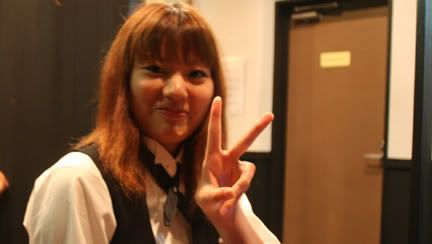
Our waitress, Ayako, the Abunai Girl.


Kobe Beef. We hear so much about it in the United States. That it's "so good" and "so fatty." That they massage the cows. They feed them beer. They sleep on real linens. In America, there's something known as "American Kobe" and evidently, those are cows that have been bred from stock imported from Japan. I've tried Kobe Beef and it's been, well, okay. Nothing spectacular, just good meat.

Wagyu Hiratsuka
The first course - Just look at all the fat! I think it was a ribeye.


If American Kobe is your only experience with Kobe Beef and you haven't tried the real Wagyu from Japan, let me tell you: you're missing out.

I will state it now: there is nothing, and I mean NOTHING, like true Wagyu. It's rich. It's fatty. It's succulent. It's magnificent. It's absolutely, unbelieveably UNREAL.

And we just went to some local joint.

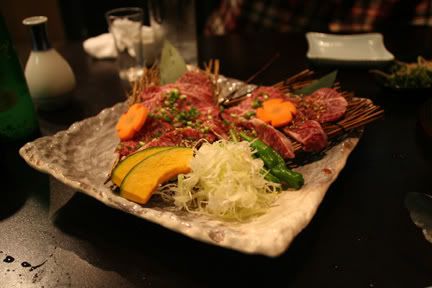
Wagyu Hiratsuka
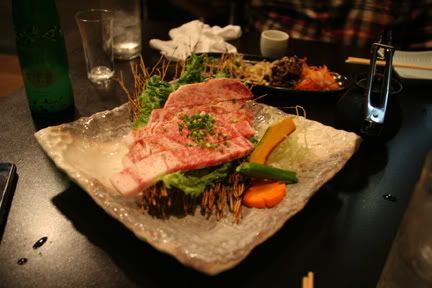
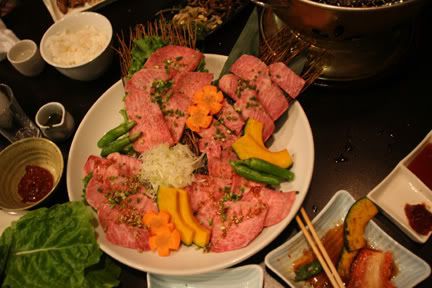
Course Two - More meat. This time served on bamboo branches with veggies.


From what I could gather, there are different grades of Wagyu, with A5 being the best cuts, the most fatty cuts. Michael's mother-in-law chose this place because they only serve A5 and Thank The Lord for that woman and her choice.

I'm not converational at Japanese - and these people couldn't speak any English, so I let "mama" do all the selections and she went to town! It seemed like she ordered everything on the menu. By the end of the meal, I was wasted. I was stuffed. I should have been ill.

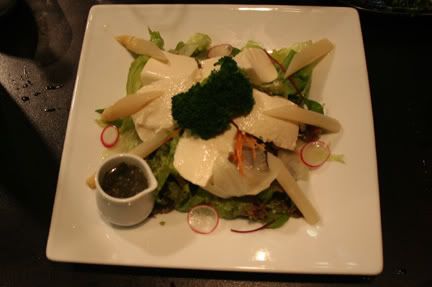
Wagyu Hiratsuka
Course Three - Tofu salad with white asparagus. Nice!


Wagyu Hiratsuka
Course Four - Another salad. Greens with sesame dressing.


It was just waves and waves of meat, and the occasional grilled crab legs, kim chee, veggies, salad and ice cream thrown in for good measure. And when the waves of meat stopped, another wave of Wagyu Sushi came as a pre-dessert course. Holy crap, was that good!

Wagyu Hiratsuka
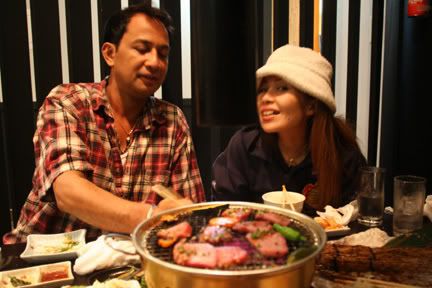
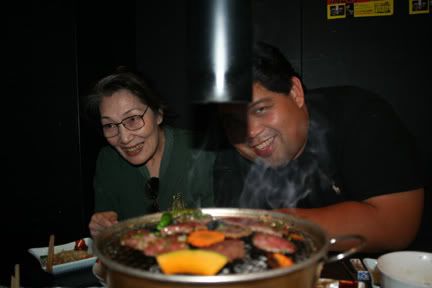
Michael, Mayumi and our grill.


Preparation was simple. The meat was sliced and served raw for you to cook yakiniku style. They plop down a big bowl of hot charcoal and you cook it to your desire. Mama was serious about not cooking the meat too much. Just a nice medium to keep it juicy and fatty.

Wagyu Hiratsuka
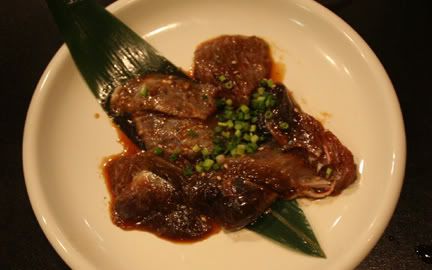
Course Five - Next we veered away from beef to another red meat: marinated tuna.


And fatty it was. By the end of the meal, my body was reeling from the succulent fat. I could handle no more. And then the sushi came. It would have been disrespectful of me to say no. So I said yes, three times.

Wagyu Hiratsuka
Course Six - Still more meat. This time with some lettuce, cucumber and sauce to make little wraps.


There's no way to accurately describe the experience. Once cooked, just a little sauce or none at all and eat with rice. Simple. Beautiful. Perfect. No need for all the additives and seasonings. Just beautiful meat left to be experienced at it's best as God (or Buddha) intended it.

Wagyu Hiratsuka
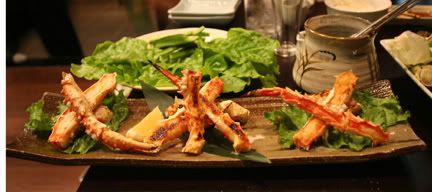
Course Seven - Another diversion with some grilled crab legs. Amazing.


Words won't do it justice. I'll let the images speak for themselves. If you haven't had Wagyu then, by all means, rush out an find some. I've got a line on a Wagyu wholesaler in Los Angeles. It's roughly $800-900 for nine pounds of ribeye. It's not cheap, but it's certainly cheaper than a twelve day visit to Japan. Of course, the 12 day visit does have it's benefits...

Wagyu Hiratsuka
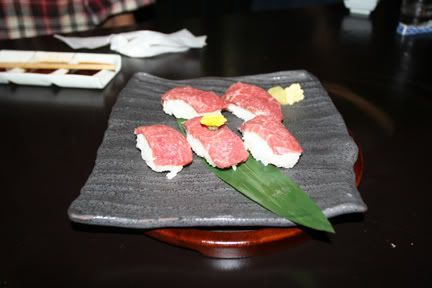
Course Eight - Wagyu Sushi, nigiristyle. You mix the ginger and horseradish with soy sauce for the dip. I could just cry.


Wagyu Hiratsuka
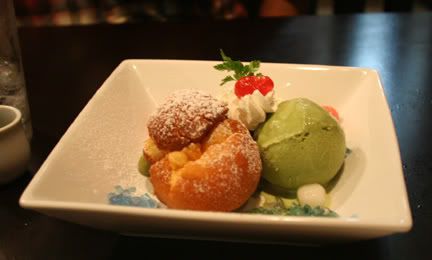
Course Nine - Green Tea ice cream with cream stuffed profiterole.


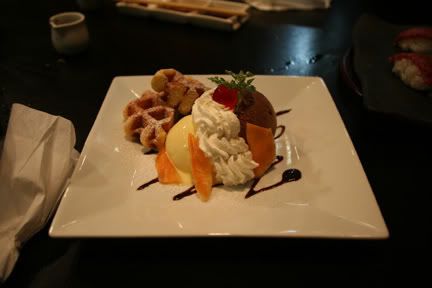
Wagyu Hiratsuka
Course Ten - End Game - Chocolate and Vanilla ice cream, served with dried mango slices, whipped cream and Belgian waffles.


Don't know the name of this place, but if you ever get to Hiratsuka, let me know and I'll direct you to this place.

Wagyu Hiratsuka
"Mama" and me on our side of the grill. One thing I do have to say is that this "mama" warned me off of the abunai girl and knew a lot more about soaplands and the darker side of nightlife than I ever expected a "mom" to know (or at least talk about).

Wasted

Yesterday was a long day of travel. Two hours in the Airport Limousine from the Shinagawa Prince Hotel to Narita Airport. An hour hanging out in the airport mall. Another hour in the Red Carpet Club. Twelve hours from Narita to Chicago. Two hours getting through immigration, customs and figuring out what to do. Nine hours at the Red Carpet Club. Two hours from Chicago to Baltimore, then another hour to get bags and get home. Into bed by 4am and up again at 4pm.

In other words, I feel utterly wasted. I want to go back to bed. I've got reports and payroll to complete by tomorrow morning. I'm sorta hungry, but I'm tired. I just want to go back to bed. But I know if I do, it'll take longer to recover. Need to push through the time zones and get back to business.

My cell phone is utterly quiet. It's so quiet, it's unnerving. No one knows that I'm back. No one calls. It should be blissful, but it's just unnerving. I think I'm bored but I'm too tired to tell. Maybe I should go out and see a movie. Will they take 10,000 Yen instead of a ten dollar bill?