Thursday, August 09, 2007

Wagyu The Dog

I spent my final day in Japan in Hiratsuka, a town about 50 minutes (by train) south of Tokyo, where I visited my kumu hula, Michael Dela Cruz to hang out a bit and learn new hula. For lunch, we ate crazy sushi at a local conveyor belt sushi joint and that night we went out for some real, authentic Wagyu (Kobe) beef.

Wagyu Hiratsuka
Our waitress, Ayako, the Abunai Girl.


Kobe Beef. We hear so much about it in the United States. That it's "so good" and "so fatty." That they massage the cows. They feed them beer. They sleep on real linens. In America, there's something known as "American Kobe" and evidently, those are cows that have been bred from stock imported from Japan. I've tried Kobe Beef and it's been, well, okay. Nothing spectacular, just good meat.
Wagyu Hiratsuka
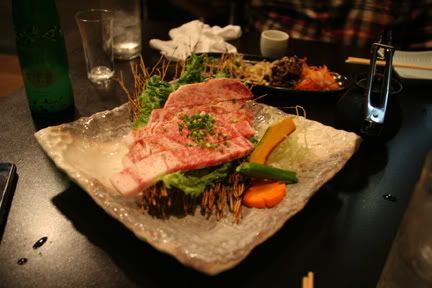
The first course - Just look at all the fat! I think it was a ribeye.


If American Kobe is your only experience with Kobe Beef and you haven't tried the real Wagyu from Japan, let me tell you: you're missing out.

I will state it now: there is nothing, and I mean NOTHING, like true Wagyu. It's rich. It's fatty. It's succulent. It's magnificent. It's absolutely, unbelieveably UNREAL.

And we just went to some local joint.
Wagyu Hiratsuka
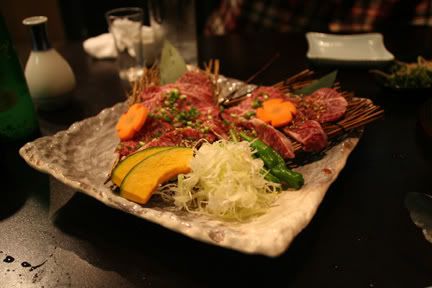
Course Two - More meat. This time served on bamboo branches with veggies.


From what I could gather, there are different grades of Wagyu, with A5 being the best cuts, the most fatty cuts. Michael's mother-in-law chose this place because they only serve A5 and Thank The Lord for that woman and her choice.

I'm not converational at Japanese - and these people couldn't speak any English, so I let "mama" do all the selections and she went to town! It seemed like she ordered everything on the menu. By the end of the meal, I was wasted. I was stuffed. I should have been ill.
Wagyu Hiratsuka
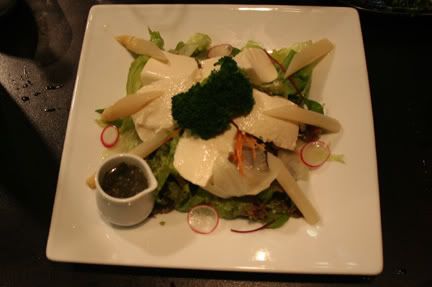
Course Three - Tofu salad with white asparagus. Nice!


Wagyu Hiratsuka
Course Four - Another salad. Greens with sesame dressing.


It was just waves and waves of meat, and the occasional grilled crab legs, kim chee, veggies, salad and ice cream thrown in for good measure. And when the waves of meat stopped, another wave of Wagyu Sushi came as a pre-dessert course. Holy crap, was that good!
Wagyu Hiratsuka
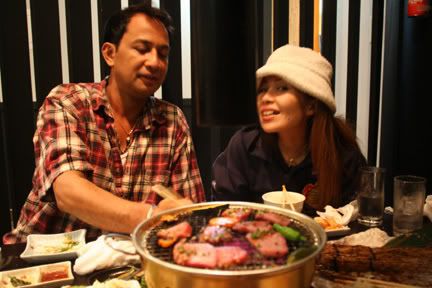
Michael, Mayumi and our grill.


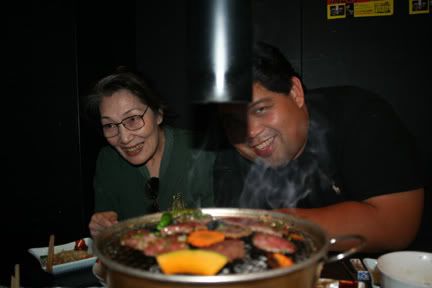
Preparation was simple. The meat was sliced and served raw for you to cook yakiniku style. They plop down a big bowl of hot charcoal and you cook it to your desire. Mama was serious about not cooking the meat too much. Just a nice medium to keep it juicy and fatty.
Wagyu Hiratsuka
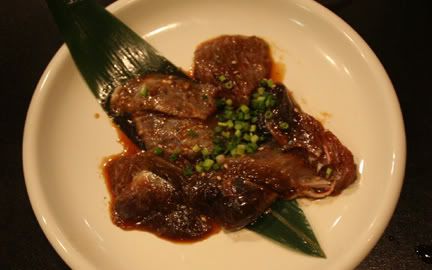
Course Five - Next we veered away from beef to another red meat: marinated tuna.


And fatty it was. By the end of the meal, my body was reeling from the succulent fat. I could handle no more. And then the sushi came. It would have been disrespectful of me to say no. So I said yes, three times.
Wagyu Hiratsuka
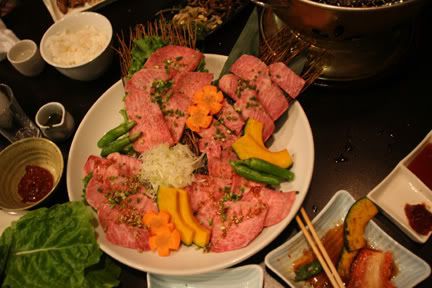
Course Six - Still more meat. This time with some lettuce, cucumber and sauce to make little wraps.


There's no way to accurately describe the experience. Once cooked, just a little sauce or none at all and eat with rice. Simple. Beautiful. Perfect. No need for all the additives and seasonings. Just beautiful meat left to be experienced at it's best as God (or Buddha) intended it.
Wagyu Hiratsuka
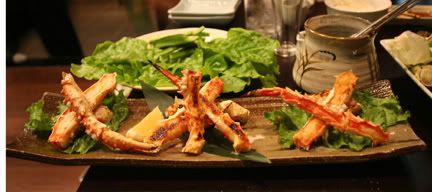
Course Seven - Another diversion with some grilled crab legs. Amazing.


Words won't do it justice. I'll let the images speak for themselves. If you haven't had Wagyu then, by all means, rush out an find some. I've got a line on a Wagyu wholesaler in Los Angeles. It's roughly $800-900 for nine pounds of ribeye. It's not cheap, but it's certainly cheaper than a twelve day visit to Japan. Of course, the 12 day visit does have it's benefits...
Wagyu Hiratsuka
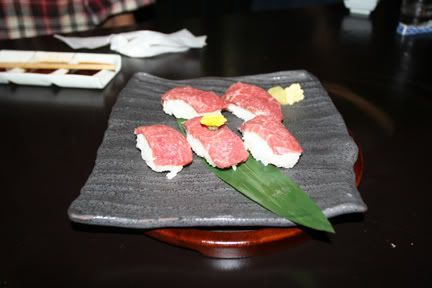
Course Eight - Wagyu Sushi, nigiristyle. You mix the ginger and horseradish with soy sauce for the dip. I could just cry.

Wagyu Hiratsuka
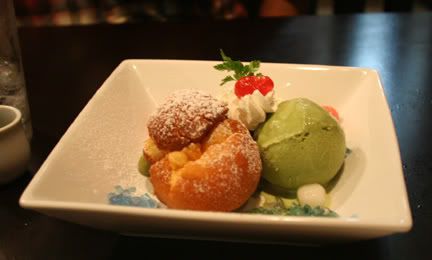
Course Nine - Green Tea ice cream with cream stuffed profiterole.

Wagyu Hiratsuka
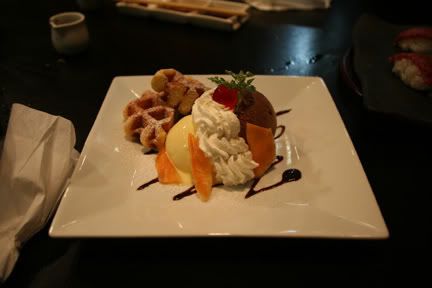
Course Ten - End Game - Chocolate and Vanilla ice cream, served with dried mango slices, whipped cream and Belgian waffles.


Don't know the name of this place, but if you ever get to Hiratsuka, let me know and I'll direct you to this place.
Wagyu Hiratsuka
"Mama" and me on our side of the grill. One thing I do have to say is that this "mama" warned me off of the abunai girl and knew a lot more about soaplands and the darker side of nightlife than I ever expected a "mom" to know (or at least talk about).

Wasted

Yesterday was a long day of travel. Two hours in the Airport Limousine from the Shinagawa Prince Hotel to Narita Airport. An hour hanging out in the airport mall. Another hour in the Red Carpet Club. Twelve hours from Narita to Chicago. Two hours getting through immigration, customs and figuring out what to do. Nine hours at the Red Carpet Club. Two hours from Chicago to Baltimore, then another hour to get bags and get home. Into bed by 4am and up again at 4pm.

In other words, I feel utterly wasted. I want to go back to bed. I've got reports and payroll to complete by tomorrow morning. I'm sorta hungry, but I'm tired. I just want to go back to bed. But I know if I do, it'll take longer to recover. Need to push through the time zones and get back to business.

My cell phone is utterly quiet. It's so quiet, it's unnerving. No one knows that I'm back. No one calls. It should be blissful, but it's just unnerving. I think I'm bored but I'm too tired to tell. Maybe I should go out and see a movie. Will they take 10,000 Yen instead of a ten dollar bill?

Wednesday, August 08, 2007

A Day On The Red Carpet

Red Carpet Chicago
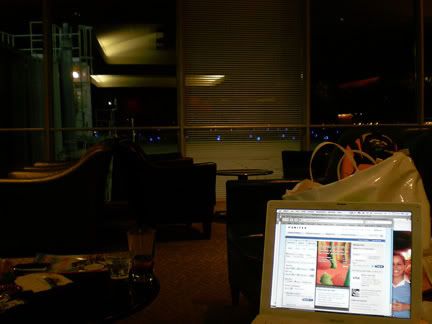
My perch in the Quiet Room at the C Concourse Red Carpet Club.


When I secured my business class seat this morning in Tokyo, I didn't realize how fortuitous that was going to be. Unlike Domestic First Class, International Business Class actually gives you access to United's Red Carpet Club (more reasons why domestic first class is just a joke).
I spent about an hour this morning in the Narita Red Carpet Club where I enjoyed automated beer, Pepsi and some snacks. My layover in Chicago turned out to be over eight scheduled hours and while I thought about renting a car and hitting some restaurants, the $85 fee Alamo was going to charge, plus the crappy Chicago weather, made my decision to pursue standing-by for a flight back to Baltimore.
That was about nine hours ago.

After hauling my overstuffed flight case, ukulele case and Narita FaSoLa Duty Free shopping bag across O'Hare, enduring the seemingly endless line of summer tourists, submitting to the Totalitarian subjugation that is airport "security" and hiking underground to Concourse C, I was told by a typically curt United Gate Agent that I had to remain with my original ticketing because I had checked baggage.

I've just flown halfway around the world, hiked across the airport in the heat, after both the International Agent and two International Phone Agents told me to go stand-by, and now I can't go??? Well, fuck you bitch.

Of course, I didn't actually say that. I just thought about saying it and that was enough. Afterall, I had just cruised across the world stretched out in the lap of luxury that is Business Class so I was feeling a bit refined, thank you very much.

United's Red Carpet Club in Concourse C is the usual mix of leather seating and tables arranged to allow small groups to mingle. Since this is United's largest hub, it's also a pretty busy and loud place to be. Happily, they have a quiet room where cell phones are verboten and where I have made camp for the day.

Sandwiched between gates C16 and C18, I've got a commanding view of the airfield, as well as the two wide-body jets sitting here at any one time. From my perch, I've seen the weather change from hazy to low-hanging black clouds to cloudy to drizzle to hard rain, and then back to beautifully sunny.

I've also watched how planes stack up here on the ground because of the weather. It's like a dance. A symphony, if you will, of aircraft and weather. I've watched the weather roll in and forcing what looked to be a complete ground stop of operations here. Which is probably the reason behind my flight back home being delayed for over an hour.

Throughout the day, I've watched the two gates do their thing. It's mostly Boeing 777s, with the occasional Boeing 747 thrown in for good measure. I'm amazed at how long it takes for the ground crew to refuel a 777. I'm fascinated with how the baggage carts follow in a near perfect arc as the driver makes a turn.

Sitting here in the lounge, one sees a slice of life. The ebb and tide of United's Hub System. Things were really hopping around here from 5pm to 7pm, then really died off after 8pm. For awhile, the main lounge was a raucous - filled with business travellers, tourists and the occasional interloper, like myself.

Now that it's nearly 9:30pm, it's quiet all around. There's still some loud women in the main lounge. C16 is getting ready to board another flight, except this time, it's a smaller jet, perhaps an A319 or B757, while the B767 at C18 looks as though its' getting powered down for the night.

I've spent an entire day sitting in this leather chair under the air conditioning vent where it's been so cold that I've had to seek out some blankets to keep myself warm. The blanket, paired with the blindfold from my business class personal kit, has been a lifesaver. I've taken at least four naps throughout the day since my body knows it's been nighttime in Tokyo.

I have to say that it's been a nice day here at the Red Carpet Club. The nine hours have gone by pretty smoothly. I've had beverages, snacks and a small meal while sitting here. I can't say I'd feel the same way if I had to fend for myself in the public gate areas...

Back In The High Life

UA884
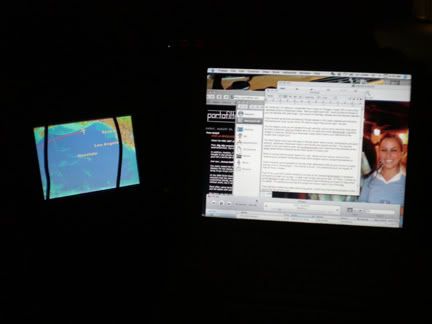
Mission Control in seat 12F, just south of the Aleutian Islands. And yes, that's this blog on the screen.


The bane of travel is the incredible amount of time dawdling about in security checkpoint lines, waiting in airport gate areas, sitting on the tarmac, flying about the world, waiting for your stuff at the baggage carousel and commuting to and from the airport itself. All in all, it's a horrible experience no matter how much you enjoy traveling.

To add insult to injury, we are forced (usually due to economic restraints) to endure all of this as herded cattle. Mushed onto the airplane and into cramped seating that seems to get more uncomfortable with each passing year. There you are, wedged into your seat and, if you're really unfortunate, sandwiched between burly guys in a center seat.

UA884
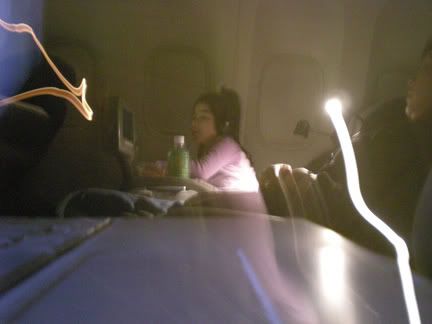
To my right, the little girl got sick on landing. I remember those days.


Most of us sitting in "coach" or "economy" (read:steerage) peer desperately into the cabin ahead of us, past the flimsy curtains separating the haves from the have nots. We wonder what it must be like to sit in Business Class, sipping mimosas and being massaged by nubile, young flight attendants.

As I write this, I'm sitting on United 884 from Tokyo to Chicago in seat 12F in one of the hallowed chairs of Business Class. We're at flight level 330 - that's 33,000 for those of you not familiar with pilot lingo - due south of Cold Bay, Alaska and the Aleutian Islands.

UA884
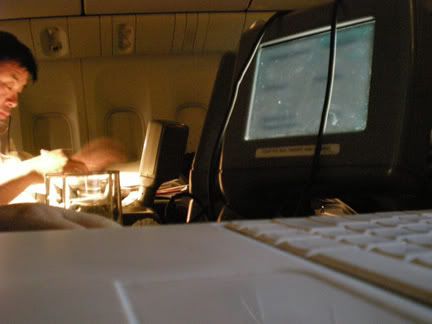
To my left, this guy worked the entire way to Chicago, making use of the words "business class."


If you've ever sat around wondering if those people in the upper classes are enjoying themselves as much as you think, I'm here to report that you're right - we are.

The fun begins once you've passed through security, and a visit to the Duty Free store for liters of alcohol (Johnnie Walker Blue for my dad) and some Montecristo Cigarillos (illegal in America), where your Business Class ticket means your welcome at the United Red Carpet Club.

The Red Carpet Club your first step in refined travel. Warm tones, comfortable and quiet seating, Japanese-influenced interior and drinks and snacks for free. This country (Japan) is so cool they've even got superautomatic beer machines that correctly tilt the pilsen glass before dispensing and then gives it a foamy top!

When it comes time to board, there's no rush. Board at your leisure. None of that "boarding by numbers" tomfoolery those other people have to subject themselves to.

Once onboard, you're greeted by friendly flight attendants offering your choice of water, orange juice or champagne. The choice is yours. For barbarians such as myself, I'll take all three, please.

Part of my usual M.O. while traveling is to stop at the nearest McDonald's or whatever and grab a burger for my bag - in case I get hungry along the way. In Tokyo, I picked up some McDees burger with bacon and thousand island dressing but have no idea what it's called. I'm predicting now that the burger will never make it out of the bag.

They talk about fattening cattle before slaughter, if that's true then we're probably on the way to the slaughterhouse.

UA884
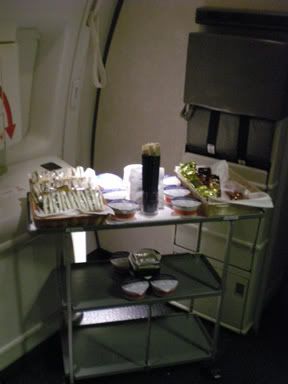
The mid-flight snack cart. Filled with sandwiches, cookies, Twix bars and noodles for the taking.


Once airborne, the fun begins and the food starts rolling out. Crap. I wish I hadn't eaten lunch before boarding because the Japanese Bento lunch comes in two trays. The first filled with appetizers like smoked fish, daikon, green tea and cold soba. The next tray is the actual bento itself with salmon, shrimp, more miscellaneous fish and rice. Drinks are available a plenty - green tea, black tea, water, two Cokes, champagne, port wine - and that's within the first 90 minutes of the flight!

The feeding continues with an open galley bar of whatever you desire. There's a cart filled with Twix bars, chocolate chip shortbread cookies, pretzels and ramen noodles for the taking. And, of course, you can drink to taste - beer, wine, whiskey, vodka - it's no problem. It's times like these that I wished I drank more.

UA884
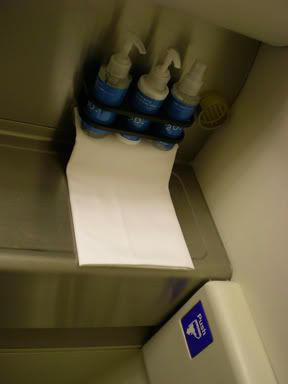
So refined, even the rest room has linens.


In spite of the constant ability to feed, the whole thing is refined. Want to take a whiz? We've got our own rest rooms. Need to take it now? There's never a line. Want to take a nap? Then stretch out on the near flat bed/chair and cover your eyes with the provided blindfold. Want to work or watch movies on the laptop? No problem, just plug into the DC outlet in your seat. Need to stretch? Take a walk around the cabin, there's plenty of room.

The staff is so accommodating, I bet you could waltz with a partner if you so desired.

So what's the downside?

Knowing that it's only temporary and in just a few hours you'll be back in America resuming your role as cattle on the flight to Baltimore.

If only I could stretch this trip a little further...

Beeru O-Kudasai

Beeru O Kudasai
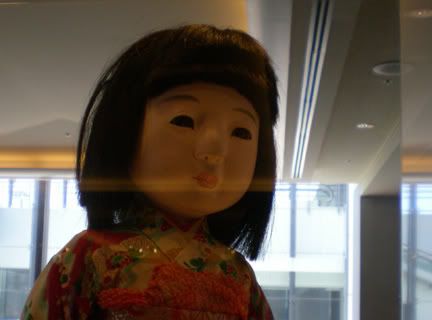
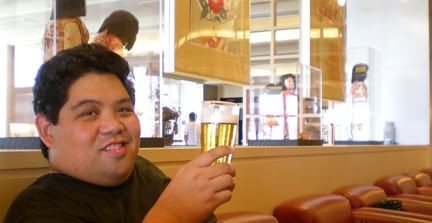
One of the porcelain girls at the Red Carpet Club Narita.


There are moments in life when you just sit back and enjoy. My time at the Red Carpet Club at Narita was one of those moments.

It was the period between shopping at Duty Free and boarding the long flight back to the United States. Just sitting there in the rich, Japanese-inspired interior, under the constant gaze of porcelain dolls that I enjoyed a reall nice, tall beer. Don't know what brand it was, since it came out of an automated dispenser, but it sure was good.

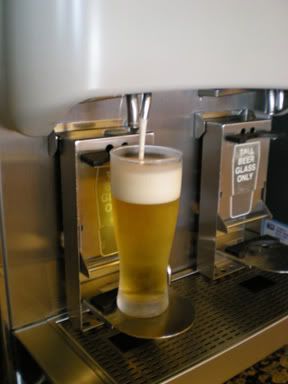
In Japan, they've found a way to automate just about everything, and beer has not escaped their clutches. Overall, it's pretty simple. Just grab a pilsner glass from the freezer, place it under the nozzle and hit the button.

Beeru O Kudasai
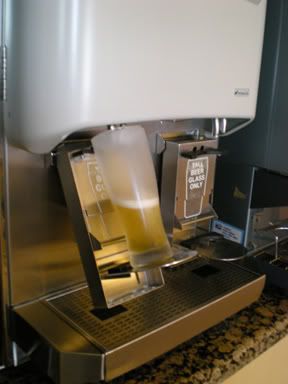
Tilting and filling to prevent foam.


The machine tilts the glass to the correct angle to prevent foaming and let's her rip. The icy cold beer flows smoothly into the frosty glass as if poured by an expect bartender (without his constant neediness to stroke his ego).

Once the proper amount has been dispensed, the unit stops, then reorients the glass into an upright position where it finishes dispensing with a perfect foamy cap for the perfect proportion.

Beeru O Kudasai
Getting all nice and sudsy!


There's no waste, no muss, no fuss, no trying to get the machine's attention to serve you. It's just flowing golden goodness.

Best of all, it was free!

If only you could buy a beer this easily in the real world...

Beeru O Kudasai
Is there any better way to spend your time before a flight? I bet I can think of one.

Sunday, August 05, 2007

Aroha Tokyo

Tokyo WBC
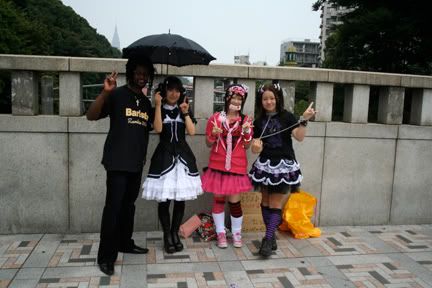
2007 Zambian Barista Champion, Francis Njovu, and the real Harajuku Girls of Yoyogi Park.


Every night before I lay myself down to sleep I think about writing to this blog to keep the blog updated on my Tokyo adventures. Then, as it is every night, I realize that I'm just wiped out, stinky and generally worked that I take a hot shower, crawl into bed and am knocked out in under two minutes.

It's been a whirlwind adventure here. Non-stop action. Food, coffee, friends, touring, shopping, partying, chicks, hot chicks, more partying, more food and then more chicks. It's been so exhausting that I'm literally falling asleep at the table.

I'm in Tokyo for the World Barista Championship where I spent four days doing station prep and maintenance on the big stage. Four days of early mornings, long days and late nights of partying, drinking and meeting old and new friends from all over the world.

In case you didn't know, or don't follow the competitions, James Hoffman of the United Kingdom has won the World Barista Championship. It was a stunning victory, upsetting the Scandinavians (who typically dominate the competition) and swiping it away from American Champion, Heather Perry. Drama and intrigue prevailed.

There's so much to report and I'll have to follow up at a later date when I have the time and energy to focus, write and edit photos.

Tuesday, July 24, 2007

The Butcher of Cadiz

Please Note: The following post contains images that sensitive people may find offensive.

We visited the processing plant at Locust Point Farm in Elkton, Maryland a week after visiting the Meat Locker. I originally started writing this post immediately after that visit.

Locust Point Farm
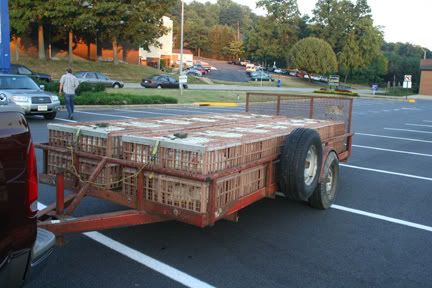
The chickens, all 275 of them, ready to go for a ride.


I am a barista.
I am a butcher.
I am the harbinger of Death.

I am standing there, in my ubiquitious black Polo t-shirt, black short and New Balance Shoes. The concrete floor beneath my feet is a cold reminder of the horror I have become. The black-handled curved blade boning knife whips in a frenzy. At the top of my game, it's three quick cuts. At my pinnacle, it's two. At my worst, it's five cuts plus some sawing, some hacking and/or some chopping.

I feel dirty and I'm covered in a grotesque haze of guts and carcasses juices sprayed onto my once clean and pristine black uniform. Had I known what I was to become, I would have dressed differently. Perhaps some work boots, Carhartt jeans and workshirt to keep the slime off my exposed flesh.

In my continuing quest to learn about locally grown and produced foods, we've ventured to the Northeastern tip of Maryland to Locust Point Farms in Elkton where we've brought 275 chickens to slaughter at the hands of a very friendly Mennonite family.

Locust Point Farm
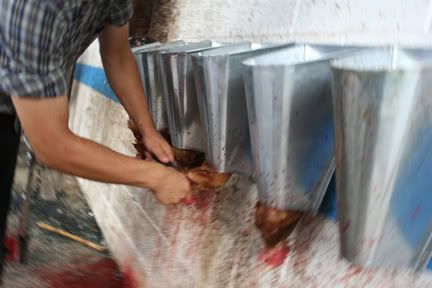
And so it begins with the flick of a sharp knife.


As an omnivore, we eat meat. Meats of all kinds. I handle chicken all the time. I've become accustomed to buying whole chickens and butchering them at home to save some money and understand the chicken. But chicken is supposed to be the cold meat we buy at the store, not the warm flesh it is in my hands. Until now, the warmest chicken I've held was made for me by a guy named Popeye.

The slaughter of any animal is a gruesome experience. It's real. Real Death. To see the neck sliced, its' blood draining and the bird flailing about in denial of fate is nothing short of real. To say it's ugly is a lie. It's horrific. There's nothing pretty about death. But it's what must be done in order for us to live.

Locust Point Farm
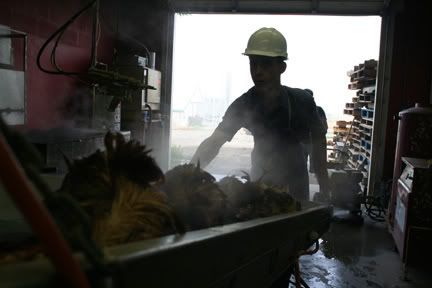
After being immersed in a hot water bath, the chickens are loaded on a conveyor.


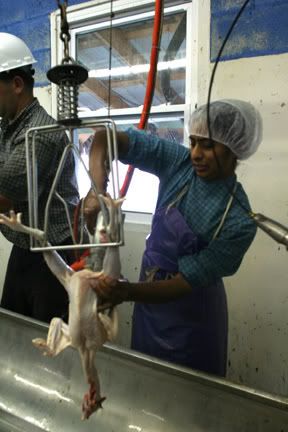
The processing of chickens at Locust Point is done by hand. Unlike the mechanized utility of commercial plants like those run by Purdue, the Locust Point plant is small and family-run. Family members handle everything from slaughter to defeathering to dressing the birds.

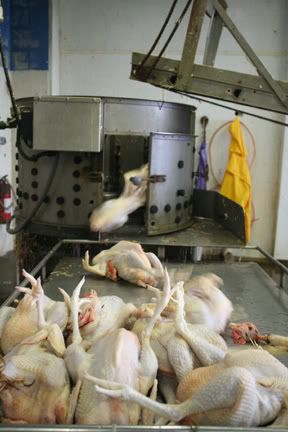
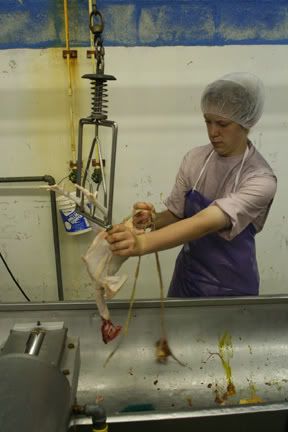
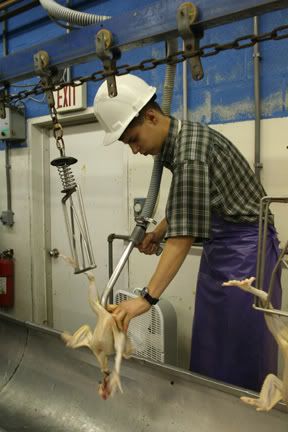
Once slaughtered, the chickens are dipped in a 140 degree Fahrenheit water bath to loosen the feathers. Then they're placed in what one can only describe as a washing machine with rubber fingers set on spin, that removes the feathers and outer skin. Once the feathers have been removed, the carcass is hung and the oil gland is removed, the butt is drilled out, the internal organs are removed by hand and then anything left in the body cavity is forcibly vacuumed out. And I do mean forcibly.

Locust Point Farm
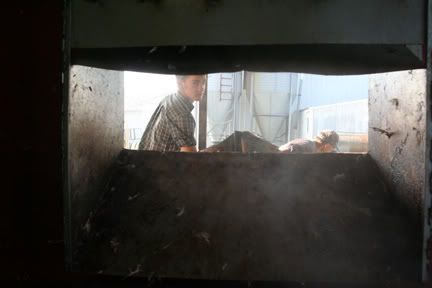
Where their feathers are removed.


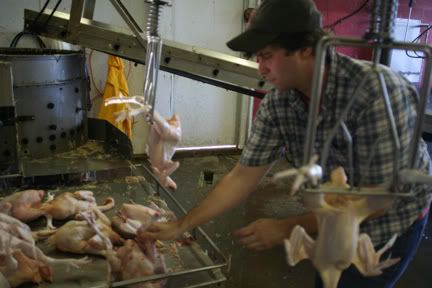
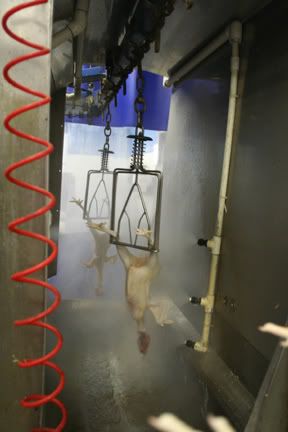
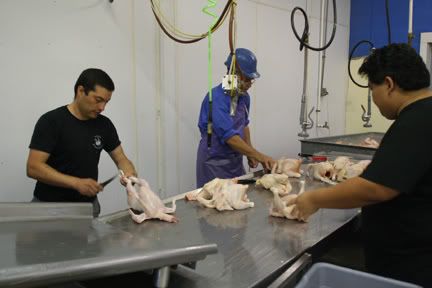
Once cleaned of its' internals, the hanging chickens continue down the production line through a water shower to rinse them off, then over to the finishing table where they come off the hangers and slide down to the table where I await them with blade in hand.

For our batch of soup chickens and roasters, it's up to myself and Mariano to cut off the feet. It looks simple and the father makes it look like easy work. But actual practice is something else, especially with the soup chickens.

Locust Point Farm
Then hung onto the processing line.


The soup chickens are older. They're old laying hens that have lived past their prime production life and can now continue on their journey in someone's (grandma's?) chicken noodle soup. Since they're older, they're tougher and harder to slice through. It starts off as clumsy work. Sawing, hacking, whittling - it's tough to make a clean cut through the joint and I fumble and falter a bit. When the young roasting chickens arrive it's amazing to feel the difference. The joints are young, tender and, therefore, easy pickings. I'll admit, I can't help but wonder if this is how it feels to chop up humans, a la Tony Soprano. And was Ralph Cifaretto harder to cut up than a young guy because of the age factor, like the chickens?

About twenty chickens into my slaughter, I start getting the hang of it. Slice, slice, slice and that leg pops right off. The joint is clean - just how you'd expect the end of a drumstick to look. Gosh, I feel like a professional. If I had access to a band saw, I might actually go berzerk.

Locust Point Farm
First, the oil gland is cut off and then the body cavity is opened with this drill.


Locust Point Farm
The internal organs are pulled out by hand.


I started off smelling fresh and looking trim in my nice, clean clothes. The longer I stand around in the facility, the more water and chicken bits are splashed on me from every direction. At first, I'm mortified. Disgusted. Gross. As the metal of my blade flashes by, I grow more accustomed to being coated in chicken film. I butcher chicken. I am chicken. I am the Chicken Master.

Slice, slice, slice and more feet pop off and into the icy tub, destined for a future in some exotic kitchen where a Chinese guy is going to slurp and scarf down my professional goodness. Moments of glory flash by when I can sever the feet in two slices instead of three. Mariano and I discuss the best way to cook these chickens and rotisserie is the hands down favorite. We're not grossed out by our carnage. We're not renouncing our consumption of meat for some ill-conceived ideal that vegan-ism is going to Save The Chickens of the World. We're enthused by this. So enthused that we're getting hungry.

Once Mariano and I have lopped off the feet, the chickens are basically done and look exactly like the fryers you buy at the local supermarket. The mom of the farm cuts a slit in the skin and tucks the legs, then plops the whole thing into an ice bath where they will drop in temperature to below 40 degrees Fahrenheit in under three hours.

Locust Point Farm
Anything left inside is vacuumed out.


Locust Point Farm
Gutted chickens are then given a cleansing shower.


Still coated in chicken grime, we take a moment to enjoy a little yogurt from a local farm. It's sweet, delicious and better than any of the commercial yogurts I've tried, and it's a nice respite from the massacre we've just been part of. And I do mean massacre. In about an hour and ten minutes, we've killed and processed two hundred seventy five chickens. Sure, that's small potatoes for a processor like Frank Purdue, but for our little crew doing everything by hand, it's been a veritable blood bath.

Locust Point Farm
Mariano and I doing "our thing."


Blood bath or not, it was an amazing experience. To see where the food comes from and how it's processed is something that more people need to do. If I had asked, I could have been one of the guys dispatching the chickens by slicing their necks and letting the blood drain out. Next time, I want to be one of them. To know the feeling of actually killing the food. To give it honor and respect for its' sacrifice so that we can live.

Seeing all of this is incredibly amazing. Respect. There's no other way to describe it. From the farmer who raised the chickens and cared for them to this Mennonite family who processes them, it's respect all the way around and now that respect is placed upon us to treat our food properly and respectfully.

Locust Point Farm
No looking back now.

Meat - It's What's For Dinner

Please Note: The following post contains images that sensitive people may find offensive.

Mt Airy Meat Locker
Sirloin steak, as we know it, being trimmed down for retail sale.


Readers of this blog know that I'm a fan of meat. Give me a nice ribeye steak, some grilled veggies, hot white rice and a big cigar and I'm happy as can be.

Lately, I've been getting into locally grown beef that's grass fed and free range. Unlike commercial beef that's raised on large ranches where the steers are confined in pens and fed a corn-based feed, these animals are allowed to roam around, eat grass and are herded in small numbers. It's what they call "Grass Finished" beef - meaning that the animals are left to eat grass throughout their existence until the last couple of weeks when they're fed a corn-based feed that fattens them up a little before slaughter. I realize that, to the non-cattlemen, the name sounds opposite to the reality, but that's how they categorize it.

This "old is new" kind of approach to beef gives great flavor, texture and quality to the meat. It's absolutely delicious. I can't get enough of it. Give me more.

In the interest of understanding where our food comes from (other than the refrigerated case at the grocery store), Spike, Mariano and myself headed up to Mount Airy, Maryland to visit the Meat Locker where the beef and pork that we consume is slaughtered and processed.

Mt Airy Meat Locker
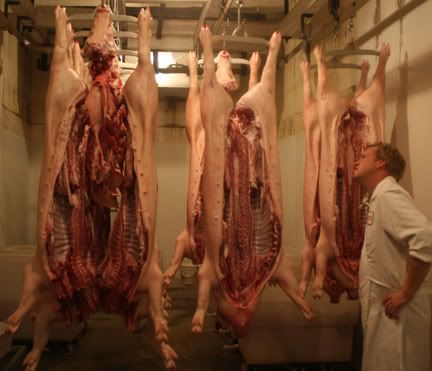
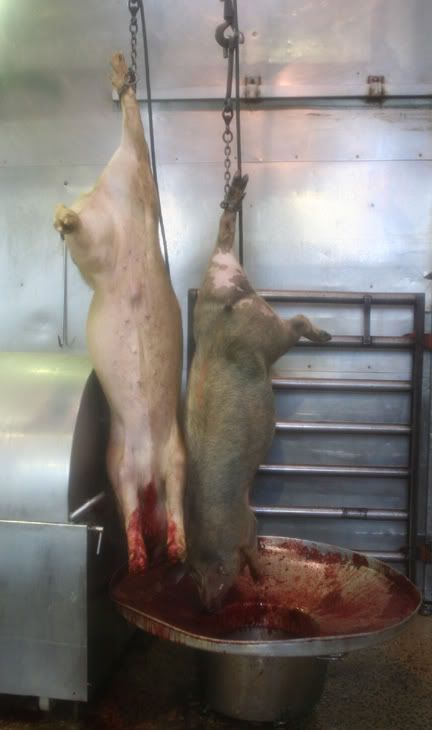
Pork doesn't get any fresher than this.


It's an unassuming building in the very sleepy town of Mount Airy. You could pass it by and never know what was going on inside. There's a school across the street it's so innocuous. And considering the carnage that goes on inside, it's a strange juxtaposition that I can't help but to think of something as odd as Jeffrey Dahmer.

Not that there's anything sinister going on inside. The place is clean. Spotless even. The USDA has an inspector in the building at all times observing the processing at every step and checking for any problems or contaminants.

Mt Airy Meat Locker
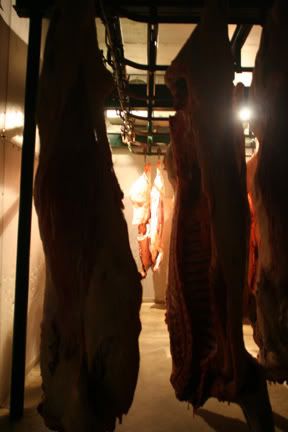
Sides of beef waiting 21 days.


The animals come from select farms in the region who grow quality steer and pigs. They're loaded into holding pens at the side of the building which lead into the Kill Room.

The Kill Room. Concrete. Tile. Utility. There's nothing glamorous about the Kill Room or working in it. It's gruesome work. Pigs throats are cut and steers are shot in the head with a .22 caliber pistol. The animals are hung to drain their blood, then hit with hot water to remove the body hairs.

Many people find it hard to believe that our food comes from these animals. They'd much rather know their food as that plastic-wrapped cut they're used to. Watching how our food comes to be is slightly unnerving, but it instills respect. Respect for the animals that have been slaughtered so that we can survive. Respect for the meat so that it's cared for and cooked properly.

Mt Airy Meat Locker
Spike checks out the quality of the pork.


Walking into the Kill Room reminded me of being in the Philippines. The aroma was fresh - like that of the open-air markets. Men in jeans and boots did their deeds of slaughtering pigs and preparing them for storage then butchering. The USDA inspector taking their heads and inspecting their glands for any signs of problems or trichinosis. Brutal efficiency.

Mt Airy Meat Locker
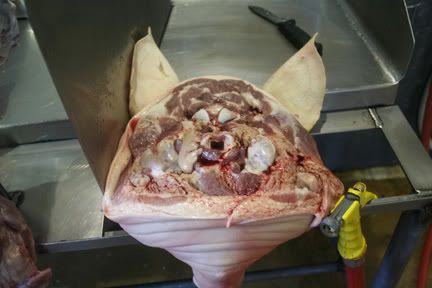
A pig head after the USDA has inspected it for contaminants.


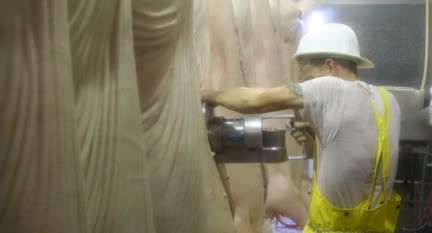
When looking at a 150+ pound pig, one has to wonder just how they take this animal and break it down? Once the hair has been removed from the carcass and the entrails removed, it must be split with a stainless steel chain saw.

Mt Airy Meat Locker
The Kill Room - splitting the carcass.


Once cut down, beef is kept in refrigerated storage for 21 days to "age" the meat. Pork can be used right away. The sides are rolled into large, refrigerated rooms and then are later brought into the cutting rooms where they are broken down into the pork chops, sirloin and skirt steaks we all know and love.

Mt Airy Meat Locker
The End gives us a new beginning.

Sunday, July 22, 2007

Studs of Shave Ice

Artscape 2007
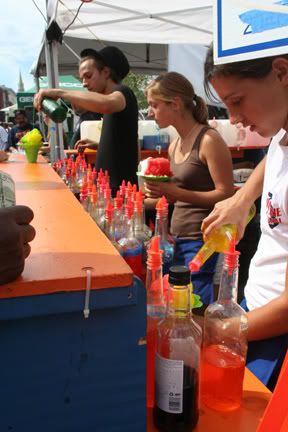
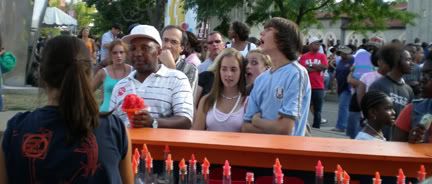
The Line.


Studs.

That's the only way to describe them - both the boys and the girls. Whatever their gender, they are The Studs of the Shave Ice industry.

1300 pounds of ice
65 gallons of syrup
1400 flower cups
1850 spoons

Shave it all together and you get the last day of the Jay's Shave Ice booth at Artscape 2007. At a crisp 89 degrees with cool breezes, it was another perfect day for shave ice.

Artscape 2007
Isaiah, Isabel and Sara working it.


Returning for the final day was our tough crew from yesterday, along with the return of both Mariano, the cook who cooked for a Michelin 1-star restaurant in Italy, and Isaiah, who spent yesterday gallavanting with his wife at a roller coaster park in Pennsylvania. joining us for the first time was Isabel, fresh from building decks in the wilds of Kentucky.

Artscape 2007
Stud Mariano - this guy from Argentina never left the line - all day.


There's not much more to say than these guys are studs. All of them. No breaks. No pissing. No whining. No moaning. Just hard, solid work. Drilling out over a thousand shave ices in a seven hour period. Maybe a quick phone call here and there to scheme and connive for their next gig, or to answer that important text message, but the beat never wavered and they kept pounding it out.

It was amazing. It was awesome. It was awe-inspiring.

I can't wait to do it again.

Next year.

Artscape 2007
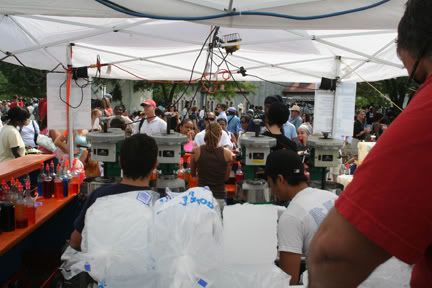
The view from the catbird seat.

Saturday, July 21, 2007

It Must Be Prime Time - Artscape 2007

Artscape 2007

Today had to be one of the most beautiful days of 2007 in Baltimore. The weather was cool, breezy and about 85 degrees. No humidity. Absolutely perfect.

It's also prime shave ice weather.

After eight years in the shave ice business I've come to realize the ideal weather. Dip down into the 70s and it starts to be a bit chilly for shave ice. Reach up into the 90s and humidity and people just don't want to leave their air conditioning at home. But right in the middle is where everyone and their mother (including mine) come out to play and eat shave ice.

After six years of Artscape, it's never this nice. Usually it's on the hot and humid side. Perhaps not as bad as the Dog Days of Summer, but close. Sometimes, we'll have passing showers and even the odd thunderstorm (that was exciting).

Four shavers, four crew, myself and mom. Pounding it out in the hot sun in front of hundreds of thousands of attendees, cranking out well over a thousand shave ices in just over eight hours. Grueling. Tough.

On the front line were two Jay's Shave Ice alumni. Sara (2005 Seasonal Manager) and Derrick (2006 Season staffer) rocked the front line, taking orders, fielding questions and putting on a friendly and hospitable face for the company. All by herself on the third line to the side of the booth was mom - holding her own in a never-ending line that was 20 deep (after Jordan decided to pull off the front and work the shaver line). Holding it all together was long-time friend Tony M. whose main job is to prep and cut ice, as well as maintain inventory and prepare dinner.

Artscape 2007

Mom's line. This line never grew shorter than you see it here.


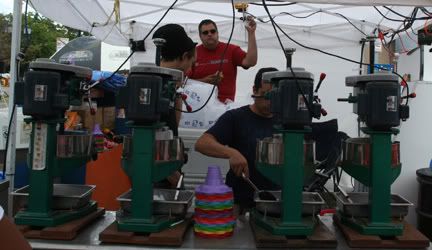
I rocked the shaver line the whole day, along with some help in the late afternoon from Jordan. Four shavers, never stopping except to reload. Shaving ice in a never ending ribbon of fine, delicious stuff.

To be honest, I've never rocked four machines at once. At one point, Tony was about to step in to help but I shooed him away with my ego being the main reason. I wanted to see if I could rock the four machines and keep up with the demand of three lines of customers. I rocked it for about two hours. I was in love with myself. Then mom came and Jordan stepped back to run two of the shavers.

Artscape 2007

Sara's Line - amazed and in awe to get shave ice.


Day two is over and while I'm usually wiped out and dreading one more day at Artscape, tonight I'm feeling good. We worked it - hard. My crew are studs. They never looked up. They never complained. They never took a piss. They're fucking awesome.

Tomorrow, the same crew returns, but this time they're going to be joined by Mariano and Isiaiah, two of some of Baltimore's best line cooks - studs in their own right (Mariano worked for a Michelin 1 star in Italy), as well as first-timer newbie Isabelle.

Whatever the outcome, I'm stoked and pumped that we're going to have a rockin' crew for the final day in the sun.

Maybe this time we won't run out of ice...

Artscape 2007

Throughout the day we see old friends, like B.J. and his family - long time supporters of Jay's Shave Ice.

Friday, July 20, 2007

Like Riding A Bicycle

Artscape 2007

It's been nearly a year since I stood behind a proper ice shaving machine - and I wasn't sure how it was going to turn out. But it was just like riding an old bike, once you know how to do it - you just can do it.

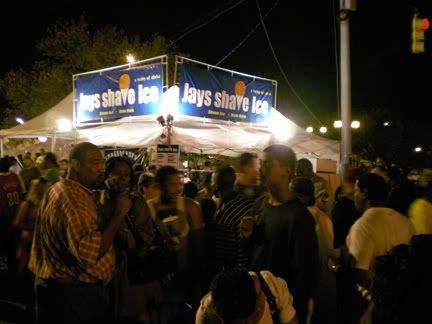
Artscape weekend is here and on full-blast. The weather is beautiful (if slightly cool) and the crowds are on the street and hitting our little shave ice stand at the corner of Mount Royal Avenue and Cathedral Street. It's in the heart of Artscape. The "crossroads", if you will, of the entire festival. And we're smack dab in the middle of it.

This week is traditionally the worst week of the year. It's the busiest as we try to cram everything together. It's crazy and everything falls to the wayside as we prepare ourselves for battle.

But I'm happy to report that even after all this time, I can still rock an ice shaver. No line is too long for this strapping chap. i'll spin three machines simultaneously and beat down a hundred people in line. Never mind that all these unused muscles are aching, in pain and in need of a rubdown from a (younger) woman, I can still kick it with the best of 'em.

Let's hope my creaking bones make it through the weekend...

Artscape 2007

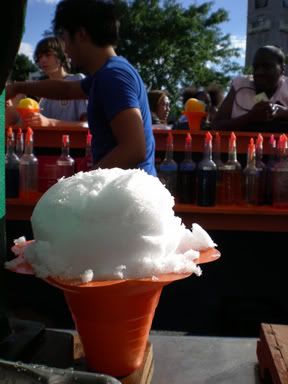
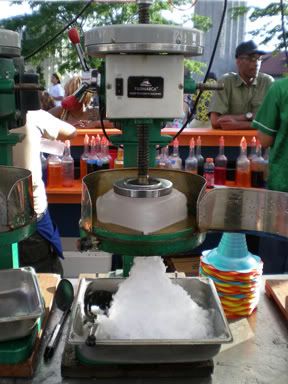
Rockin' the Fujimarca 709.

Wednesday, July 18, 2007

The End Before The Beginning

Locust Point Farm


The Egg. It's a symbol of life. New life. A life to come. But this egg is anything but that. It's a sad reminder of a life that was and one that will never become. An ironic twist to the lives that will continue as a result of the end to this one.

Sunday, July 15, 2007

iScrewed

On July 26th, I board the aluminum behemoth known as a Boeing 777 and fly to the Land of the Rising Sun. It's been 17 years since my last trip to Japan. A trip that included visits to Tokyo, Kyoto, Kanazawa, Osaka and a couple of rides on the Shinkansen or Bullet Train, not to mention shopping in Akihabara, strolling through Shibuya Park and general mischief at Club Gold with Nat and Misuzu.

Preliminary reports indicate that Japan is one of the few places left on Earth whose cellular telephone system does not work with GSM wireless phones. Evidently, one has to rent a phone in Japan or be left without wireless communications.

It's a horrible thought. Especially since I spent $500 on a 4GB iPhone that is supposed to revolutionize my travel and bring the world to my fingertips.

As the thought of not having a cell phone in Japan seeps into the mind, I'm scared. How will I live? How will I communicate? How will I make plans with friends?

It makes me wonder how I survived in the years prior to a cell phone. When large groups of my friends would plan, meet and party the night away - all without the convenience of calling each other on their cell to arrange everything. How did it happen? Did we just plan to meet at a certain place and at a certain time and just made it???

This trip will encompass hanging out with friends who are arriving from all over the world. All of whom will have some form of crippled communication. How will we meet and coordinate? I've also got friends who live in Tokyo - how will I coordinate with them?

No cell phones? That's a Brave New World.

It shouldn't be all that bad. When I was in Ethiopia, my cell phone didn't work at all (despite reassurances by Cingular prior to my trip that it would) and I was left to fend for myself in the African badlands. Now, I'll be dragged away by screaming Harajuku Girls in schoolgirl uniforms carrying Sanrio tchotchke and I won't be able to tell anyone about that fortunate incident nor send them photos of the carnage.

No cell phones in Japan. I don't know if I'm ready for 1987 all over again...